


 146 / 213

14-D Maine Antique Digest, March 2017
-
AUCTION -
NPY
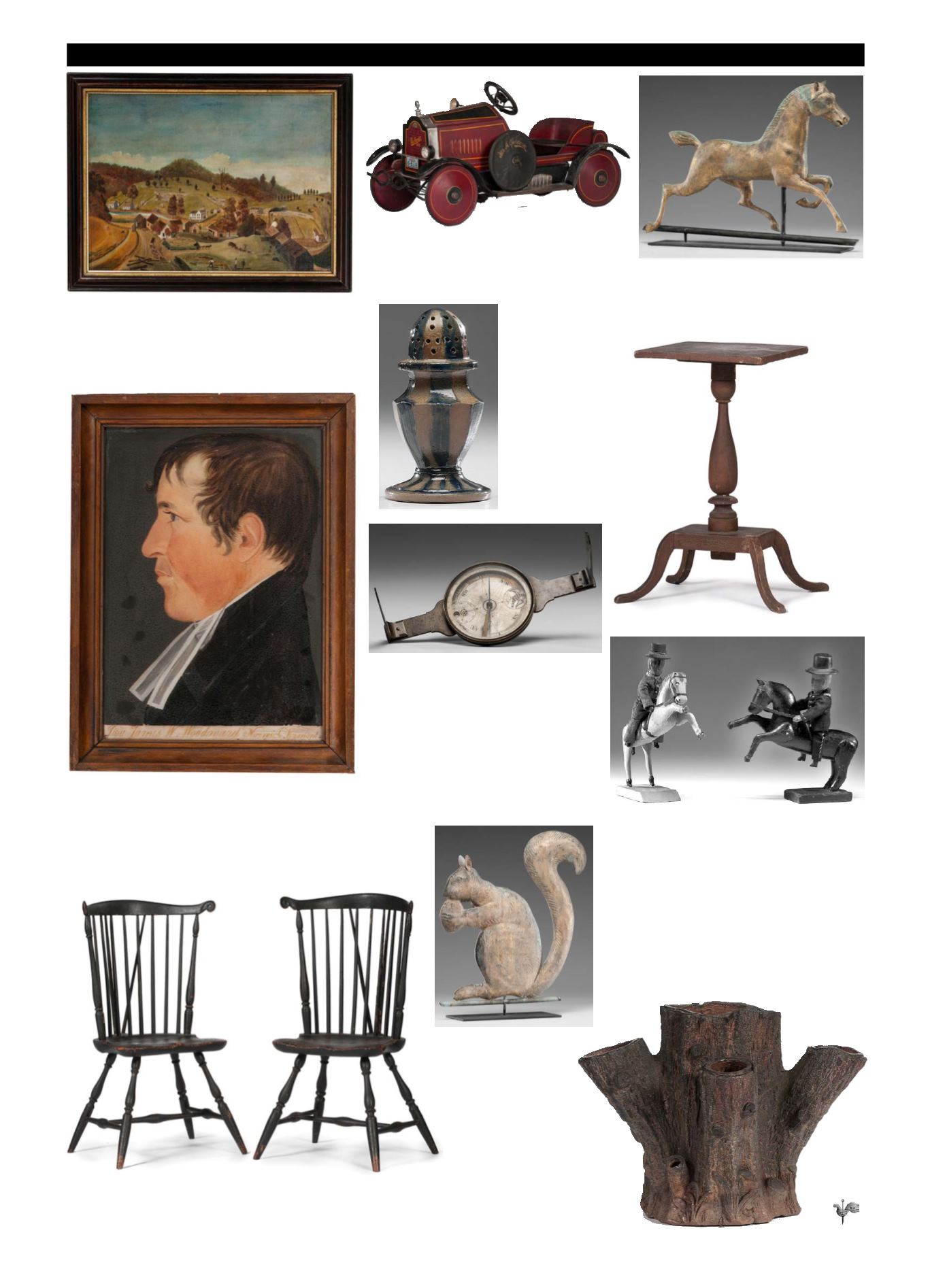
Folk art bird’s-eye view purportedly of Ironton, Ohio, depicting
an early iron works and numerous buildings with roles in the
manufacturing process, probably 1830s, oil on canvas, 21½" x
29" plus frame, $9600. Beginning in the 1830s and continuing
until the late 19th century, Ironton was the hub of a thriving
pig-iron manufacturing region that extended across portions of
southern Ohio and northern Kentucky.
Packard Six toy pedal car by Gendron Wheel
Company, Toledo, Ohio, early 20th century,
lithographed tin dashboard and license plate, 27"
x 48" x 24", original painted surface, original
leather side wheel with label, $7800.
Running hackney horse weathervane, attributed
to E.G. Washburne and Company, New York, late
19th century, copper body, cast head, 22½" high x
30½" long, the high-stepping equine mounted on a
metal stand, $7200.
Two New England brace-back Windsor side chairs in old black paint over earlier red,
probably Rhode Island, 1775-90, each 37¾" high, alligatored surface, possible old
repair to one seat, several layers of paint history, $5700 the pair.
Cobalt-decorated
stoneware muffineer
with faceted body
and top, American,
probably Ohio or
Pennsylvania, 19th
century, 5" high, $9300.
Painted candlestand
in poplar, the turned
pedestal on a platform
base with outswept legs,
eastern Ohio, attributed
to Muskingum County,
mid-19th century,
27¼" high, original
grungy surface, one foot
reattached, $3600.
Copper weathervane in the form of
a squirrel holding a nut, cast metal
ears, American, early 20th century,
23" high, excluding stand, worn
gold-leaf surface, $3240.
Wooden folk art carvings of Civil War soldiers on
horseback, possibly Generals Grant and Lee, with
original cotton uniforms, the horses with leather bridles,
American, probably 20th century, the gray horse 11" high,
each soldier 9¼" high, gray horse missing ears, black
horse missing yarn tail, $3300.
Pair of reverse-painted portraits on glass (one shown) by
Benjamin Greenleaf (1769-1821) of Massachusetts and New
Hampshire, of a Vermont minister and his wife, both identified,
each 13½" x 9¾" plus period frame, scattered paint loss to wife’s
portrait, $10,800 the pair.
Surveyor’s plain compass, the signed work of
Goldsmith Chandlee (1751-1821), marked for
William Hord and dated 1808, the compass limb
engraved with an “L” and “T” calculating scale,
the compass face with gold watch hand, divided in
both poles and miles, the north marker designated
by an eagle perched on a globe, 14¼" long overall,
needle 5" long, includes both its sight vanes, compass
cover, and tripod with ball-and-socket joint, $13,800.
Chandlee’s compasses were considered the most
technically advanced of their day.
Sewer tile planter in the
form of a tree trunk with
four branches in a reddish-
brown glaze, American,
likely Ohio, 19th century,
24½" x 34" x 33", age-
consistent wear, $1920.