


 150 / 213

18-D Maine Antique Digest, March 2017
-
FEATURE -
Antique Jewelry & Gemology
Turnbull Jewels Perform Well
by Mary Ann Brown
Photos courtesy Joseph DuMouchelle
J
oseph DuMouchelle’s jewelry sale on December 15, 2016,
was held at the Lotte New York Palace in New York City
and simulcast to Birmingham, Michigan, where “twenty-
five-plus phone workers” took the bulk of the bids, according
to Melinda Adducci, G.G., vice president of the company.
There were also people working the phones in the New York
sale location. Though live, it “was not a sit-down auction.”
There was phone and Internet bidding. Adducci explained
that they “just don’t see people—especially in December—
taking the time to come and sit anymore.” DuMouchelle did
have a sit-down auction in June 2016, but “again, most of our
bidders—ninety-nine percent of them—were on the phone.”
Adducci said that the auction house knows it is “important to
have the preview in New York. We also did a good preview in
Michigan.” (Joseph DuMouchelle has offices on Fifth Avenue
in New York City, Worth Avenue in Palm Beach, Florida, and
Fifth Avenue in Naples, Florida, in addition to its home base in
Birmingham, Michigan.)
When I asked what the most memorable aspect of the sale
was, Adducci said, “I would say the range of quality goods
that we had overall. It was a wonderful culmination of pieces
that came together from estates. It had depth to it—something
for everyone—which doesn’t always happen in our sales.”
Adducci explained that DuMouchelle builds its sales “from
the true aspect of the estate world and traditional auction
house methods,” and noted that “a lot of online auctions now
are really dealers that have already bought from an auction,
or they’re looking for another method to sell. It’s a so-called
‘loaded’ sale.”
Adducci and her business and marriage partner, Joseph
DuMouchelle, were “extremely happy” with the results of the
sale, especially given the fact that December is such a busy
time of year, and people are often distracted by so much going
on.
Adducci had written an e-mail to me in advance of the sale
when she realized that many pieces of antique jewelry formerly
in the collection of Edward Augustus Turnbull (1856-1916)
and Emma Aileen (Tinkham) Turnbull (1866-1944) could be
highlights of interest to our readers. After the sale, she said,
“It’s always a pleasure to see vintage jewelry come out of the
family vaults.”
The family who consigned the Turnbull jewelry supplied
DuMouchelle with an informative historical brochure telling
the story of the lives of Edward A. and Emma Tinkham
Turnbull, from which I synopsize:
Edward Augustus Turnbull was born in Alnwick,
Northumberland, England in 1856. Educated in private
schools, he worked in London for a tea import house for three
years after graduation. Afterward he went to South Africa for
a short period of time. In 1876 he immigrated to the United
States, locating first in New York, where he was employed as
a manager at the Western Union Telegraph Company. A few
years later he moved to Cleveland and then in 1882 moved
to Grindstone City, Michigan, and became manager of the
Worthington Company.
While in Grindstone City, Edward met Emma Tinkham
of Grand Ledge, and they married on May 20, 1884. The
Tinkham family had lived in Grand Ledge since 1861 and was
well established there. Emma was one of four daughters born
to William Maxon Tinkham (1845-1899) and Sarah (Hixson)
Tinkham (1849-1917), who built and operated the Tinkham
House, one of the first hotels to be built in the town. It became
known as the Grand Ledge House after 1899.
In 1889 Edward and Emma moved to Grand Ledge where
they ran a grocery business until 1893. Soon after they became
co-owners of the Grand Ledge Chair Company. They were
eventually the sole proprietors of that business, which thrived
under their ownership.
The company saw much expansion, and Edward Turnbull
didn’t stop there. He made a large investment in a new company
that became the Grand Ledge Clay Products Company, owned
by R.E. Olds and John W. Fitzgerald. (Olds was the founder of
Oldsmobile and later the REO Motor Car Company. Fitzgerald
was the father of Michigan Governor Frank D. Fitzgerald and
grandfather of Michigan Supreme Court Chief Justice John W.
Fitzgerald.)
After her husband’s death, Emma Turnbull took charge of
the companies, which was practically unheard of in 1916.
According to the family-supplied brochure, “Emma was the
first and only woman to own and head a furniture company
anywhere in the United States. She was definitely competing
at the highest levels in what was considered, at that time,
a man’s world. Emma proved to be a strong and effective
manager of the businesses that she oversaw. She was also
a compassionate employer and was well respected by her
competitors in the furniture industry.”
The top items in the sale didn’t veer very much from
existing market trends—Art Deco designs, signed pieces,
and colored stones from the “right” places in the “right”
colors are bringing consistently strong results.
A signed Cartier Art Deco natural pearl, platinum, and
diamond clip brooch sold with buyer’s premium for $27,500
(est. $15,000/25,000). From the Turnbull collection, an
Art Deco Kashmir sapphire and diamond ring mounted in
platinum with a blue sapphire weighing approximately 1.53
carats sold for $31,250 (est. $15,000/25,000).
Other antique items from the Turnbull collection also
exceeded presale estimates. An Edwardian platinum and old
European-cut diamond twin ring with a 2.99-carat diamond,
F color, VS2 clarity, and a 2.89-carat diamond, D color,
VS1 clarity, sold for $50,000 (est. $15,000/25,000). An
antique 18k yellow gold, Kashmir sapphire, and diamond
ring with a central oval mixed-cut natural sapphire weighing
approximately 1.59 carats was accompanied by an AGL
report stating that the origin of the sapphire was classic
Kashmir and had no heat enhancement. It realized $36,250
(est. $15,000/25,000).
Adducci also spoke cautiously about a trend that she is
starting to notice when I asked if there was anything new
happening in the market. “This is really early—but I do see
an interest in saltwater cultured pearls again.”
She explained, “When the Chinese freshwater market
took over in early 2000, it crushed the Akoya saltwater pearl
market. What I’m seeing now is that buyers are aware—
they’re going back in and they’re looking, and dealers, too,
at the bigger South Sea pearls.” And now “nice cultured pearl
strands will sell, whereas before they wouldn’t sell—we
could put them up for anything and we couldn’t sell them.”
When consumers had the choice, “they could buy Chinese
for nothing. But now, the especially nice quality, well-made
pieces that are interesting—maybe they have a lot more gold
to them, or they have some other aspect, a signature or how
well it’s made”—cause buyers to take notice.
“A really cool bangle bracelet that has pearls on it, too—
those pieces were not selling for a while. And I’m just starting
to see interest.” She reiterated, “This is an early interest.”
Signed pieces with cultured pearls “will definitely always
sell, like Mikimoto. If we get a Mikimoto anything,” clients
will buy it. She said, “We had a black strand of Tahitian
pearls in our December sale, and everybody was looking at
them.” The 17" long Mikimoto Tahitian cultured pearl and
diamond necklace in18k white gold had 45 pearls measuring
approximately 8.30 to 10.00 mm each, and the necklace sold
for $2250 (est. $500/800).
Joseph DuMouchelle has a newly designed website (www. josephdumouchelle.com) that went live while I was writingthis column. The company was also holding previews in
New York City for its January 26 sale at that time. Adducci
wrote in an e-mail that the auction included a Harry Winston
ring with a 15.02-carat pear-shape diamond, D color and
internally flawless, with an estimate of $1,000,000/1,500,000
and a platinum ring with a 9.68-carat marquise diamond, GIA
color I, clarity VS1, from the estate of Elaine Stern of Grand
Blanc, Michigan, with an estimate of $100,000/200,000.
Check out the new smartphone-friendly website for results
from that sale, and click on the “BidLive” icon to connect to
the current auction catalog.
“It’s always a pleasure to see vintage
jewelry come out of the family vaults.”
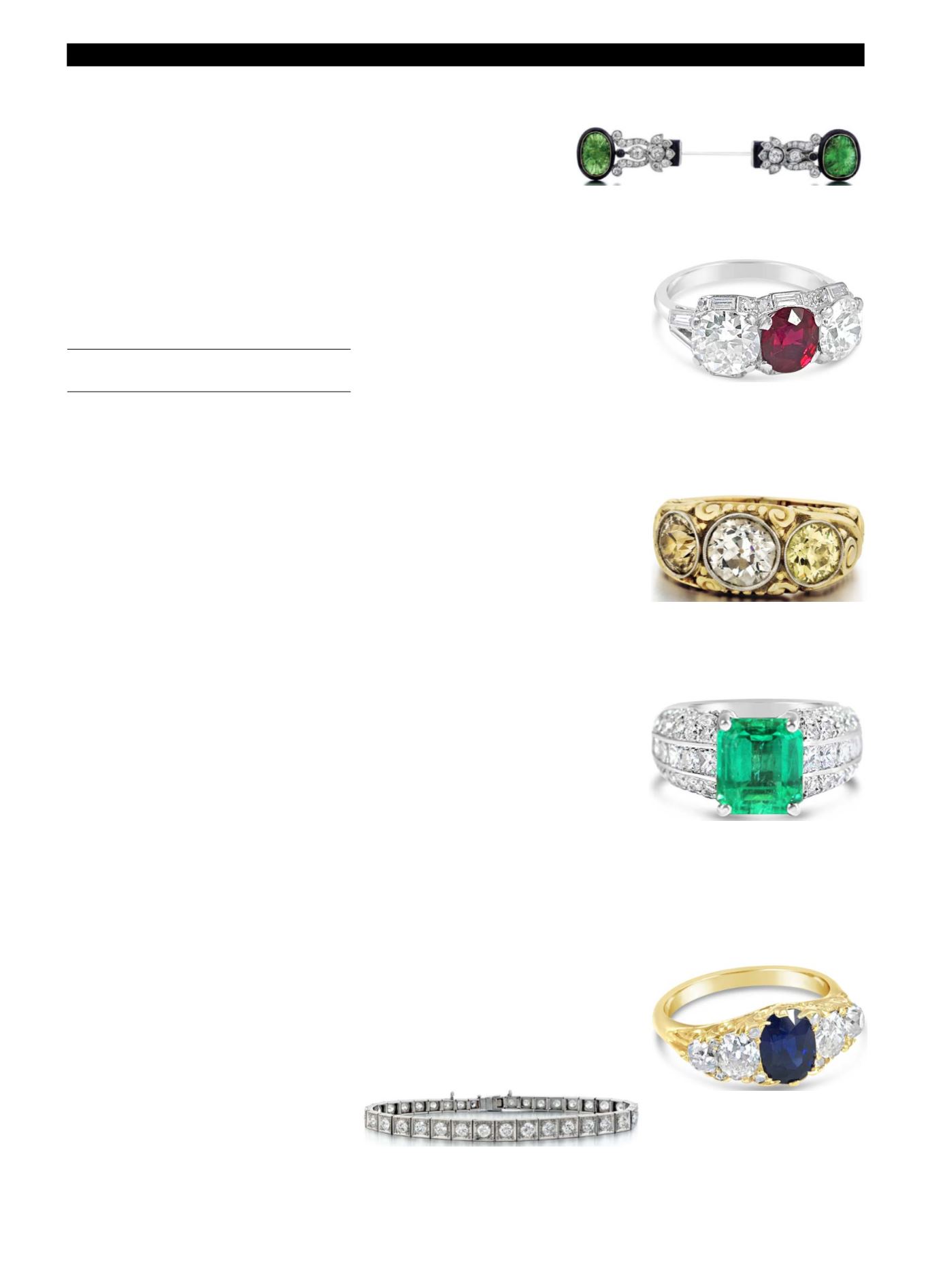
This 3" long Cartier Art Deco platinum,
emerald, diamond, and black onyx jabot pin sold
for $25,000 (est. $8000/12,000).
This platinum, Burma ruby, and diamond
ring with an antique central cushion mixed-
cut faceted ruby weighing 1.45 carats was
accompanied by an AGL report stating the ruby
is natural and of Burma origin. With presale
estimates of $10,000/20,000, it did not find a
buyer at the sale.
A number of items that saw strong prices were
from the Edward Augustus and Emma Tinkham
Turnbull collection. This antique yellow gold
and three-stone diamond gentleman’s ring sold
for $18,750 (est. $10,000/20,000).
This Colombian emerald, platinum, and
diamond ring from the Turnbull collection, set
with a central emerald measuring approximately
10.15 mm x 8.96 mm x 5.90 mm and weighing
approximately 3.95 carats, was accompanied by
an AGL report stating that the central emerald
is natural beryl, green color, with an origin
of Colombia, and has insignificant to minor
traditional clarity enhancement. It sold for
$4687.50 (est. $3000/5000).
This antique 18k yellow gold, Kashmir sapphire,
and diamond ring with a central oval mixed-
cut natural sapphire weighing approximately
1.59 carats was accompanied by an AGL report
stating that the origin of the sapphire is classic
Kashmir and it has no heat enhancement. It
realized $36,260 (est. $15,000/25,000).
This 7½" long Art Deco platinum and diamond straight line
bracelet brought $3000 (est. $2000/3000).