


 155 / 213

Maine Antique Digest, March 2017 23-D
-
AUCTION -
23-D
The Potomack Company, Alexandria, Virginia
Potomack Gets Presidential
by Walter C. Newman
Photos courtesy The Potomack Company
T
he Potomack Company held its
quadrennial auction of presidential,
political, and historical material on
November 5, 2016, at the firm’s gallery
and showrooms in Alexandria, Virginia.
While virtually all of the past presidents
of the United States were represented,
many of the highlights of the sale came
from a large selection of lots associated
with the John F. and Jacqueline Kennedy
years.
The Kennedy items included pieces
from the year before Senator Kennedy’s
election, as well as from his White House
years, the family retreat in Middleburg,
Virginia, and his final day in Dallas.
It is often said that antiques are
important not simply for what they
are but because of the stories that they
tell. That thought is made quite clear
when examining one group of lots from
the Kennedy-related items. John and
Jacqueline Kennedy owned a home in the
Georgetown area of Washington, D.C.,
while he served as a U.S. senator. When
John was elected president, the Kennedys
sold that home as they prepared to take
up residence in the White House. With
that seemingly insignificant event, a very
interesting time line emerges.
John Kennedy was elected president
on November 8, 1960. Nine days later,
President-elect Kennedy sent a telegram
confirming his acceptance of an offer
that had been made to purchase the
Georgetown home. The Kennedys
continued to live in Georgetown until
after the inauguration. In fact, they left
from the Georgetown home to attend
the inauguration on January 20, 1961. In
March 1961, John and Jacqueline signed
the deed transferring the title of the
Georgetown home to its new owners, Mr.
and Mrs. Perry Ausbrook.
In May 1961, Jacqueline Kennedy
wrote a lengthy letter to Mrs. Ausbrook
appealing to her to return a chandelier
that mistakenly had been left in the
Georgetown house when the Kennedys
vacated. Jacqueline stated that the “hall
lantern,” as she later called it, had been
a gift from her sister and obviously held
great sentimental value. Apparently Mrs.
Ausbrook did not agree immediately,
and one month later a second appeal
was sent by Jacqueline Kennedy. Finally
Mrs. Ausbrook agreed to return the light
fixture, and in her reply to the first lady
she agreed that she would begin to “start
looking [for a replacement] as soon as
possible.” Apparently the light fixture
dispute was ultimately solved to the
satisfaction of all parties.
Each component of this snippet
of history was offered for sale at the
Potomack auction. A photograph of the
Kennedys relaxing with their daughter,
Caroline, in the garden of the Georgetown
house was pictured with a lot that included
the home’s garden fountain, which was
in the background in the photograph.
The telegram agreeing to the sale of the
Georgetown home and the signed deed
were offered as a single lot. A photograph
of the Kennedys leaving the Georgetown
home for inaugural ceremonies
It is often said that
antiques are important
not simply for what they
are but because of the
stories that they tell.
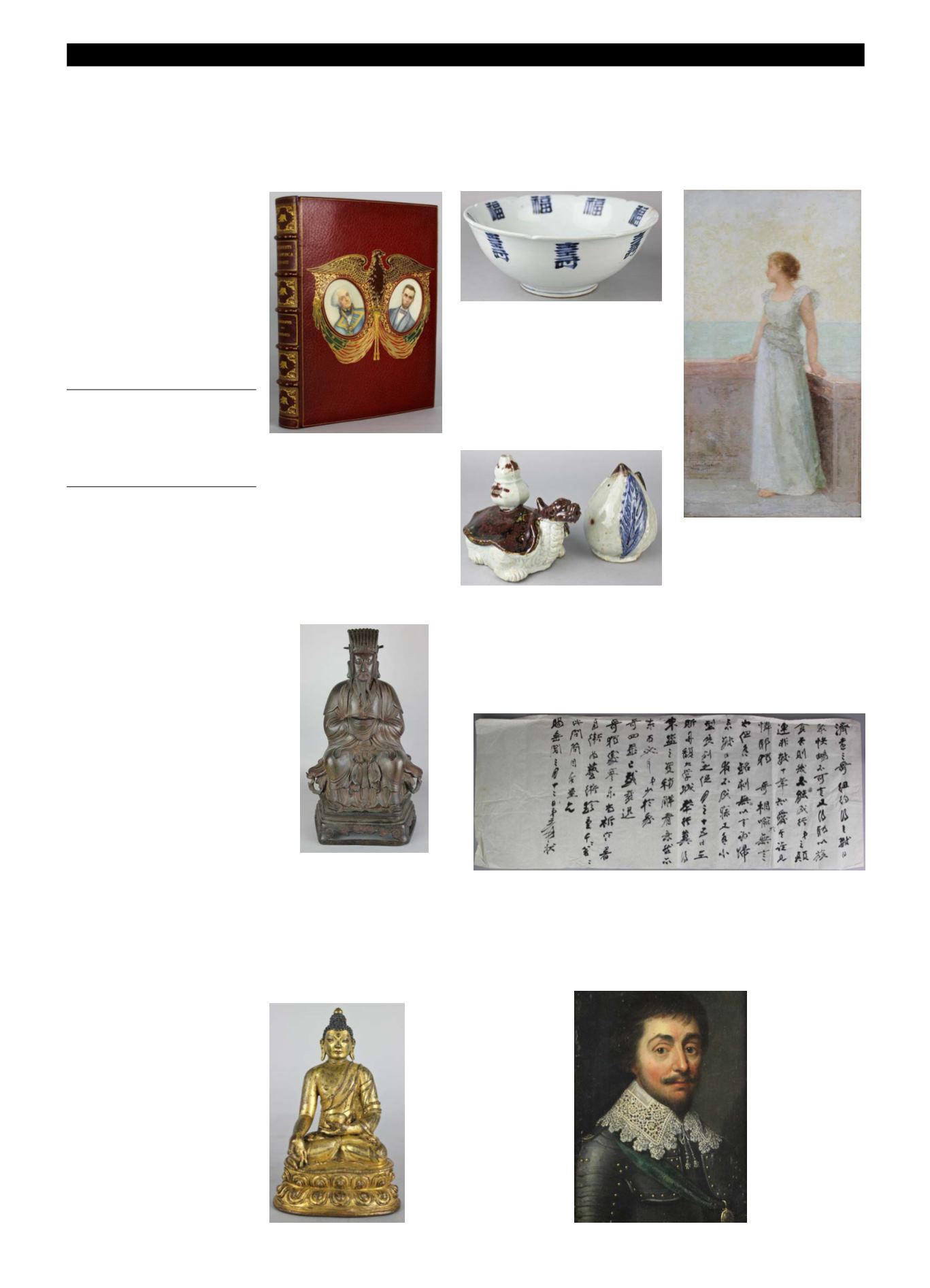
The high lot of the sale was this
remarkable autograph album. The
volume contains 31 documents, each
signed by a U.S. president; all but
five were signed while the individual
was in office. The book is bound
in the Cosway style, with the cover
featuring portrait miniatures of George
Washington and Abraham Lincoln
mounted under glass and set beneath
the wings of a gilt eagle.The binding
is the work of the George Bayntun
firm of Bath, England. The autograph
album sold to a collector in the room
for $50,000 (est. $10,000/20,000).
This blue and white porcelain bowl is from
the 19th-century portion of Korea’s Choson
Dynasty (1392-1910). The bowl displays a
slightly flared scalloped rim and is decorated
with eight longevity characters evenly spaced
around the outer surface. There are eight
characters of good fortune on the inner bowl.
There is a single central character in the
center of the inner bowl. The 10" diameter
piece appears undamaged, and it sold for
$7500 (est. $6000/9000). Kalbak collection.
Here are two figural water droppers that
date from the 19th century or later. One
of the droppers is modeled as a 5¼" high
tortoise with a double gourd on its back. The
other example is slightly smaller and is in the
form of a peach. The two droppers sold to a
telephone bidder for $4062.50 (est. $600/800).
Kalbak collection.
Competition was intense for this 18"
high Chinese bronze figure. The piece
depicts a gentleman seated atop a stepped
platform base. The figure is dressed
in flowing robes and his hands appear
to hold a small vessel at his waist. The
most notable feature is his headdress,
which takes the form of a close-fitting
dome with flat sides and eight rows of
decoration running from front to back.
The figure sold to an Internet buyer for
$15,000 (est. $1000/2000).
This Sino-Tibetan cast bronze
figure of Buddha is only 4¾"
high. Buddha is seated on a
double cushion, with his right
hand in a meditative position
and what appears to be an alms
bowl in the other. The base
is sealed, with the underside
displaying an elaborate vajra
design with a central auspicious
mark. This little figure sold to
an Internet buyer for $5625 (est.
$300/500).
Here is a portrait of a
gentleman in military-
style dress with a
fine lace collar and a
brooch-like pendant
worn as a sash. The
painting is likely the
circle of Sir Anthony
van Dyck (1599-1641).
The portrait is framed
and measures 10" x 7¾"
(sight size). The oil on
panel sold for $1875 (est.
$1000/1500).
This portrait of an unidentified young
woman is by Jean Ernest Aubert
(French, 1824-1902). The oil on canvas
depicts the woman standing barefoot
against a low wall, looking out over a
body of water. The coloration is light
and hazy, giving the image the look
of a pastel. An inscription, lower left,
is dated 1892 and indicates that this
painting was a gift of friendship from
the artist. The painting measures 17" x
9¾" and sold to a telephone bidder for
$3125 (est. $1500/3000).
By all accounts Zhang Daqian (Chinese, 1899-1983) was one of the most prolific Chinese
artists of the 20th century. His works covered a wide range of styles and subjects, from
grand panoramic landscapes to intricately detailed single flower blossoms. His works
and style are often imitated, and ironically he was also considered a master forger.
This letter is written from Zhang Daqian to his friend and fellow artist Wang Jiyuan
(Chinese, 1893-1975). In it he thanks his friend for his assistance with expenses related
to their recent trip to New York, and discusses other personal news. The letter brought
$25,000 (est. $6000/9000).