


 161 / 213

Maine Antique Digest, March 2017 29-D
-
AUCTION -
29-D
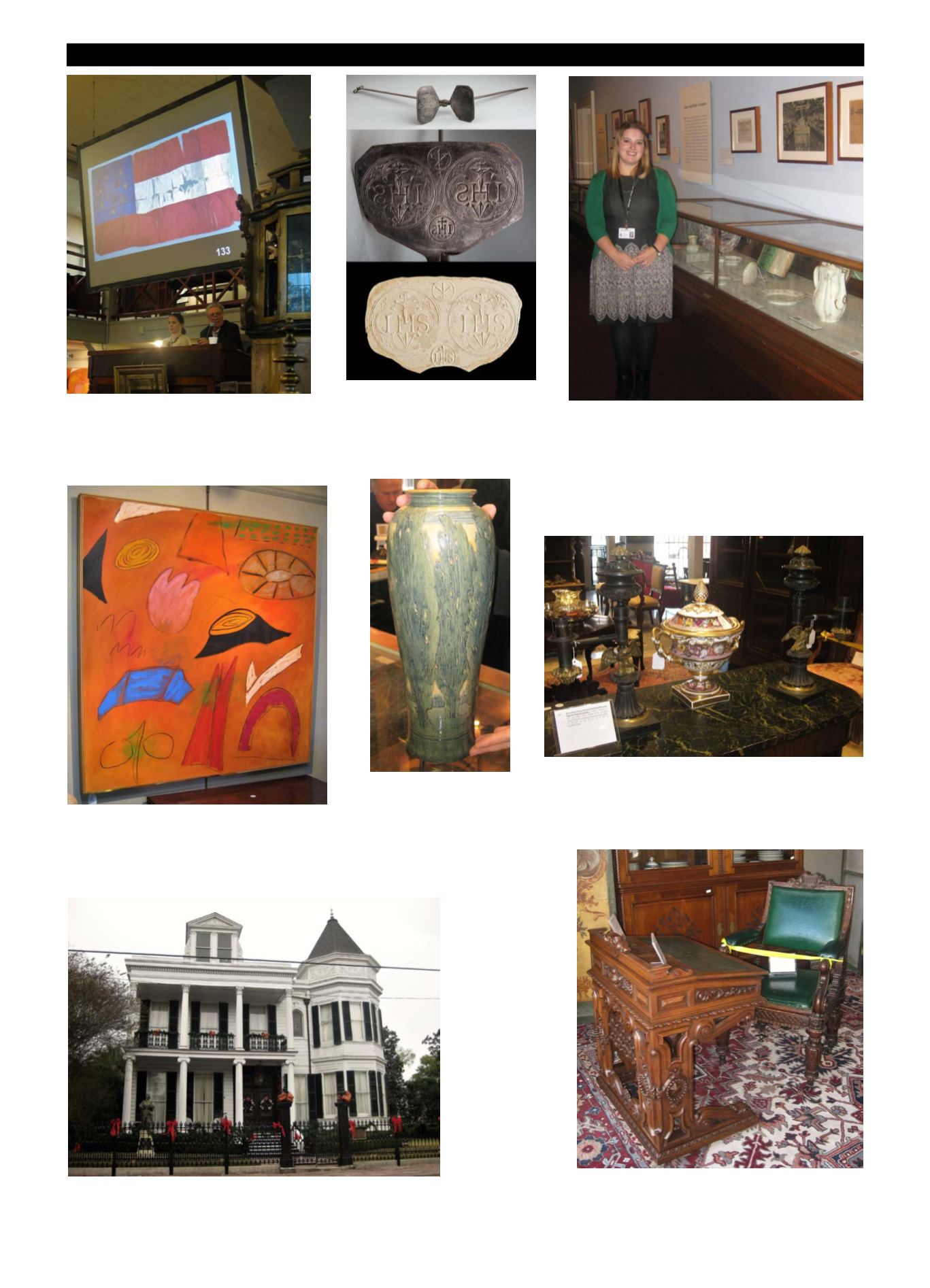
Amanda Mantle Winstead, the
firm’s fine arts appraiser and
Newcomb expert, displayed
a 14¼" tall high-glaze vase
decorated with relief-carved
cedars by Marie de Hoa LeBlanc,
1907, that sold for $37,820.
Fragmentary, the silk in tatters, this Confederate
first national flag, circa 1861, 21¼" x 40", inspired a
sustained bidding competition between multiple phones.
President Neal Alford on the podium with Bettine Field
Carroll at his side finally sold the artifact from the
Cusachs collection for $31,250 (est. $3000/5000).
Over in the French Quarter, the Historic New Orleans Collection
had organized
Goods of Every Description: Shopping in New
Orleans
,
1825-1925,
an exhibition on display through April 9.
Curator Lydia Blackmore has been interested in retail history since
her Winterthur days. For the show she gathered over 150 objects
and advertisements that document the range of furniture, silver,
china, and clothing that drew southern shoppers to the Crescent
City during that century. The objects now bought and sold as
antiques were once brand new purchases from enterprising local
merchants.
Antique lighting is a traditional strength at Neal Auction Company. This
pair of American gilt and patinated bronze Argand lamps, circa 1825,
marked “J. & I. Cox, New York,” 18¾" tall as shown here without the
shades, doubled their estimate to bring $6405; the gilt eagles were a
point of appeal. The colorful English porcelain covered urn with an old
label from Royal Street dealer M.S. Rau brought $976.
Desks and chairs of this
type, after a design by
Thomas Ustick Walter
(1804-1887), were
used in the House of
Representatives from
1857 to 1873, years of
momentous events for
the Congress; the carved
decoration appropriately
includes American shields
and stars. Although there
are quite a few surviving
examples, collectors never
fail to show interest. Sold separately, the chair, attributed to Bembe and Kimbel, New York,
brought $12,500; the carved oak desk with the stenciled label for Doe Hazelton, Boston, sold
for $17,920. Both came from the estate of Frank C. Littleton of Oak Hill (James Madison
House) in Loudoun County, Virginia; he had acquired them in 1952 at a Sloan auction.
How did they make communion wafers in
the 18th century? With a hand-operated
wafer iron. This wrought-iron curiosity,
thought to be from the Ursuline convent,
sold for $3782 (est. $1000/1500). Cusachs
collection. Neal Auction Company photo.
Bursting with orange, this large oil and mixed media on
canvas,
Composite 91-2
by Ida Rittenberg Kohlmeyer
(1912-1997), elevated the happiness level in the room.
Collectors responded, taking the work to $53,680 (est.
$18,000/25,000). It would be a bright image to start the
day.
Not far from Neal Auction Company the magnificent mansions of the Garden
District were decorated for the port city’s festive holiday season and the arrival of
Papa Noël.