


 164 / 213

32-D Maine Antique Digest, March 2017
-
AUCTION -
NPY
Freeman’s, Philadelphia
American Art and Philadelphia Impressionists
by Lita Solis-Cohen
Photos courtesy Freeman’s
T
wice a year, in December and June,
when Freeman’s holds American
paintings sales, local collectors fill the
salesroom. Some come to bid on the early
lots of landscapes, still life, illustration art,
and sculpture, but most of the early lots go
to phone bidders or bidders online. Many of
those in the salesroom wait until the last part
of the sale when Pennsylvania Impressionists
are offered, and they stay to the very end
of the sale. Competition in the salesroom
is spirited. Pennsylvania collectors like to
live with paintings of their neighborhoods,
especially those by local painters of the New
Hope school, who magically created scenes
of spring, summer, and autumn, and the ever-
popular snow scenes out of pure color.
Predictably, the top lot in the December
4, 2016, sale was an Edward Redfield 32¼"
x 40¼" plein-air painting done in the height
of spring with flowering fruit trees and trees
with new pale green growth. It sold for a mid-
estimate $200,000 (est. $150,000/250,000)
with buyer’s premium. A larger (42
⅛
" x
46
⅛
") snow scene by Arthur Meltzer titled
The Robe of Winter
sold for $81,250 (est.
$80,000/120,000). When this painting sold
at Garth’s on January 30, 2010, at the top
of the market, it brought $156,875 (est.
$2000/4000), a record for the artist.
A classic Fern Coppedge snow scene,
Evening Glow
, with her signature purple hills
and orange houses with blue-green roofs sold
for $59,375 (est. $40,000/60,000). Some
small Bucks County Impressionist works
sold for more than the estimates. George
Sotter’s charming
The Bathers
, 10" x 12",
depicting families on the sand, bathers in the
water, and sailboats on the horizon under a
big summer sky, all miraculously captured
with daubs of paint, sold for $23,750 (est.
$12,000/18,000). An even smaller (8
⅛
" x
6
⅛
") picture of Philadelphia’s City Hall by
Paulette van Roekens sold for $10,625, more
than twice its high estimate ($2500/4000),
because two collectors marveled at her skill
in using color to express the bustle of the
city.
There were some appealing landscapes by
artists who did not paint in Pennsylvania.
Jonas Lie’s tightly composed
Harbor Scene
of the New England coast, 30" x 45¼", was
a crowd favorite and sold for $50,000 (est.
$10,000/15,000). A coastal view by Thomas
Moran, 22
⅛
" x 37
⅝
", signed and dated
“T. Moran 1859,”
sold for $26,000 (est.
$30,000/50,000).
Freeman’s sells paintings by all the
Wyeths in its American paintings sales. This
time the sale offered two illustrations by
Newell Convers Wyeth and got $112,500 for
The Departure of the Rose
, an illustration for
Charles Kingsley’s novel
Westward Ho!
, and
$106,250 for a slightly smaller illustration,
At the Door of Their Little Cabin He Kissed
Her
, an illustration for a short story in the
Delineator
magazine in 1912. An Andrew
Wyeth watercolor,
From a Cushing Window
,
sold for $81,250 (est. $80,000/120,000).
Two other AndrewWyeth watercolors failed
to sell.
Illustrations by the Red Rose Girls were
in demand. A painting on board by Jessie
Willcox Smith of a young girl reading while
seated in a wicker chair sold for $53,125
(est. $25,000/40,000), and a painting on
board by Elizabeth Shippen Green of two
children with their new camera sold for
$40,625 (est. $10,000/15,000). It was an
advertisement for Kodak. Both Smith
and Shippen lived at the Red Rose Inn in
Villanova, Pennsylvania, with artist Violet
Oakley. That is why they are known as the
Red Rose Girls.
The cover lot was a discovery. It was a
study by German-born American Winold
Reiss (1886-1953) for a mosaic mural
proposed for the Chrysler Building in 1929.
The mural was never completed because
of the stock market crash. The gouache
on illustration boards triptych sold on
the phone to the trade for $125,000 (est.
$70,000/100,000). The German-trained
artist who came to the U.S. in 1913 was
inspired by James Fenimore Cooper’s novels
and was intent on paintingAmerican Indians
and did so while he lived with the Blackfeet
tribe. This study with skilled portraits of
Indian chiefs combined Jugendstil with Art
Deco. Painted in the late 1920s, the portraits
in this triptych are believed to be the earliest
of Reiss’s portrait studies for a commercial
design project.
Alasdair Nichol was pleased with
the results of the sale, which totaled
$1,751,687.50, with 85% of the lots selling.
“This is the most fun I have had selling in
a while,” said Nichol a few days after the
sale. Together with results from the modern
and contemporary sale held on December
6, the total was $3.6 million for about 220
lots. The contemporary sale was nearly 92%
sold. Both sales were smaller sales than in
the past partly because consignors were
reluctant to sell so close to the election,
but also because Nichol was selective and
sought high-quality pictures, which pushed
up the average price per lot. That seems to
be what auctioneers want these days. The
pictures and captions tell more.
For more information, go to (www. freemansauctions.com).Illustrations by the
Red Rose Girls
were in demand.
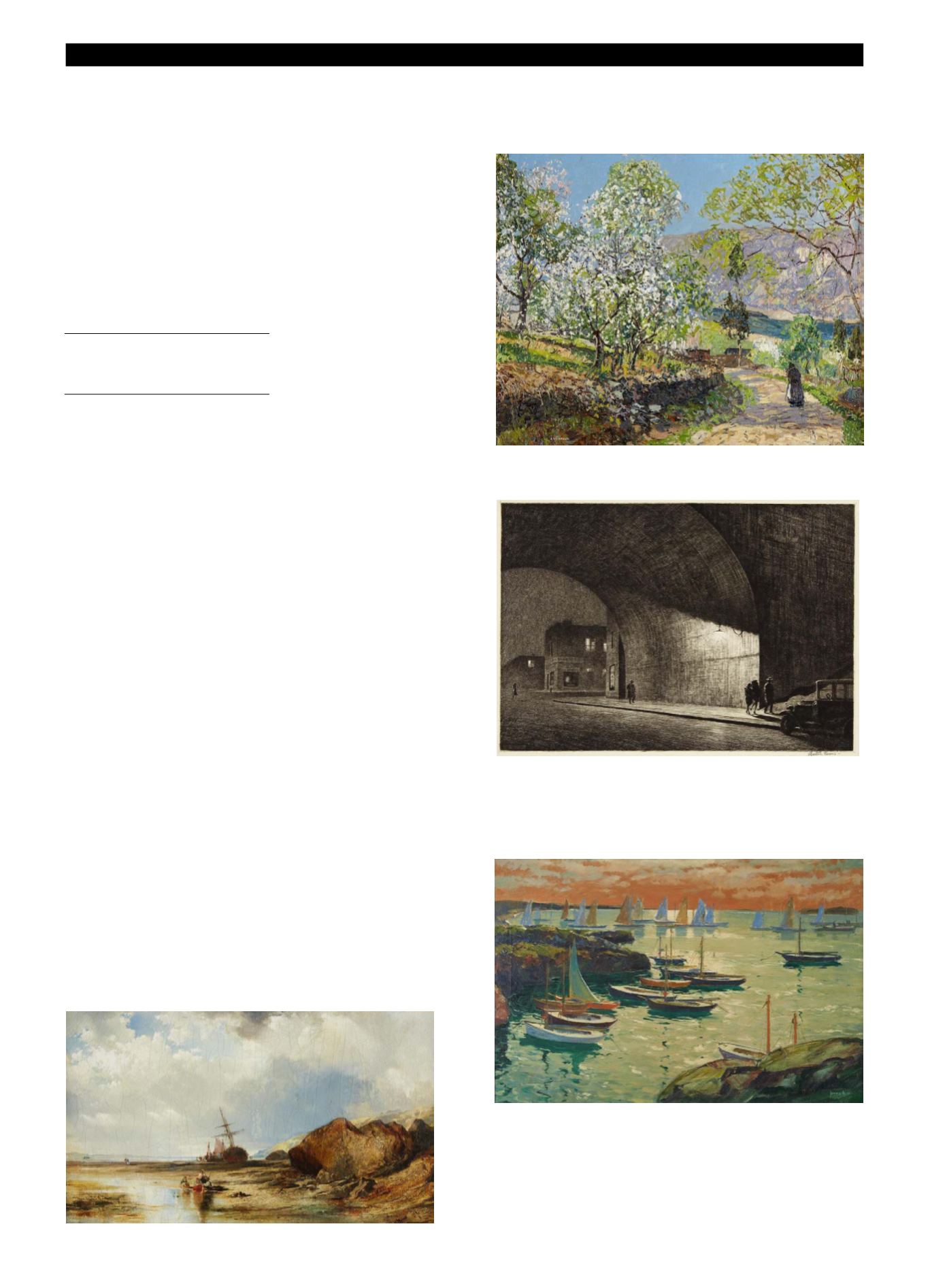
Edward Willis Redfield (1869-1965),
Road to the River
, oil on canvas, 32¼" x 40¼",
depicting the height of spring, signed “E.W. Redfield” bottom left, inscribed with
the title on the stretcher, sold for $200,000 (est. $150,000/250,000).
Martin Lewis (1881-1962),
Arch Midnight
, 1930, drypoint etching, signed in pencil
on the margin, 8
⅛
" x 11
⅝
", unframed, from the estate of Daniel Dietrich, sold for
$18,750 (est. $6000/10,000). Lewis taught Edward Hopper the basics of etching.
Lewis is famous for his black-and-white prints of night scenes in New York City.
He was largely forgotten after his death in 1962. The Bruce Museum, Greenwich,
Connecticut, staged an exhibition of Martin Lewis prints from October 2011 to
February 2012.
Jonas Lie (American/Norwegian, 1880-1940),
Harbor Scene
, oil on canvas, 30"
x 45¼", signed “Jonas Lie” bottom right, sold for $50,000 (est. $10,000/15,000).
Thomas Moran (1837-1926),
Coastal
View
,
22
⅛
" x 37
⅝
", signed and dated
“T. Moran 1859” bottom right, sold
for $26,000 (est. $30,000/50,000).