


 160 / 213

28-D Maine Antique Digest, March 2017
-
AUCTION -
28-D
that related to the history of the city. Other institutions
were on the floor and phones, but private collectors
weighed in as well.
Maps, portraits, pistols, and many small artifacts found
buyers; the total for this portion of the sale was around
$270,000. What did not sell were two objects associated
with the Battle of New Orleans in 1815—an infantry
snare drum that belonged to African American military
drummer Jordan B. Noble (1800-1890), and an Andrew
Jackson commemorative presentation flag. Both received
lengthy and informative catalog entries, but each bore
very ambitious estimates of $200,000/250,000.
Earlier on Friday, historian Shelene C. Roumillat had
presented a lecture on Jordan Noble and the Battle of
New Orleans; the scholar wrote her Tulane dissertation
on the social and cultural history of the battle. Roumillat
is also the spark behind an entertaining website for the
New Orleans Costume Center, a must-visit click for
anyone interested in the city’s cultural ambiance and/or
dressing up.
Regional fine art from the 19th and 20th centuries
ruled the rest of the sale, as is most often the case. The
catalog cover lot was well chosen, for it became the top
lot of the sale and set a staggering new record for the
artist. While landscapes by Richard Clague and William
Henry Buck may be better known, views painted by
Everett B.D. Fabrino Julio (1843-1879) are far rarer, in
part because his life and career were cut short. His signed
and dated oil on canvas of a tranquil bayou scene is filled
with captivating detail—a picturesque pirogue boat oared
upstream, a skiff loaded with logs, animals feeding on
the banks, a bird of prey soaring above. The substantial
$100,000/150,000 estimate was left far behind as new
phone bidders piled on, pushing the price to $453,000
(with buyer’s premium).
Julio was born on the same south Atlantic island, St.
Helena, where Napoleon was exiled. Julio studied in Paris
and Boston and painted from 1864 to 1870 in St. Louis,
where he completed his best-known work,
The Last
Meeting of Lee and Jackson
. Marney Robinson, Neal’s
painting expert, explained, “He comes to Louisiana in
1870 and sets up shop on Canal Street above the Seebold
Gallery, which is an important art supply store here and
a gathering place for artists. These paintings hardly ever
come up at auction.”
Among the portraits, the eyes of Daniel William Coxe
(1769-1852) as painted by José Francisco Xavier de
Salazar y Mendoza (c. 1750-1802) in his portrait seemed
to follow the viewer around the gallery. If you measure
sartorial splendor by big buttons, he was something of
a dandy and was probably considered quite handsome
to boot. As the page-long catalog entry outlined, Coxe
was from an important Philadelphia political, social, and
mercantile family. In 1792 he traveled to New Orleans,
which was then under Spanish control, on business,
put on his best jacket, and decided to have his portrait
painted by Salazar. Born in Mexico, Salazar was as
highly regarded in his orbit as was contemporary Charles
Willson Peale in the East. The portrait, which had
descended in the family of the sitter, sold for $122,000,
reportedly to an institution.
Quietly ethereal, the portrait of young Félicie Aime,
later MadameAlfred Roman (1825-1859), by French-born
Louisiana artist Jacques Guillaume Lucien Amans (1801-
1888) tripled its high estimate to bring $76,250. She was
the daughter of sugar planter ValcourAime and lived on St.
James Plantation, known as Le Petit Versailles, the gardens
of which can be seen in the background. Robinson noted,
“Amans was a traveling artist who would go to various
plantations and paint a number of members of the same
family. She’s probably about twelve to fourteen years old
there. It was the largest, the grandest of the old plantation
homes, but it does not survive unfortunately.” Amans
also painted Aime’s cousin Jeanne Roman (the Aime and
Roman families were linked by multiple marriages) and
a portrait of a young girl holding a dove, which sold in
the 2012 Louisiana Purchase Auction for a world record
$197,175. This 2016 lot of Félicie takes second place as
auction record for Amans.
In addition to strong offerings by Ida Rittenberg
Kohlmeyer and George Rodrigue, the selection of
20th-century art yielded
Repose
, a bronze sculpture of a
graceful woman at rest by Enrique Alferez (1901-1999),
which sold for $173,240 after enthusiastic bidding (est.
$15,000/25,000). Local collectors know the artist’s work
well. The Helis Foundation Enrique Alferez Sculpture
Garden at the New Orleans Botanical Garden features
14 of his works, including another casting of this figure.
Amanda Mantle Winstead, senior appraiser in fine
arts at the Neal Auction Company, said, “The Alferez
sculpture is exceptional; she is really special.” Born in
Mexico, Alferez rode with Pancho Villa before coming
to the United States, where he eventually settled in New
Orleans in 1929. His sculpture and reliefs, some created
during the W.P.A. program, ornament public areas all
over the city.
President Neal Alford said later, “The seated nude is
such a terrific example of that sculptor, a recognized
artist with a great deal of standing. He did dancers as well
at times, all tied into his interest in human figures. With
that patina on it, it will certainly be displayed inside.
That buyer has a lot of sophistication, and there were
three, maybe four, bidders serious about that lot. I think
the prices in this sale are a bit of an index to the overall
marketplace. The marketplace has its surprises that you
can see more clearly at auction than anywhere else. There
was a small picture earlier in the sale that a museum had
deaccessioned, rather conservatively estimated, and it
brought over $9000 with four bidders at one point. That’s
a dynamic you like to see.”
The total for the three-day sale was around $2.8
million. It is usually held in November; the timing of
Thanksgiving pushed 2016’s Louisiana Purchase into the
holiday season. The city was decorated in anticipation
of a visit from Papa Noël, and as an extra enticement
for visitors many restaurants were offering elaborate
réveillon
menus laden with local delicacies. For the 2017
auction schedule and more detailed entries on the items
illustrated, visit
(www.nealauction.com).
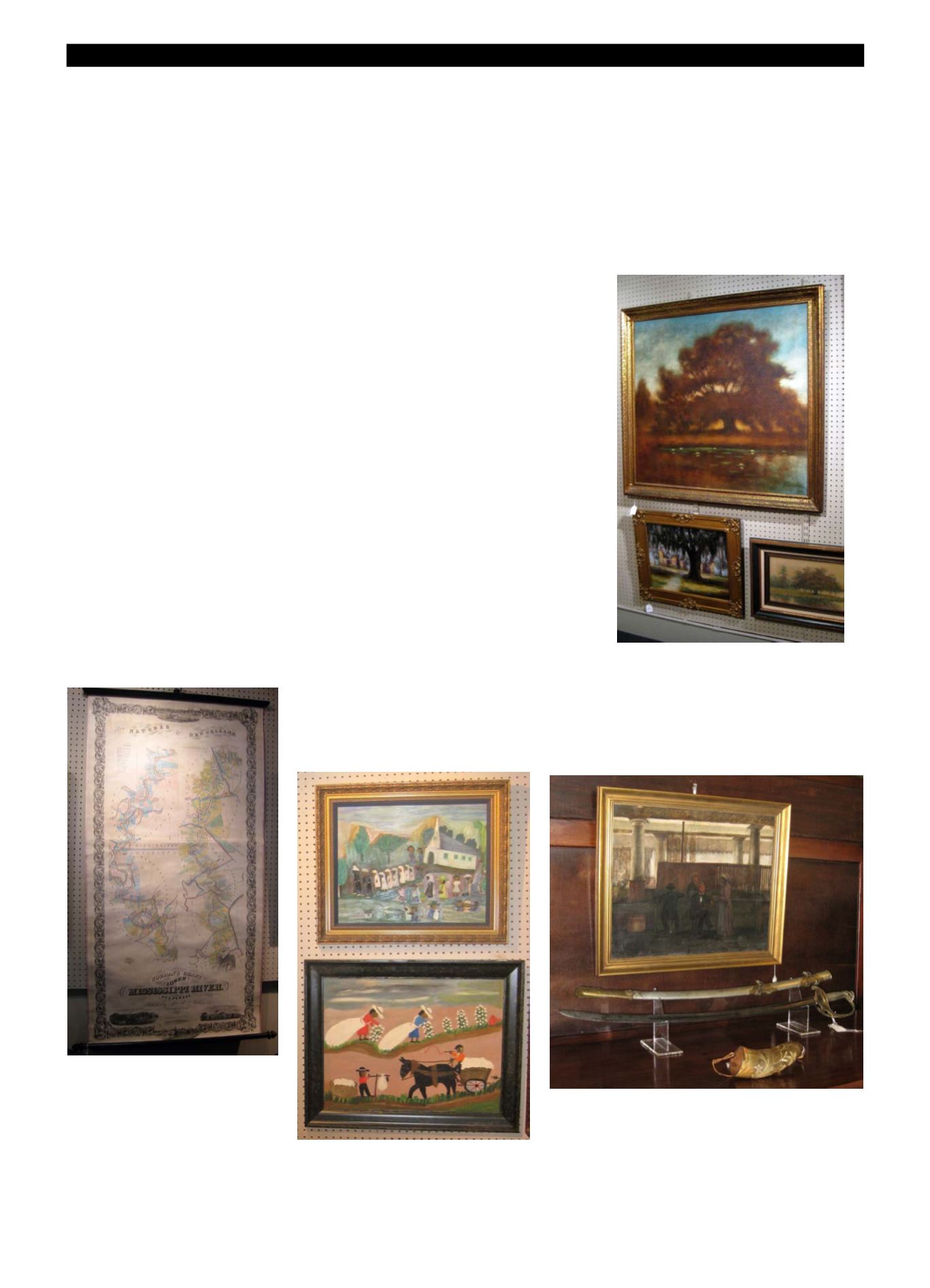
Although copies of this map have been on the
block before at Neal, this example looked to be
almost brand new, neither discolored or faded.
“Norman’s Chart of the Lower Mississippi
River from Natchez to New Orleans,” 1858,
by Marie Adrien Persac (1827-1873) not only
captures the bends of the river but documents
the land parcels along the way with the names
of their owners. Persac navigated the river in
a skiff, making notes and drawings along the
way. Three strong phone bidders including
one on the line with map expert Marc Fagan
took the lot to a well-deserved $106,750 (est.
$50,000/70,000).
In a group of works by self-taught artist Clementine
Hunter (1886-1988) was an early
Baptism
scene from
the late 1940s, 16" x 20", that she had given to her
personal physician Dr. Eleanor M. Worsley. It’s final
price was $9760. The oil on board below showing
workers picking and weighing cotton brought $6875.
An unusually large (36" x 39") view of New Orleans’
own
City Park and Lagoon
by local artist Alexander
John Drysdale (1870-1934) brought on a contest
among collectors in the room and a very determined
phone bidder, who paid $17,080, more than double
the high estimate. Below left, a live oak with ruins
beyond by Mississippi painter Cornelius Haly
Hankins (1863-1946) sold for $4375.
The Gaspar Cusachs collection, as advertised, did include every sort of
“Important Historic Louisiana Material Culture.” In a special Friday
session, the paintings, maps, and artifacts that had been on view for
over a hundred years in the Louisiana State Museum were dispersed
to private and public collections. The interior view of
Rose Nicaud’s
Coffee Stand, French Market
brought $7015. The floral relief-carved
powder horn attributed to Pierre Joseph Landry sold for $2806, and the
Confederate presentation sword and scabbard brought $3355.