


 159 / 213

Maine Antique Digest, March 2017 27-D
-
AUCTION -
27-D
Neal Auction Company, New Orleans, Louisiana
The Louisiana Purchase Auction: History, Art, and
Artifacts
by Karla Klein Albertson
T
he Louisiana Purchase Auction is a
special event on the annual calendar
at Neal Auction Company in New
Orleans, and collectors expect a lineup
of great estates and six-figure fireworks.
From December 2 through 4, 2016, the
three-day sale offered more than 1200
lots. Although there is always diversity at
the Magazine Street house, this particular
auction traditionally focuses on regional
art and objects with a strong connection
to the history of Louisiana and the
surrounding area.
The Friday session, which began at
2 p.m., was devoted to art and artifacts
gathered by a single collector—the Gaspar
Cusachs collection of important historic
Louisiana material culture. Cusachs
(1855-1929) exemplifies the cultural mix
of New Orleans as the child of a Spanish-
born father and a mother of French
descent. He became a turn-of-the-century
entrepreneur, undertaking important civil
engineering and construction projects. In
private life, he was passionate about local
history, serving as the seventh president
of the Louisiana Historical Society from
1914 to 1929 and amassing a collection
of artifacts and ephemera (usually called
“curios” at the time) back when the getting
was good. The Civil War was an event that
occurred during his lifetime, and he was
a young man in 1876 when the national
centennial spurred interest in preserving
historic objects.
Before the sale, vice president of
consignments Marc Fagan, who is also the
firm’s documents and maps man, said of
the Cusachs collection: “We’re privileged
to be able to sell it. We knew about this
and have been working with the family for
several years. We’re glad to finally see it
through. There are institutions interested
in all these things. We definitely hope
they get their share. The maps are obvious
highlights for me. There’s a group of
Collot maps starting at lot eleven. They’re
from a super-rare atlas; you can buy
the entire atlas for about $120,000. We
have the majority of those maps. The
Confederate flag is in fragile condition,
but a lot of people want that. There are
great manuscripts from the War of 1812
and the Battle of New Orleans. Everything
on Friday is from that collection; it’s really
a cabinet of curiosities that this gentleman
collected and loaned to the museum.”
The Cusachs session presented 199
lots, which included documents, maps,
portraits, photographs, and militaria.
The contents of the collection were well
known because Cusachs had lent it in 1909
to the Louisiana State Museum, where
objects had been put on display for over
100 years. Some pieces had previously
been exhibited at the Louisiana Purchase
Exposition at the St. Louis World’s Fair
of 1904. When Cusachs’s descendants
chose to sell the collection, institutions
were naturally among the most interested
bidders. Representatives of the Historic
New Orleans Collection in the French
Quarter, an entity which combines the
functions of a museum, research library,
historic property, and publisher, came
with a want list that included documents
“The marketplace has its
surprises that you can see
more clearly at auction
than anywhere else.”
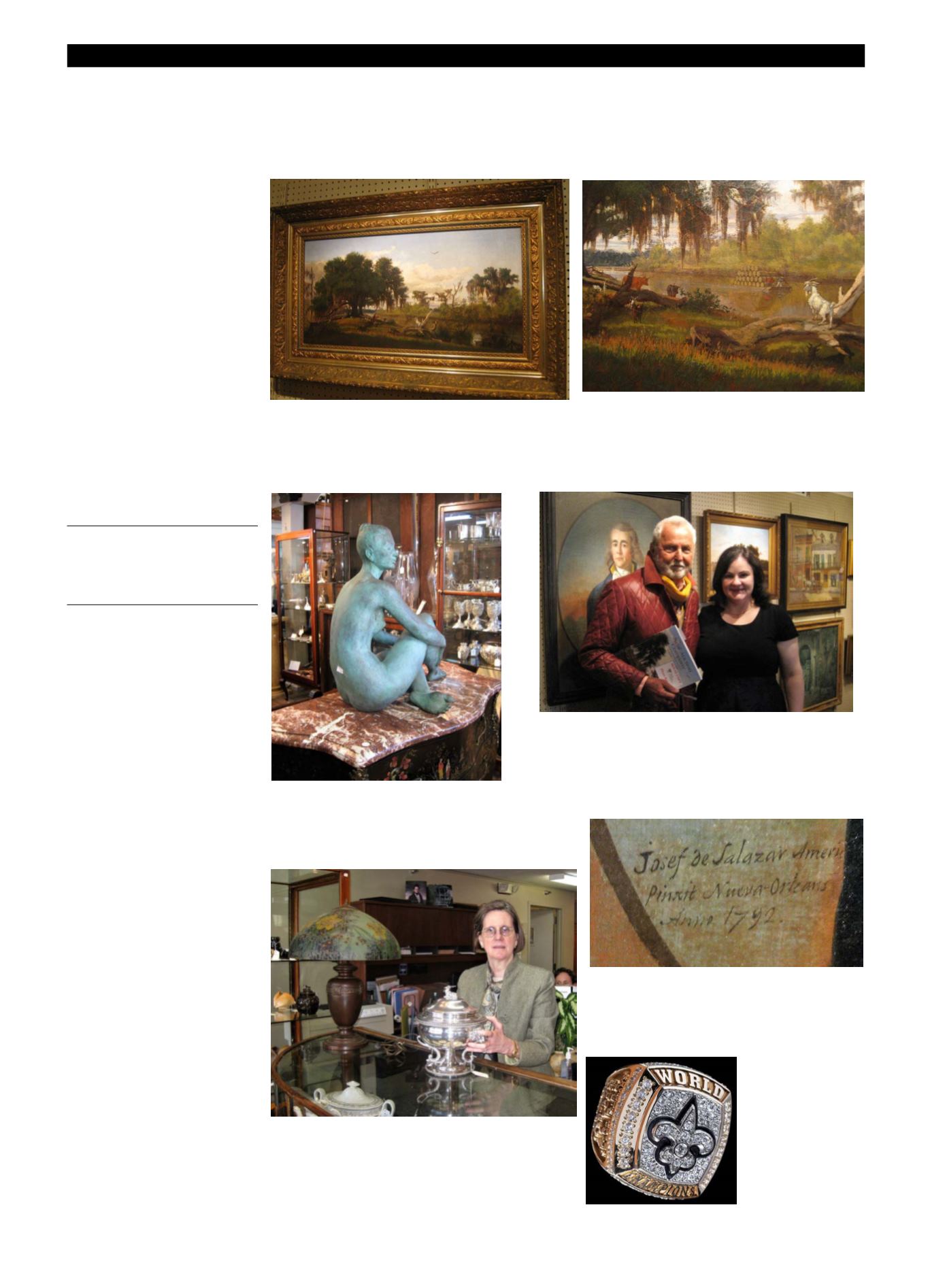
Among all the southern regional landscapes, the star of the show was
a compact but incredibly precise 1877 bayou view by Everett B.C.
Fabrino Julio (1843-1879), who painted in Louisiana between 1870
and 1878 before passing away in Georgia at 36 years of age. Strong
bidding on multiple phone lines took the rare work beyond the
$100,000/150,000 estimate to $453,000, a new record for the artist.
Perched on a chest in the showroom, the 30" x 24"
x 27"
Repose
by New Orleans sculptor Enrique
Alferez (1901-1999) seemed unaware of her six-
figure star power. The beautifully patinated bronze
sold for $173,240 after enthusiastic bidding (est.
$15,000/25,000).
The presale painting gallery displayed a whole lot of southern regional
awesomeness. Peyton Bruns, up from Palm Beach, was taking it all
in with painting department head Marney Robinson. Daniel Coxe, as
portrayed by Salazar in the auction highlight, which sold for $122,000,
looks distinguished at left. At upper right, a view of Rue Chartres in the
French Quarter, as it appeared in 1905, by William Woodward (1859-
1939) brought $115,900.
Making everyone’s life easier, José Francisco Xavier de
Salazar y Mendoza (c. 1750-1802) clearly signed and dated
his portraits. Why “Nueva Orleans”? The city was part of
the Spanish Empire between 1763 and 1803; the painter had
brought his family from Yucatan to New Orleans in 1782.
Tureens with New Orleans provenance are enthusiastically sought
after by collectors. This example was made by Adolphe Himmel
(active 1862-77) for retailer Hyde & Goodrich and had a fine 1866
presentation inscription tying it to a local family. Silver expert and
senior vice president Katherine Hovas was on the winning phone
when it sold at its high estimate for $18,910. Also in the picture is a
case of small George Ohr pots at left, a Handel lamp with a Daffodil
shade, which brought $3840, and a counter case below filled with
French Creil creamware.
Although it did not find
a buyer until after the
auction, everyone had a
chance for a close look at
this Super Bowl XLIV ring
by Tiffany commemorating
the Saints 2009 victory
over the Colts. Presented to
Russell “Rusty” Bonin, the
ring is covered with New
Orleans motifs in relief with
a large diamond fleur-de-lis
on the face. Neal Auction
Company photo.
Within the small scope of the canvas (15¼" x 30¼" with frame),
Julio captured a wealth of historic detail—the herd of goats and
cows by the water, two men on a skiff rowing logs downstream,
and a manmade structure across the bayou upstream.