


 142 / 213

10-D Maine Antique Digest, March 2017
-
AUCTION -
NPY
Cowan’s Auctions, Cincinnati, Ohio
Cowan’s Americana
by Don Johnson
Photos courtesy Cowan’s Auctions
A
grouping of mirrors offered in the last half-hour
of a cataloged Americana sale held by Cowan’s
Auctions in Cincinnati, Ohio, on December
10, 2016, were a good reflection of the strong bidding
experienced throughout the day.
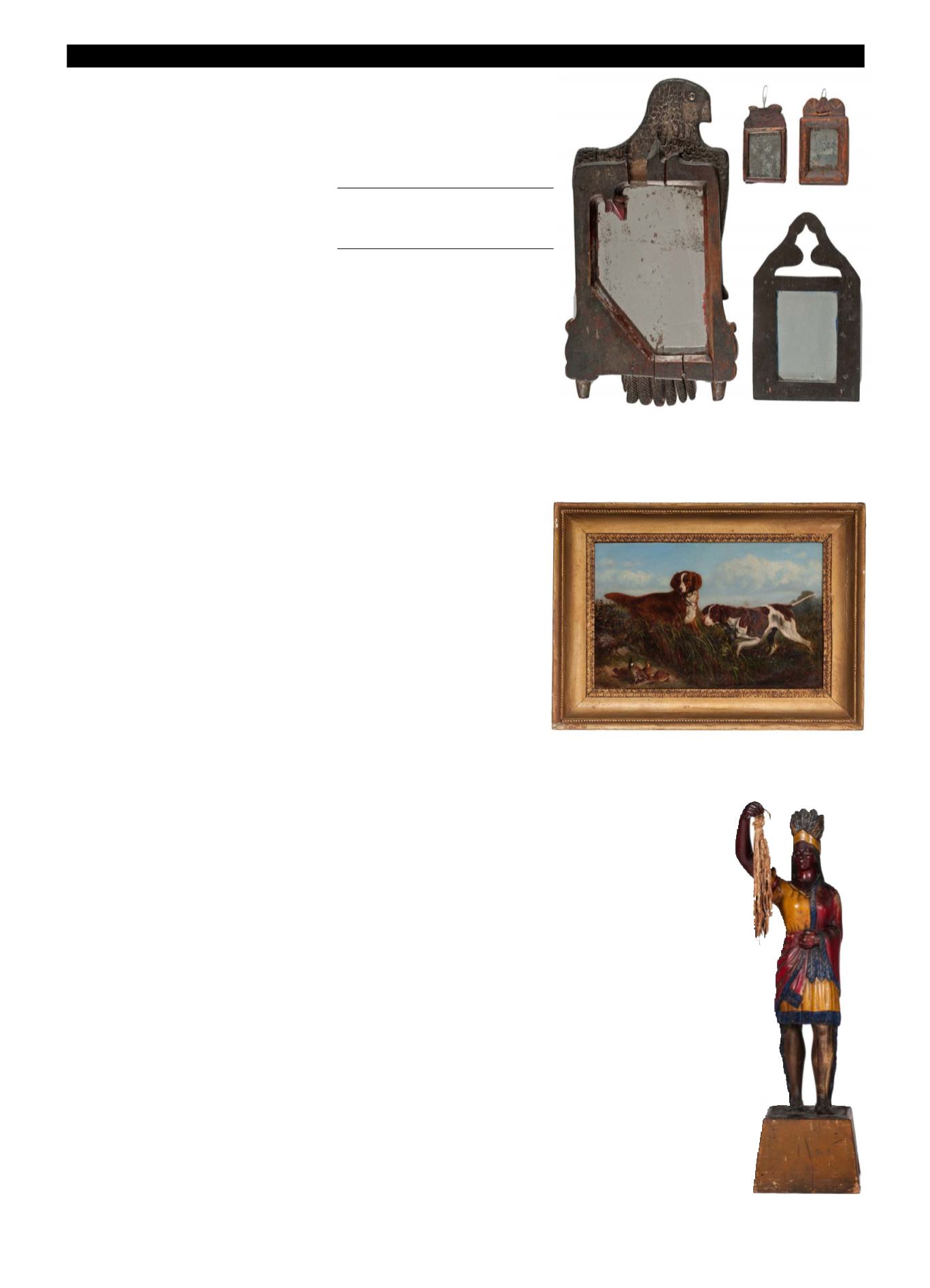
Described as primitive, the four mirrors included a
folk art example with a carved and painted frame in the
form of an eagle, the piece said to have come from a
farm in Corinth, Kentucky. Despite missing some of the
surround, the 15¾" x 8" mirror was clearly the gem of the
bunch. The other examples were smaller and of a more
traditional form. Estimated at $400/600, the lot sold for
$3480 (includes buyer’s premium). In large part, that’s
the kind of day it was—with good Americana bringing
strong prices.
The mirrors came from the collection of the late Drs.
James and Betty Sutherland of Cincinnati. The couple
began collecting in the 1960s and continued for half a
century. Cowan’s catalog noted, “They traveled widely,
buying from Ohio dealers such as Clark Garrett and
David Good, and further afield from legends such as
Peter Tillou.”
Wes Cowan, chairman and principal auctioneer at
Cowan’s, recalled his first visit to the Sutherlands’ home,
where few people in the antiques trade had been allowed.
“From basement to attic, Americana was arrayed on
shelves, atop chests, in cupboards, on window ledges,
or literally piled in dresser drawers. The experience
was truly like visiting Aladdin’s cave,” he wrote in the
auction catalog.
It wasn’t the only collection of note in the sale. Also
highly touted were items from the descendants of the
Benkard family of Oyster Bay, New York, and Tucson,
Arizona. Main players in the family included Bertha
King Benkard, said to be a scion of New York society
and a close friend of Henry Francis du Pont; and her
daughter, Bertha Benkard Rose, described by Cowan’s
as “a child of privilege and a woman of taste and means.”
The family had ties toWinterthur, the Museum of the City
of New York, the New-York Historical Society, and the
Society for the Preservation of Long Island Antiquities.
“We were fortunate to have two good collections to
offer—both from estates, and both from consignors who
understand the current market,” Cowan noted after the
auction. “These two factors combined to allow us to offer
some great material with very reasonable presale estimates,
which ultimately helped attract aggressive bidding.”
Items from the Benkard collection set the tone early
and included a China trade school painting,
The Hong
Kong Harbor with American, British, and European
Ships
, picturing a busy harbor with hong merchant
warehouses lining the shore. Dating to the early to mid-
19th century, the 19½" x 35½" (sight size) oil on canvas
was in its original Chinese Chippendale frame and sold
for $22,200. A second China trade school oil painting of
a similar scene, also from the Benkard family, topped at
$15,000. From another consignor, a third China trade
school painting,
View of the Hongs of Canton
, realized
$11,400.
“All the Chinese trade paintings did really well,” said
PaulineArchambault, a fine arts specialist at Cowan’s. “We
did have interest coming from all over, not just the U.S.”
The $22,200 painting was helped by its original frame,
although the subject matter could clearly stand on its
own. “It shows a really bustling, active harbor. The
harbor from that view of the bay is really iconic. You
can see the hongs,” Archambault said. “That’s the kind
of composition you want.”
It was a good day for art. An Arthur Fitzwilliam Tait
(1819-1905) oil painting depicting a setter, a pointer, and
a covey of quail, signed and dated 1871, 14" x 22" (sight
size), sold for $22,800. “That’s a preferred subject matter
for Tait,” noted Archambault. A James McDougal Hart
(Scottish-American, 1828-1901) Adirondack landscape,
oil on canvas, 17½" x 30" (sight size), brought $19,200,
drawing what Archambault described as “tons of
interest.” Both paintings came from the Benkard family.
Also of note was a set of six delftware Merryman
plates, each with a numbered verse in a wreath. The
English plates were dated 1734 and realized $24,000.
“They fit well with the Americana collectors, and people
like the fun sayings on them,” said Kirstie Craven,
coordinating specialist for Cowan’s fine and
decorative arts department. “They have the same
vibe that Americana has. It’s so astounding that
they all stayed together.”
The diversity of the Benkard items was
exemplified by a Hepplewhite mixing table in
mahogany veneer with a marble top, possibly
of Maryland origin, 1790-1800, at $9600, and
a great blue heron confidence decoy, the carved
and painted bird created for decorative purposes,
second quarter of the 20th century, 30" high,
that brought $8400. Archambault said the buyer
believed the decoy was the work of “Chief” Eugene
Cuffee (1866-1941) of Shinnecock Reservation.
The biggest disappointment among the Benkard
material was a French Empire ormolu mantel clock by
DuBuc, 1815-17, made of brass and having a figure of
George Washington holding his resignation papers next
to a shield-breasted spread-wing eagle on
a sphere. Estimated at $60,000/80,000, the
clock did not sell.
“That was on me,” Cowan noted. “I failed
to understand the market for the clock and
overestimated its value. It’s funny, when
I first saw the clock in Tucson, I told the
consignor that Sotheby’s original estimate
of $100,000 was off the mark. The more I
researched these clocks, however, the more I
questioned my initial reaction; in retrospect,
I was right.”
From the Sutherland collection came
some of the best smalls in the sale, including
a cobalt-decorated stoneware muffineer with
a faceted body and top. Probably made in
Ohio or Pennsylvania, it dated to the 19th
century and sold for $9300. “We had a lot of
interest in that presale,” said Craven. Other
things drew little attention until bidding
began. As she noted, “The cat was kind
of a surprise.” That cat was a large chalkware seated
figure with a painted and smoke-decorated surface. Of
American origin and 14¾" high, it was estimated at
$500/700 but brought $7500.
Also from the Sutherlands were two New England
brace-back Windsor side chairs in old black paint over
earlier red, probably from Rhode Island, 1775-90, that
sold together for $5700.
“Some of the Windsors did pretty well. There was a
great selection of chairs in this sale,” said Craven.
Also in the auction were numerous clocks, including
more than two dozen from the collection of Hal Wehling
of Cincinnati. Included was a scroll-top Massachusetts
shelf clock in mahogany with a silvered dial and newer
movement by Kilbourn & Proctor that sold for $3360.
From other consignors, the mix included a pig
weathervane, copper with a gold-leaf surface and a cast
metal tail and ears, American, early 20th century; it sold
for $10,800. “Given our location here in Porkopolis, we
knew there would be some interest in him,” said Craven.
“He’s a rare form and had a lot going for him.” Cincinnati
became known as Porkopolis around 1835, when the
city was the country’s chief hog packing center. It still
proudly holds onto the moniker in a number of ways,
including the Flying Pig Marathon each spring.
A surveyor’s plain compass by Goldsmith Chandlee
(1751-1821), marked for William Hord and dated 1808,
sold for $13,800. It was one of a dozen compasses
offered, of which only five sold. “We had this opportunity
to present this group. We wanted to test the waters to see
how they would do,” said Craven. Buyers largely stuck
with the better examples.
Selection also played a role in the sale of a wooden
cigar-store Indian maiden wearing a feathered headdress
and holding tobacco leaves. Dating to the late 19th or
early 20th centuries, the figure was 68" high (including
“We were fortunate to have
two good collections to
offer—both from estates.”
Four primitive mirrors, the carved and painted folk art
eagle purportedly from a farm in Corinth, Kentucky, the
remaining looking glasses with crests of varying designs,
two of the mirrors pocket size, American, 19th or early
20th century, the eagle 15¾" x 8", the smallest mirror 3¾"
x 2", the eagle missing a portion of the surround, all with
wear, $3480.
Wooden cigar-store Indian maiden
wearing feathered headdress and
holding tobacco leaves, American,
late 19th or early 20th century,
68" high including plinth base,
old polychrome paint possibly
the original surface, age split
to chest, wear to base, and
minor chips to wood and paint
throughout, $16,800.
Oil on canvas painting depicting a setter, a pointer, and
a covey of quail, the work of Arthur Fitzwilliam Tait
(1819-1905), signed and dated 1871, 14" x 22" plus frame,
patched, some inpainting, $22,800.