


 138 / 213

6-D Maine Antique Digest, March 2017
-
FEATURE
-
-
Letter from London
by Ian McKay,
<ianmckay1@btinternet.com>
T
he longest piece in this month’s “Letter” mixes up one artist’s
impressions of windy days in Tangier and on a Scottish golf
course with another’s take on a curiously dressed young player of
kolf
.
Other items feature sunrise over Mount Fuji, a miniature selfie,
papal rings, views of Manila’s country waterways and one of Jimi
Hendrix’s guitars. English and Italian views of what constitutes
opulence—a water flask or a
bonbonnière
—are added to breakfast
and troubled times at Tiffany’s, along with Constable’s day at the
seaside. Google Birds, a marble hermaphrodite, and artistic depictions
of “The Flagellation” are also part of this month’s selection.
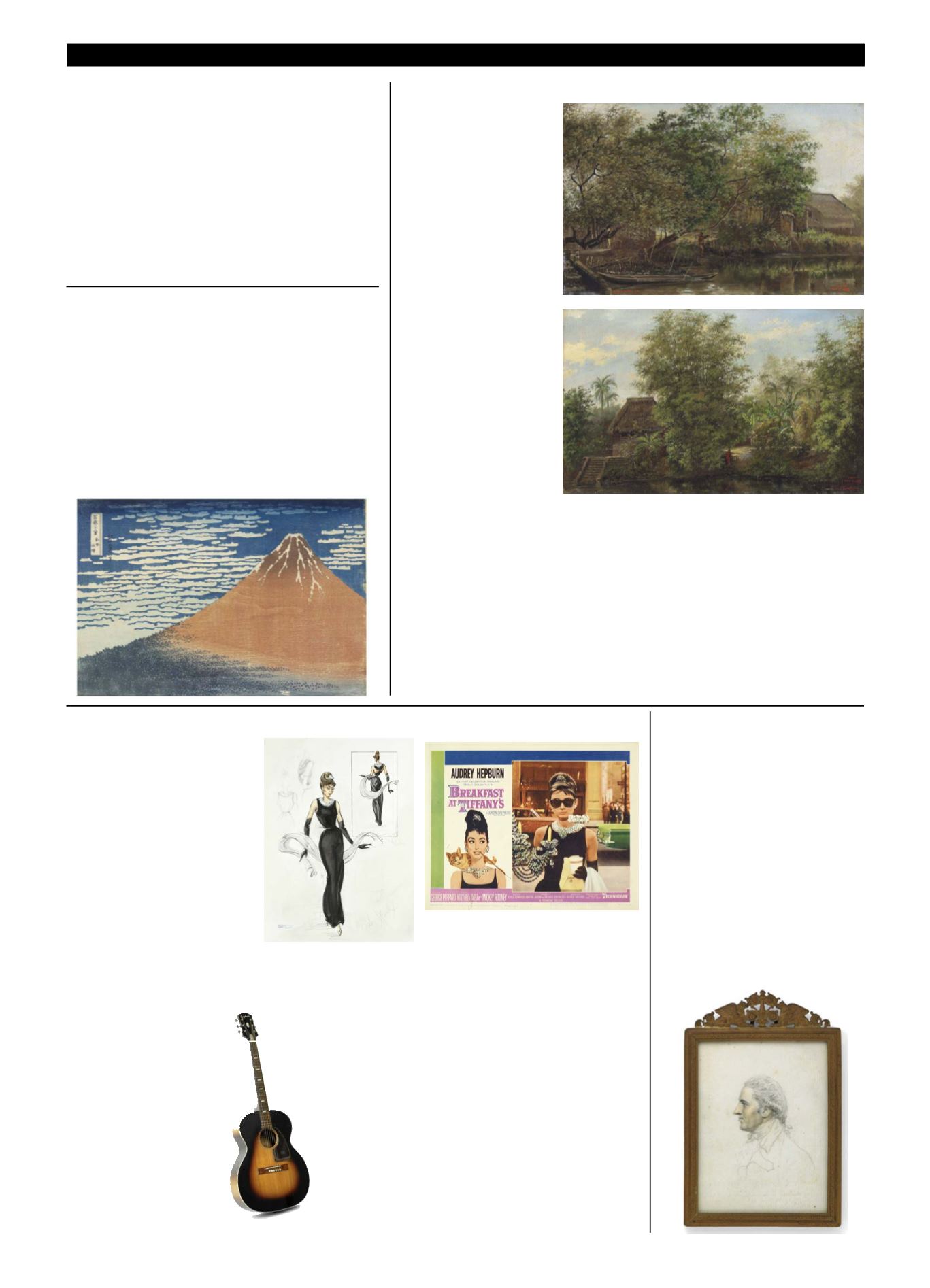
Hokusai’s
Red Fuji
Rises to $134,300
A
lso known in English as
Fine Wind, Clear Weather
, or indeed as
South Wind at Clear Dawn
, and other names besides, this beau-
tiful woodblock print on paper is one of the magnificent series by the
painter and print-maker Katsushika Hokusai (1760-1849) known as
“Thirty-Six Views of Mount Fuji.” The most famous, or familiar, of
these prints is probably
The Great Wave off Kanagawa
, but this one is
certainly a close rival for the title of Hokusai’s masterwork.
Published by Nishimuraya Yohachi and dating 1830-31, when the
artist was already in his 70s but still at the height of his powers, it
measures roughly 10" x 14¾". It captures those moments in early
autumn when, with the wind southerly and the sky clear, the rising
sun can turn Mount Fuji red.
It was sold for $134,300 in an “Art of Japan” sale held by Christie’s
on December 8, 2016.
6-D
Manila River Views Bring Record Bids of $1.3 Million
“Tiffany Rues the Nightmare Next Door”
The two early oils by the Philippines-born artist Félix Hidalgo sold
for $592,670 (below) and $712,955 (at the top) at Christie’s.
B
orn in Binondo, the old
“Chinatown” district of
Manila, Félix Resurrección
Hidalgo y Padilla (1855-1913)
took the remarkable and rather
daunting educational path of
studying law at the same time
that he enrolled as a student at
the local art school, the Escuela
de Dibujo y Pintura, but it was
painting that proved to be his
true calling.
Taught by Augustin Saéz, an
expatriate Spaniard, Hidalgo
enjoyed some success when he
exhibited his work in Manila
in the years 1876-78 but in the
following year left the Philip-
pines for Spain, returning to his
native Manila only once in his
later life.
In Spain he won a silver
medal in an 1884 Madrid
“Exhibition of Fine Arts,”
which, together with the gold
medal awarded to Juan Novicio
Luna, a fellow but rather more
politically active Philippine
artist, inspired those involved
in the Philippine Reform and
Propaganda Movement.
For the rest of his career,
however, Hidalgo focussed
on genre and history painting,
moving from Madrid to Rome
and finally settling in Paris for
the last 20 years of his life.
The two pictures illustrated
here, however, are views of
the country around Manila that
date from his early years. Both
are signed and dated to just
one March week of 1876—as
were two others of similar size,
again inscribed and dated in red
paint (but executed in the pre-
vious month), that were sold by
Sotheby’s in Singapore in 2005
for $195,890.
The two oil on canvas views, offered by Christie’s on December
15, 2016, as part of a sale of topographical pictures, were given
quite modest estimates of $50,000/75,000 apiece but brought
much, much higher sums.
Both were catalogued by the saleroom as views of the
Bank of
the Pasig River, Manila
and each measured 13¾" x 21½", but the
picture seen at the top, showing a small boat moored beneath large
overhanging trees, was sold for $712,955, while that in which
stone steps at lower left lead directly up to a riverbank dwelling
was sold for $592,670.
Though they are unlikely to be visible in the reproductions, a
single figure features at the water’s edge in each of the pictures.
O
ne of a small group of self-portraits
known to have been made by the min-
iature painter John Smart (1741-1811), this
framed pencil and watercolour drawing on
card, about 3½" tall, was among a small group
of miniatures sold by Christie’s as part of its
“The English Collector” sale on November
17, 2016. It made a treble estimate $24,860.
In her 1964 book
John Smart: The Man
and his Miniatures
, Daphne Foskett identi-
fied nine of what might nowadays be termed
Smart’s “selfies”—the majority of which
were finished portraits on ivory.
A black-and-white illustration of what
appears to be this same miniature features
in an online article on Smart’s numerous
self-portraits by Amy Marquis, “Intimate
Objects: British Portraits from Smart to Spen-
cer in The Fitzwilliam Museum,” that can be
found at
(www.fitzmuseum.cam.ac.uk/sites/default/files/Intimateobjects.pdf).
And This Is Another One of Me
T
his was the headline that caught my
eye in the business section of my daily
paper, a copy of
The Times
published just
a few days before the inauguration of
Donald Trump as U.S. president.
Positioned right next door to Trump
Tower on Fifth Avenue, Tiffany’s Man-
hattan store has seen its sales fall by
14% in recent weeks and they blame
“post-election traffic disruptions” for
some of that decline. Police, protesters
and the world’s media swarming around
Trump Tower, they suggest, seem to be
scaring their customers away.
The story went into much more detail
on the ups and downs of the vast global
Tiffany business, but what drew me to
the story was not financial acumen, nor a
picture of the two buildings, but another
that employed part of a film poster
depicting Audrey Hepburn in
Breakfast
at Tiffany’s
.
It was that newspaper image
which drew me back to a sale that
I had not originally selected for
coverage in this “Letter.”
Reproduced above at right is a
lobby card for that hugely popular
1961 film which sold for $2030 as part
of a December 15, 2016, Bonhams sale
of “Entertainment Memorabilia,” but
bid to $32,815 was the watercolour
and pencil costume sketch of
Hepburn as Holly Golightly
by Edith Head, costume super-
visor for the film, that is seen
above.
Watercolour and pencil sketches
by Edith Head of the “little black
dress” designed by Hubert de
Givenchy for Audrey Hepburn to
wear as Holly Golightly in
Break-
fast at Tiffany’s
sold for $32,815.
It features the famous black
gown worn by Hepburn in the
opening scene of the film—the
creation of the film’s principal
costume designer, Hubert de
Givenchy. Head has included
both front and back views
of the dress, along with
a few somewhat cruder
sketches of details.
Something a little
more than the lit-
tle black dress that
is a staple in “most
women’s wardrobes,”
as referred to by the
This acoustic guitar used by Jimi
Hendrix in the years 1967-70 sold
for $261,255 at Bonhams.
This lobby card for the 1961 Paramount
movie sold for $2030.
Knightsbridge cataloguer, this is a fashion
icon.
Top lot in the Bonhams sale was something
very different—an Epiphone FT 79 acoustic
guitar of 1951, bought secondhand for about
$25 in New York in 1967 by Jimi Hendrix
and used by him for around three years.
It had been previously sold by Bonhams
in 2001 for around $87,750 when a collec-
tion of personal items from Hendrix’s years
in London were sold by his girlfriend of the
time, Kathy Etchingham, to raise money for
a charity, Drugscope.
This time it was bid to $261,255. If that
seems to some readers to be rather a lot of
money for a guitar, then I refer them to a
website (http://newatlas.com/most-valuable- guitars-ever-sold/38147/) that lists the 60most valuable guitars ever sold. At that price,
the Hendrix guitar will only just pip an Eric
Clapton 1977 acoustic guitar to take up the
No. 33 slot!