


 141 / 213

Maine Antique Digest, March 2017 9-D
-
FEATURE
-
-
9-D
Bonnet Clutching, Teeing Off and Dressing-Up
T
wo pictures by the Belfast-born painter John Lavery
(1856-1941) were featured in end of season sales in
London.
Sold for $919,305 at Sotheby’s in May 2008 (when
sterling-dollar exchange rates were very, very differ-
ent—roughly $2 to the pound) and sold at $1,166,840 at
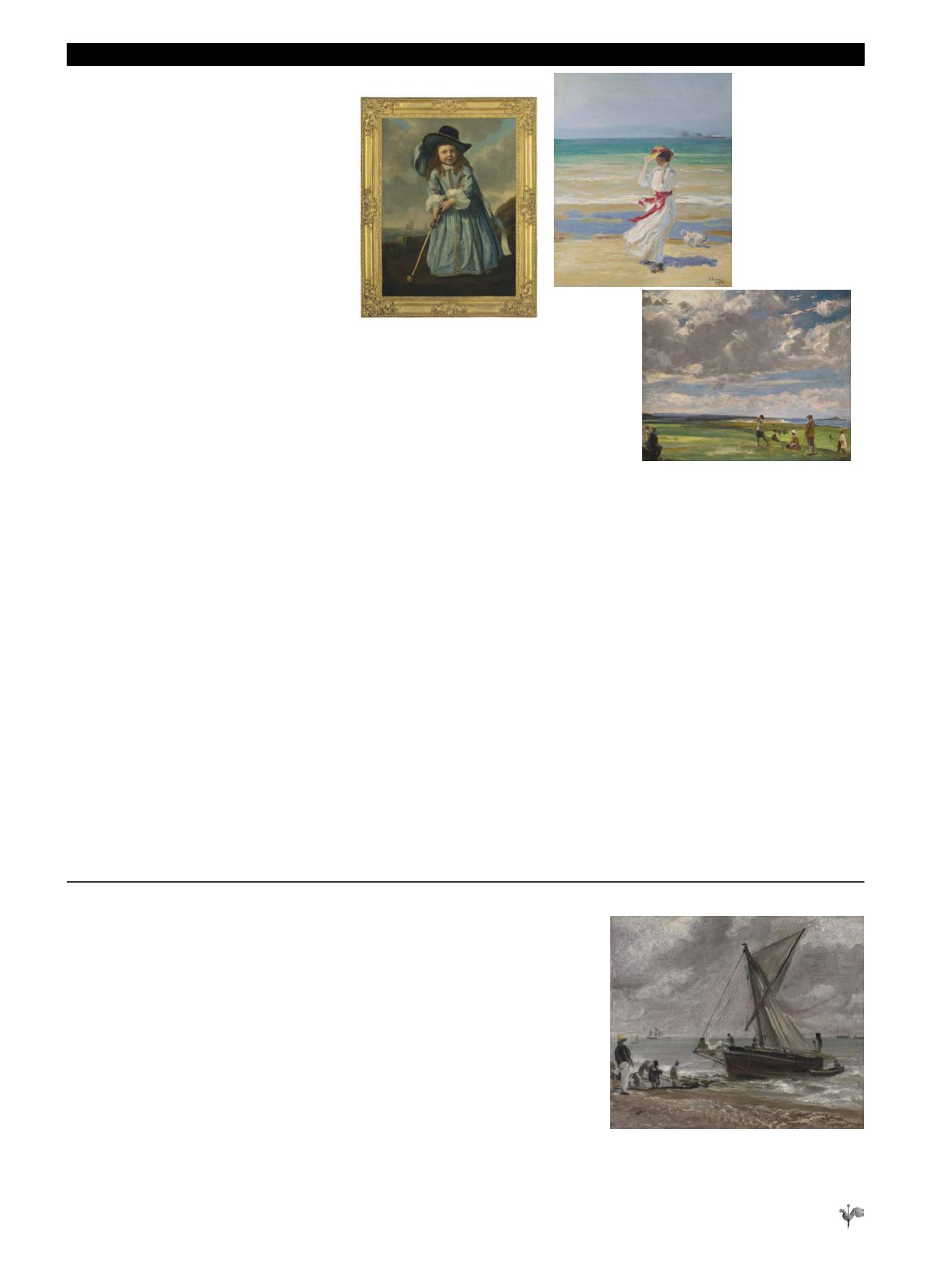
Christie’s on November 23 last year was the oil seen far
right,
A Windy Day
.
Painted around 1908, it shows a woman—possibly the
artist’s own teenage daughter, Eileen, or perhaps his Ger-
man model, Mary Auras—clutching at her straw bonnet
as she and her dog walk along a breezy shoreline near
Tangier in Morocco.
The North African port was one of the artist’s favou-
rite overseas locations and the subject of many such
beach scenes. He had first visited Tangier in 1891—the
year in which his first wife had died of TB, shortly after
Eileen’s birth—and had been immediately captivated by
the “white city.”
In the early years of the following century, Lavery pur-
chased a house on the outskirts of the city and within
walking distance of the sea. There followed annual win-
ter pilgrimages to those warmer climes that were inter-
rupted only when shipping lanes came under attack from
German U-boats during World War I.
However, it is the game of golf, together with its sup-
posed Dutch forerunner,
kolf
, that initially prompted this
piece, and illustrated at right is
The Golf Links, North
Berwick
, painted by Lavery in 1921, which sold at Sothe-
by’s on November 22, 2016, for $1,087,470.
During those war years, Lavery had worked as an offi-
cial war artist and painted very different subjects—naval
dockyards, munitions factories, military hospitals, etc.—
and that was the work for which he was knighted in the
early postwar years.
While painting the British fleet at anchor under the
Forth Bridge, near Edinburgh, the socially well-con-
nected Lavery had stayed at the Edinburgh town house
of his friend and patron Sir Patrick Ford, a wealthy solic-
itor, Edinburgh MP and keen collector of the works of
many Scottish and other artists.
Ford also invited Lavery to stay at Westerdunes, a
house he had built on the outskirts of North Berwick,
25 miles from Edinburgh, overlooking the sea and the
town’s famous old golf course. “Sport, politics and art
were to mingle in this splendid setting, with its tennis
courts, its Japanese garden, and on the fairways that
fringe the shoreline,” to quote the lengthy catalogue
notes on this painting.
The ever-prolific Lavery produced a great many pic-
tures on his stays at Westerdunes, many of them featur-
ing the golf course, and his favourite prospect was the
one seen in the work reproduced here, a view which he
painted at least nine times.
Six of them, sketched from one of the balconies of the
Ford house, are devoted exclusively to the setting, with
the distant beach and the island of Fidra breaking the
horizon. The remaining three, as in this example, take
the viewer down on to the green and amongst the play-
ers, but the other two are set at different times of day and
in varying weather conditions.
The same foursome feature in all three—a former
British Prime Minister, Herbert Asquith, along with Sir
Patrick Ford and his wife, Jesse, and Alice, Lavery’s
16-year-old stepdaughter, who is seen teeing off. Also
present (seated on the bench at lower left, with Asquith)
is Alice’s mother, the woman who was to become Lav-
ery’s most frequent subject for portraiture and who was
once described as “virtually a Lavery trademark.”
Lavery’s beautiful second wife, Hazel, was the Chi-
cago-born daughter of an Anglo-Irish industrialist. They
had met while she was still married to a physician,
Edward Livingston Trudeau, and following Trudeau’s
death the couple were married in 1909.
As I am aware, I have mentioned before in these col-
umns that the most famous, or at least for decades the
most familiar, of all portraits of Hazel, by then Lady Lav-
ery, is one in which she is depicted as the personifica-
tion of Ireland. This was the portrait by her husband that
appeared on Irish banknotes from 1928 until the 1970s.
The first owner of
The Golf Links, North Berwick
was
not on this occasion his regular patron, Ford, but Conrad
Ackner, a very successful dentist whose London practice
boasted several Laverys that could be admired by his dis-
tinguished patients whilst waiting for their dental exam-
inations. Among their number were European royals and
film stars such as Charlie Chaplin and Marlene Dietrich.
The picture was making its fourth auction appearance
since 1986 at Christie’s, at which time it was incorrectly
known as
Lady Astor Playing Golf at North Berwick
—
Nancy Astor having been mistakenly recorded as the fig-
ure teeing off—and it returned to King Street in 1999 to
sell for $514,635.
However, in a 2002 return to Christie’s it sold for just
$199,005, and though different exchange rates had some
bearing on that result, that was still a very long fall from
grace and financial favour.
Part of “ASurreal Legacy,” a Christie’s sale of Decem-
ber 15 that offered an eclectic selection of pictures, fur-
nishings and assorted works of art entered for sale by
the Edward James Foundation* was the portrait by Bar-
tholomeus van der Helst seen directly above.
It shows a young boy holding in his hand a tas-
selled
kolf
stick, or
kliek
—the game of
kolf
being a
stick and ball game that became popular in the Low
Countries from the 14th century onwards and may have
some links with the development of golf in Scotland.
Sometimes played on frozen canals or rivers,
kolf
fea-
tures in numerous Dutch paintings.
Despite the blue gown and large plumed hat, this oil
on canvas of 1658-59 really does depict a boy. Rules or
fashions for children’s dress in 17th-century Holland, I
am told, dictated that boys under the age of six wore such
gowns.
Van der Helst (1613-1670) had by the time this picture
was painted established himself as Amsterdam’s leading
portrait painter, ousting his contemporary, Rembrandt, as
the artist of choice amongst the city’s landed gentry and
merchant elite. His popularity, said Christie’s, stemmed
from “the prevailing taste for elegance and refinement of
technique.”
Neither that esteem nor today’s market valuations rank
him above Rembrandt, but this portrait of a young
kolf
player, measuring 45" x 34" including a 3¼" strip that
was added at some later date to the bottom edge, did sell
at a high-estimate $201,735.
Among van der Helst’s more celebrated works in gal-
leries around the world is a 1655 self-portrait that hangs
in the Toledo Museum of Art (Ohio).
*
Two truly surreal lots from the collections of Edward
James (1907-1984), a wealthy poet and patron of the
surrealists—an example of Salvador Dali’s well-known
lobster telephone and a sofa in the form of full red lips—
will feature in one of next month’s pieces.
AWindy Day
by John
Lavery was sold for
$1.166 million by
Christie’s.
Making its fourth auction appearance in 30 years,
Lavery’s
The Golf Links, North Berwick
was sold
at $1.087 million by Sotheby’s.
This portrait of a young boy playing
kolf
by Bartholomeus van der Helst was sold
for $201,735 by Christie’s.
Mr. Constable Spends Time at the Seaside
A
n oil on paper sketch laid down on canvas and mea-
suring just 10¼" x 12", a work sold for $840,560
by Christie’s on December 8, 2016, was one used in the
preparation of what in time became one of John Consta-
ble’s celebrated “Six-Footers.”
These were a series of 11 monumental canvases (the
last of them never finished) that he produced in the years
1819-37, paintings that secured his professional reputa-
tion and standing as one of England’s most admired and
acclaimed artists.
They can be divided into two distinct groups, the earlier
of which focussed on the Stour Valley and included
The
White Horse
, now in The Frick Collection in New York
City, and
The Hay Wain
in London’s National Gallery.
The second, slightly later and more wide-ranging
group of pictures were those that took him outside his
native county of Suffolk. Among the latter, the best
known is
Salisbury Cathedral from the Meadows
of
1831, now part of the Tate Britain collection in London.
The earliest of that second group, another picture now
at Tate Britain, is
Chain Pier, Brighton
of 1827. This was
the only picture on a monumental scale that Constable
produced of any marine subject and the work for which
Beaching a Boat, Brighton
,
the Christie’s picture fea-
tured here, was a preparatory sketch
.
Once a small fishing port, Brighton, or Brighthelm-
stone as it was formerly known, was at that time being
developed into a fashionable seaside resort, partly as
a consequence of its fashionable association with the
Prince Regent, by then George IV, who had remodelled
the Royal Pavilion in an extravagant Orientalist style.
Constable had moved his wife, Maria, and their four
children into lodgings in Brighton in May 1824 so that
she might benefit from the sea air, and the family returned
there at regular intervals until her death four years later.
But the artist had not immediately warmed to the place.
In a letter to his friend and mentor John Fisher, Bishop
of Salisbury, he described it as “Piccadilly … by the
sea-side,” a reference to the famous London landmark
Piccadilly Circus.
Not seen in this sketch, the Royal Suspension Chain
Pier itself had been built as a landing dock for steam
packets arriving from the French port of Dieppe and had
opened in 1823. In fact, the boat in this oil sketch does
not feature in the finished painting either, but a half-scale
oil sketch now in the Philadelphia Museum of Art shows
that though Constable had once thought to include it in
the right foreground, he ultimately abandoned it in the
final painting.
Constable did, however, keep the figure with the yel-
low hat in the left of this sketch, but moved him along
the beach.
The sketch has been requested for the exhibition
Constable and Brighton
that is to be held at the
Brighton Museum and Art Gallery fromApril to
October this year.
Constable’s
Beaching a Boat, Brighton
, an oil sketch for
the full-scale oil now hanging at Tate Britain, sold for
$840,560 at Christie’s.