


 139 / 213

Maine Antique Digest, March 2017 7-D
-
FEATURE
-
-
Roman Charity: A Difficult Subject Richly Rewarded
7-D
English and Italian Interpretations of Opulence
“Opulence” was the title given to a
November 29, 2016, Christie’s sale that
presented silver, gold boxes, 19th-cen-
tury furniture and assorted works of art—
among them the two items featured here.
The silver-gilt, gem-set and enam-
el-mounted pottery flask or water bottle
in the Victorian Gothic Revival man-
ner seen just below was designed and
indeed signed and dated 1868 by Wil-
liam Burges. It would appear from the
manner of that signature inscription,
executed in gilt on a blue enamel
ground at the foot, to be something
that he produced for his own plea-
sure and not as a commission.
Had it been so, it would most
likely have been inscribed with
the name of the patron and the
date.
The 6¼" high, brown crack-
le-glazed body is held within a
silver-gilt wire support that is
set with opal cabochons, each
of the vertical wires terminat-
ing in a cast root motif. The
rim is set with further opals and
with a border depicting leop-
ards within the initials “W”
and “B” on a blue and green enamel
ground. Above a band of applied foli-
age, the hinged cover is topped by a
pearl-set spider finial.
Burges had trained as an architect
and was a member of the Pre-Rapha-
elite circle, but his varied interests
and talents, added to an affluence not
enjoyed by some of his fellow artists,
allowed him to experiment within
the decorative arts and to work in
a wide range of styles.
Burges’ own home, Tower
House in London’s Holland Park, is
described in J. Mordaunt Crook’s
1981 book
William Burges and
the High Victorian Dream
as
“an extraordinary distillation of
his own artistic career…more
exotic than Pugin’s home at
Ramsgate; more personal even
than Soane’s strange house in
Lincoln’s Inn Fields….” It is
also described as a house in
which “…The interior became the labour
of half a lifetime compressed into six fre-
netic years.”
The Burges flask sold for a treble esti-
mate $136,290, but bid to a high estimate
$422,500 was the Saxon gold-mounted
bonbonnière
set with a micromosaic
plaque that is illustrated above.
The box itself is the work of
Johann-Christian Neuber of Dresden, a
goldsmith and, from 1775,
Hofjuwelier
to
the court of Friedrich Augustus III. The
box was made around 1785 and the more
or less contemporary micromosaic cen-
terpiece is attributed to a Roman crafts-
man, Giacomo Raffaelli.
The gold-lined box, or
bon-
bonnière
, just over 3" diame-
ter, is inlaid with 85 numbered
hardstone specimens, among
them a variety of dendritic
and banded agates, carnelian,
chalcedony, jasper, amethyst,
and quartz of different types.
Neuber exploited Saxony’s rich
resources of minerals and hard-
stones from the mines of Bohemia
and Silesia for such boxes, setting the
stones in a mosaic pattern between strips
of gold
.
Raffaelli, a very skilled micromosa-
icist, created complex compositions using
tiny
tesserae
made from spun enamel of
exceptional finesse, a technical innova-
tion made possible through the work of
the chemist Alessio Mattioli. Patronised
by Pope Pius XV, Raffaelli, who was both
craftsman and dealer, worked in the Vat-
ican workshops and from his own studio
in the Piazza di Spagna.
Rafaelli’s work often depicted butter-
flies, symbolising a belief that the soul
leaves the body through the mouth at the
time of death and in so doing represented
rebirth.
Bringing together the
creative talents of a
Dresden goldsmith,
Johann-Christian
Neuber, and a Roman
micromosaicist, Gia-
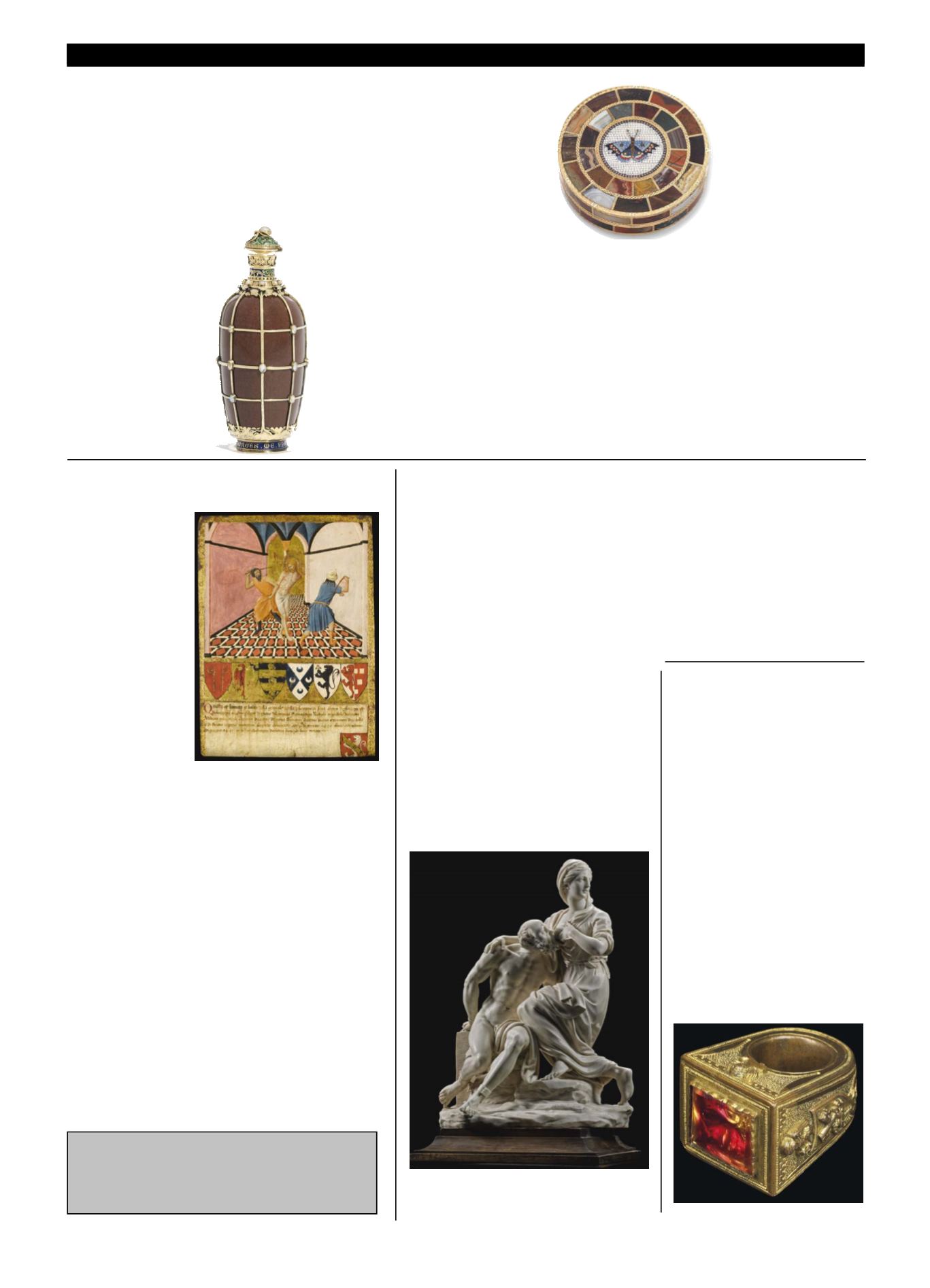
como Raffaelli, this 3"
diameter
bonbonnière
dating from the late
18th century was sold
for $422,500 at Christie’s.
Designed by William Burges,
this 6¼" high, silver-gilt, gem-
set and enamel-mounted pottery
flask or water bottle, dated 1868,
made $136,290.
Worn on the Papal Ring
Roads?
D
ecorated with a papal tiara, cross-
keys and four symbols of the Evan-
gelists, this gilt bronze and rock crystal
papal ring, dating from the 15th century,
made a notably higher than expected
$20,525 at Christie’s on December 7,
2016. It was one of the smaller lots in a
sale called “From Ancient to Modern,”
one that mostly comprised old master and
modern pictures and sculpture.
Also decorated with the arms of popes
or cardinals, papal rings of this age were
usually made of gilt bronze or copper
and set with glass or crystal bezels, as
here. They are also distinguished by their
great size—this one is 2¼" high—but
their exact function, say the auctioneers,
remains a mystery.
It is possible that they were given as
credentials to envoys from popes or cardi-
nals to other rulers or dignitaries and used
as signs of authentication by the wearers
during their journeys.
This one is inscribed on the underside
“
N.COLAVS.P.O.”
Laurent Delvaux’s
Caritas Romana
(
Roman Charity
)
sold for a far, far higher than expected $1.355 million
at Sotheby’s.
L
aurent Delvaux’s
Caritas Romana
(
Roman Char-
ity
), a 30" high marble sculpture executed in the
southern Netherlands towards the very end of Del-
vaux’s life, circa 1776, that Sotheby’s had for sale on
December 6, 2016, had not been seen in public since
1868, when it was sold at auction in Brussels. As
such, it was viewed by Sotheby’s as “an exciting and
important development in the understanding of Del-
vaux, who was one of the most celebrated 18th-cen-
tury Flemish sculptors.”
The subject, “Roman Charity,” is inspired by the
story of Cimon, anAthenian and military commander
of the 5th century B.C. who, prosecuted for allegedly
accepting bribes from Alexander I of Macedonia,
was incarcerated and left to starve prior to execution,
but legend has it that he was sustained through his
ordeal by his faithful daughter, Pero, who visited her
father in prison and secretly breast-fed him.
The episode is recorded in Valerius Maximus’
Memorable Acts and Sayings of the Ancient Romans
,
and Pero was held up in antiquity as an exemplar of
Roman honour and filial piety.
In composition it is broadly derived from a Rubens
painting,
Caritas Romana
, as was another version of
the subject produced by Artus Quellinus (1609-1668)
for a water pump in the courtyard of the Amsterdam
Town Hall.
Delvaux’s marble, said Sotheby’s, follows a
baroque prototype but is imbued with the princi-
ples of the burgeoning neoclassical move-
ment. “The innate sense of pathos in Rubens’
painting, together with the almost grotesque
nature of the subject, has given way to an ele-
gant solemnity with the emphasis on Pero’s
virtuousness.”
Some readers may be reminded of a closing
scene in Steinbeck’s
The Grapes of Wrath
, in
which Rose of Sharon Joad breast-feeds a
sick and starving man.
Valued at around $65,000/90,000,
Cari-
tas Romana
went on to sell for a remarkable
$1,355,320!
Accounts Book Adds
Up to a $1.75 Million Bid
O
ld master paintings
from end of year
sales and, in stark con-
trast, a couple of Salvador
Dali’s surreal creations,
together with yet another
helping of expensive
English watches, will all
have to wait for my next
“Letter,” but this is prob-
ably the right place to
include another “Flagel-
lation” artwork.
This time we are look-
ing at a small painted
panel, inscribed and
dated 1441, that was orig-
inally created as a cover
for official documents or
registers in the city-state
of Siena—a widespread
practice which continued
in use from the mid-13th
century until the end of
the 17th century.
Emblazoned on such covers were the coats of arms of those offi-
cials responsible for presenting the accounts. The period that these
men spent in office was short—six months—in order to safeguard
against corruption and malpractice, and at the end of each such term,
their working accounts were transferred to parchment registers for
inspection by the Consiglio Generale of Siena.
Most are still held in the Archivio di Stato in Siena, with only a
small proportion of the many covers made over the centuries found
in private collections or museums, so this fine example is a great
rarity.
As well as
the possibilities that such things offer in identifying,
through the coats of arms and the dates, the identities of prominent
members of Siennese society, they can also yield invaluable infor-
mation on the social framework of the Italian city-state. On this
“Flagellation” cover, the seven coats of arms of elected represen-
tatives correspond in order with the names cited in the inscription.
These covers have also been said to present a review of Siennese
painting in the 14th, 15th and 16th centuries.
Executed in tempera and gold on a poplar wood panel measuring
17¾" x 12", this example is the work of an artist formerly known as
the Master of the Osservanza, but now recognised as Sano di Pietro
(1405-1481), “…whose prolific and lengthy career,” say Sotheby’s,
“was at its most brilliantly imaginative in the 1440s.”
On December 7, 2016, this cover sold for a rather higher than
expected $1,754,440 in their Bond Street salerooms.
The 15th-century Siennese painted
accounts book cover was sold by
Sotheby’s for $1.75 million.
MaineAntiqueDigest.com