


 140 / 213

8-D Maine Antique Digest, March 2017
-
FEATURE
-
-
8-D
Try Googling Shiver-Doodle and the Flabbytoes
An Hermaphrodite with “Appealing, Almost
Archaeological Patination”
“Beauty Bound and Power Unleashed”: The Genius of Jacobus
Agnesius
A
n irresistible and amusing reminder that “Goo-
gle” has a rather more ancient origin than many
people might think was provided by a December 15,
2016, book sale held by Dominic Winter.
That Gloucestershire sale contained a small archive
of material relating to the work of Vincent Cartwright
Vickers (1879-1939), a man whose family name
is much more familiar, in Britain at least, from the
armaments, aviation and engineering worlds.
A man who held some serious civic appoint-
ments—Deputy Lieutenant of the City of London, for
example—and an economist who was for ten years
a director of the Bank of England, V.C. Vickers was
also a man of considerable artistic talents, despite the
lack of any formal training.
He also had a keen, somewhat bizarre sense of
humour and was particularly fond of drawing birds.
He even painted one on the back of his smart saloon
car, a Humber Snipe!
Pick of the items sent for auction by his great-grand-
son was Vickers’ own example of the 100 limited edi-
tion copies of his
The Google Book
, published at his
own expense in 1913—during his Bank of England
days. In a specially made contemporary binding of
citron crushed morocco by Bumpus, it showed some
worming to the margins of some early pages, but nev-
ertheless sold for a record $4480.
In Vickers’ Google world, the monster that bears
that name sleeps in a pool in a beautiful garden by
day and preys on the various fantastical birds of Goo-
gle Land by night.
Colourful illustrations accompany Vickers’ witty
verses about the birds, among them the Great Skull-
Headed Ston Trot, the Gogo (or Camel Bird), the Lit-
tle Gadwot, the Shiver-Doodle, the Flabbytoes, and
the Soft Nosed Wollop.
Sold for $775 was a second, trade edition of the
book that was issued by the Medici Society in 1931.
It was inscribed by its creator as follows:
“Warning! Curse not the writer of this drivvel [
sic
]
Verse / Nor blame your Mother, or your Nurse / Who
bids you turn the pages of this Book! / My Child! / For
if, my dear, you somewhat fear / what will appear is
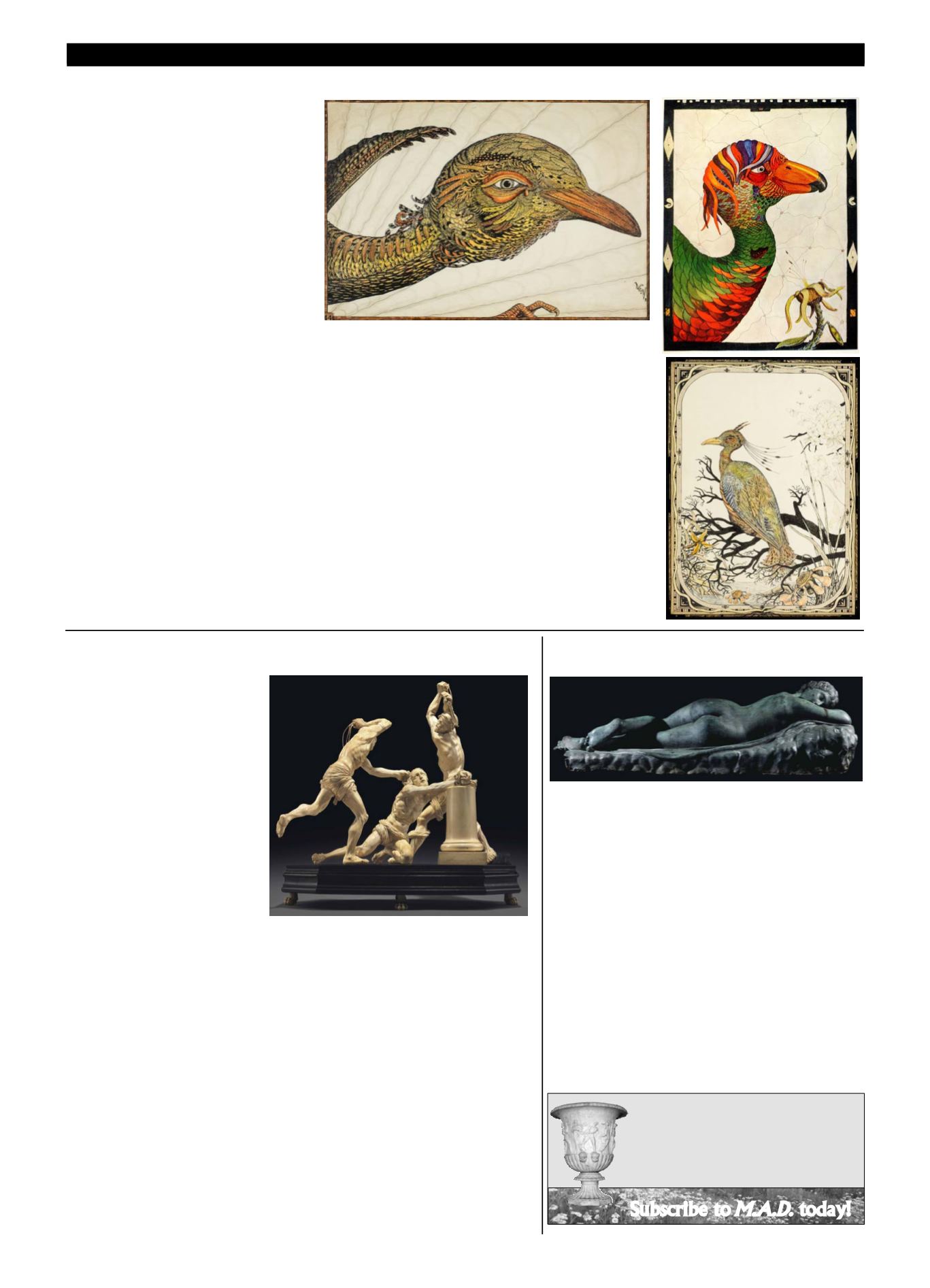
The most successful of the three original artworks by V.C. Vickers
offered by Dominic Winter was the colourful study of a bird’s head seen
above, which sold for $2465. The other, a framed avian head seen at
right, is one of the plates from the 1931 trade edition of the book.
This ink and water-
colour drawing made
for
The Google Boo
k
bears an additional
note in the artist’s hand
stating that it had been
exhibited at the Royal
Academy in London in
1926. It sold for $1645.
rather queer, or else austere - / Don’t Look! My
Child!”
A number of related original watercolours of
Vickers’ mythical creations also brought good
prices and a couple of them are reproduced
here, along with one of the colour plates from
that 1931 Medici edition.
The Google Book
was last published in 1979
by the Oxford University Press.
*
The term “googly,” which seems to have
entered the language around the same time that
The Google Book
appeared, will be familiar to
cricket lovers. It describes an off-break bowled
with a leg-break action, or for non-cricketers,
a ball bowled as if to break (slightly change
direction) one way on hitting the ground, that
actually breaks in the opposite way to confuse
and surprise the batsman. Simple, isn’t it?
At Christie’s on December 6 last year, this near-life-size bronze figure
of a reclining hermaphrodite sold for $995,380.
S
old for $995,380 at Christie’s
on December 6, 2016, was a
near-life-size bronze figure of a
reclining hermaphrodite, the fig-
ure cast from an antique marble
(restored by the sculptor Ippolito
Buzzi between 1620 and 1623)
that today reposes in the Uffizi
Gallery in Florence.
That one is known as the
“Ludovisi Hermaphrodite” after
the owner of celebrated collec-
tion of antiquities formed in
Rome by Cardinal Ludovico
Ludovisi (1595-1632). An even
more famous marble hermaphro-
dite, presumed to derive from the
same, long-lost bronze original
of antiquity, is to be found in the
Louvre Museum in Paris.
Displayed for a number of
years in a private museum in Bad
Ems, Germany, this 17th-century
bronze version was later moved
into the garden and over the
years that exposure resulted in
what the auctioneers called “an
appealing, almost archaeological
patination.”
Hermaphroditus was the
mythological figure whose name
was derived from those of his
parents, Hermes and Aphrodite.
Originally male, he was bathing
in a lake when Salmacis, one of
Diana’s nymphs or naiads, saw
him and fell immediately in love
with him. She is said to have
embraced him so passionately
that their bodies were merged
and he was henceforth half male
and half female.
The “Flagellation of Christ” group by Jacobus Agnesius
was sold for $1.223 million by Christie’s.
C
atalogued as “undoubtedly one of the
largest and most remarkable ivory
groups to have come to the market,” the
“Flagellation of Christ” group seen here,
which is just short of 2' high, was sold for
$1,223,620 at Christie’s on December 6,
2016.
A sculpture that has been in the hands
of the Bravo de Savaria family of San-
tiago, Chile almost from the moment
it was made, it is a work that had until
very recently been hidden from the eyes
of scholars. Its emergence onto the mar-
ket, said Christie’s, “…facilitated a new
understanding of the extraordinary capa-
bilities of a sculptor, long obscured from
view, whom few could rival in Europe.”
Jacobus Agnesius, who had for so long
remained completely anonymous, has
now, thanks in large part to the work of
Dr. Elke Schmidt, author of
Beauty Bound
and Power Unleashed: Jacobus Agnesius
and the Quest for Expression in Baroque
Ivory Sculpture
(2011), been properly
recognised.
Schmidt identified eight ivory figures
or groups, five of them depicting Saint
Sebastian, that show the distinctive work-
manship of Agnesius and since then, say
Christie’s, at least three more groups have
come to light—among them this powerful
“Flagellation” group.
Active in the second quarter of the 17th
century, Agnesius, is now thought to have
hailed from the Corsican town of Calvi,
and though it is speculated that he may
have been influenced in his work by a
stay in Rome at some point in his career,
he developed a style that is very much his
own.
It is characterised, said the Christie’s
cataloguer, by “…figures formed in twist-
ing, highly strained poses, their anatomy
rendered with astonishing precision,
tightly wrapped in drapery, and juxtaposed in scenes of
high drama, offering views in the round from all conceiv-
able angles.”
Schmidt wrote of one Saint Sebastian figure, but in
terms that are equally relevant to the present group:
“There is almost no comparison for such precise rendering
of human anatomy in ivory; and even in bronze statuettes
there are fewworks that show such careful observation and
articulation…Agnesius looks at the human body with an
anatomist’s eye, and exploits the landscape of bones and
muscles in order to achieve a maximum of expression.”
Ivory was a very expensive material in which to work,
something that makes the sheer size of this piece extraor-
dinary and indicates that there could have been no finan-
cial constraints imposed by whoever gave the artist the
commission.
In the Bravo de Savaria family archives is a letter of
1654 from Padre Pedro de Salina, an administrator of
the family’s castle in Almenar de Soria in Spain, which
mentions the “Sala del Santo Cristo de la Flagelación.”
It is possible that he is referring to the castle’s chapel or
oratory and that it was named after this spectacular ivory.
Go to
www.MaineAntiqueDigest.comand click on Subscribe, or call 1-800-752-8521.
Spring into fresh antiques discoveries
with a subscription to
M.A.D.
Subscribe to
M.A.D.
today!