


 58 / 213

30-A Maine Antique Digest, March 2017
-
AUCTION -
30-A
Christie’s, New York City
Portrait by Ammi Phillips
Leads Americana Auction
by Clayton Pennington
Photos courtesy Christie’s
W
hen people walked into Christie’s salesroom
on the morning of January 20, Barack Obama
was still president. By the time they walked out
hours later, Donald Trump had taken the oath of office.
Divided America outside. Divided Americana inside.
The headliners did just fine, but middle-level antiques
sometimes struggled with a thin level of support. The
long Friday sale brought in $5,037,025 (includes buyers’
premiums)—$1,242,750 for a selection of Outsider art
put together by specialist Cara Zimmerman that was
78% sold by lot, and $3,794,275 for various owners’
Americana, 80% sold by lot.
“I think the numbers speak for themselves,” said John
Hays, deputy chairman at Christie’s. “There were definite
high notes, and a few pieces performed very well. There
was a lot of material that sold where the estimates were.
We know where the market is now.
“When we sell things in the eightieth percentile overall,
it tells me that we were spot-on…. Our assessment is that
the market is resilient. It has found a new level, and it
should give confidence to people to consign.
“When something did well, it’s usually because it was
rare or had a great surface. The bottom half of the market
is still tough sledding, but when was it otherwise?”
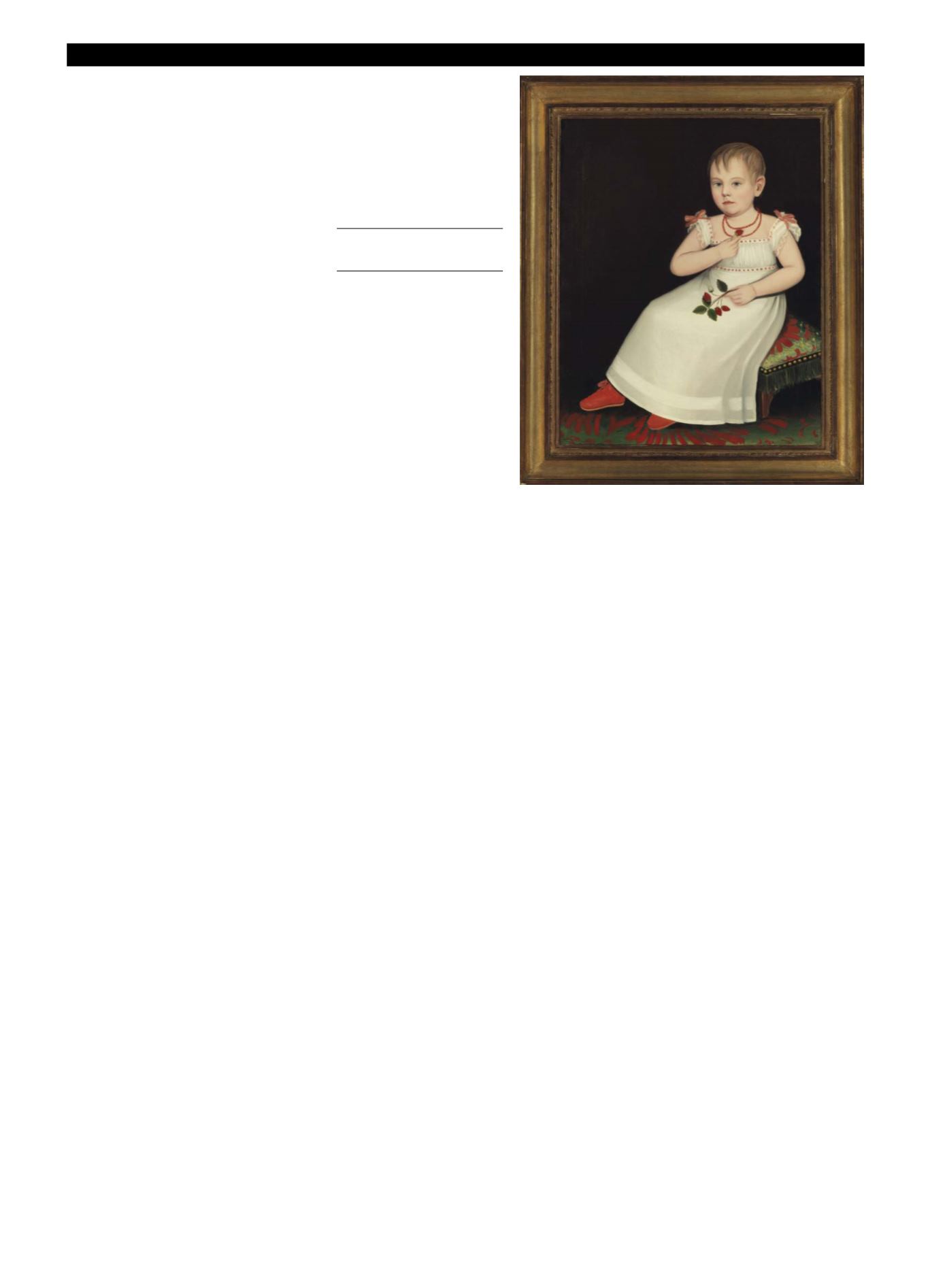
The Americana was led by a circa 1829 oil on
canvas portrait by Ammi Phillips (1788-1865) of Mary
Margaret Deuel, daughter of Catharine and Samuel
Deuel of Dutchess County, New York. Estimated at
$100,000/150,000, it sold for $391,500 to NewYork City
dealer Leigh Keno, sitting with clients. That’s the fifth-
highest price ever paid for a portrait by Ammi Phillips.
The painting descended in the Deuel family until it
was sold on October 29, 1982, for $99,000 at Robert W.
Skinner, Inc., Bolton, Massachusetts. Sotheby’s offered
it on September 30, 2010, with a much higher estimate
($500,000/700,000), but it failed to sell. Phillips’s
portrait of Mary’s father, Samuel, sold at Neal Auction
Company for $1195 in March 2010. It too had been once
bought in; Neal had tried it with a $5000/7000 estimate
in November 2009, but it had failed to sell.
Before buying the Ammi Phillips painting, Keno paid
$150,000 for a 30" x 23" oil on canvas portrait of a boy
holding an apple, attributed to John Brewster Jr. (1766–
1854), ex-Hirschl & Adler Folk.
“The bright light folk art did astonishing,” said Hays.
“The folk art goes to the real underlying theme, and that
is, paint really sold—paintings, paint on canvases, paints
on surfaces.”
A pair of 1740-55 chairs attributed to William Savery
were sold back-to-back and in a rare departure for a
New York City salesroom were sold as “choice” or
“parcel.” (Christie’s gave the winner of the first chair
the option to buy the second chair at the same price
with no competition.) The first chair brought $118,750
from a Philadelphia collector sitting with Philip Bradley
of Philip H. Bradley Co., underbid by Skip Chalfant of
H.L. Chalfant. When given the opportunity, the collector
declined to buy the second chair at the same price. “We
will bid,” he said. That decision proved costly to him; the
next chair brought an extra $6250 when it went to him
for $125,000, underbid by the trade.
“We have done this [selling lots parcel] several times
before. It empowers the buyer of the first chair, and
it added a little bit of fun to the selling,” said Hays. It
also allowed a museum to buy only one chair if it was
interested, even though chairs at this level are usually
sold in pairs. “It’s nice to show the market that we care
about keeping things together, but it also allows the
consignor to realize the most money possible. If a dealer
bought the pair and then sold each to a different museum,
the consignor doesn’t benefit. It allowed the consignor to
have the best of both worlds,” said Hays.
A selection of Colonial silver from the Wunsch
collection had mixed results. Ten lots were offered, and
three were passed. The lots were led by a coffeepot by
John Blowers of Boston, circa 1735, at $32,500 and by
a silver teapot marked by Samuel Casey of Exeter and
South Kingston, Rhode Island, at $25,000. A rare pair of
candlesticks by Simeon Soumaine, 1730-50, estimated at
$100,000/200,000, failed to sell, as did a pair of circa 1770
silver sauceboats marked by Stephen Emery of Boston,
estimated at $40,000/60,000, and
a pair of silver braziers marked by
John Burt of Boston, 1724, estimated
at $100,000/200,000.
Four lots of silver from Boston’s
Old South Church were offered.
The grouping was led by a silver
wine cup by John Hull and Robert
Sanderson, circa 1660, 7" high,
marked “Property / of the / Old
South Church.” It sold for $150,000
to a phone bidder. A circa 1715
silver beaker with the mark of John
Coney of Boston, 4¼" high, was
also engraved “Property / of the /
Old South Church.” Estimated at
$20,000/30,000, it sold to an order
bidder for $27,500. A circa 1715 silver beaker,
5¾"
high, by John Coney went to Paige Trace of Portsmouth,
New Hampshire, for $20,000 (est. $20,000/30,000). A
silver wine cup with the mark of Jeremiah Dummer of
Boston, circa 1705, also engraved “Property / of the /
Old South Church” and 8
⅜
" tall, brought $47,500 (est.
$30,000/50,000) from a phone bidder.
Jeremiah Dummer (1645-1718) was America’s
first native-born silversmith. In 1659 he began his
apprenticeship with émigré John Hull. Dummer himself
trained John Coney, with whom he maintained a lifelong
friendship, according to the catalog.
A pair of standing cups of the same form, but with the
elaborate Stoughton coat of arms as well as the mark of
Dummer, was sold as property of the First Parish Church,
Dorchester, Massachusetts, at Sotheby’s New York City,
January 2012, for $1,082,500.
Seventeen lots that were ex-Mrs. J. Insley Blair
(Natalie Knowlton Blair, 1883-1951) fared a little better;
12 sold. The lots were led by a Philadelphia 1740-60
walnut compass-seat side chair, 42½" high, estimated
at $20,000/30,000, that sold to a phone bidder for
$50,000, underbid by dealer James Kilvington of Dover,
Delaware.
Kilvington bought the next-highest ex-Blair lot, a
93½" x 35½" x 19¼" Philadelphia Chippendale carved
and figured walnut corner cabinet dating from the last
quarter of the 18th century. He paid $37,500.
“The Outsider art was heroic,” said Hays, referring to
the $1.2 million total. Outsider art featured in a separate
catalog. William Edmondson’s limestone and mortar
Lion
, circa 1937, topped at $511,500 to collector Jerry
Lauren, bidding in the room.
Lion
descended in the
family of Alfred and Elizabeth Starr, who were early
collectors and supporters of Edmondson, an ex-janitor
turned folk sculptor. The price paid was the second-
highest ever paid for an Edmondson sculpture.
Christie’s elevated prices for Outsider art to a new level
by establishing auction records for four artists during
the sale. William Hawkins’s circa 1985
Puma Kitten
sold to a Memphis, Tennessee, collector—and animated
bidder—for $85,000. (The hammer price of $68,000 is
not a record. Slotin Folk Art Auctions, Buford, Georgia,
hammered down Hawkins’s
Trail Riders
for $70,000 on
April 21, 2012. Slotin charges a 20% buyer’s premium,
resulting in an $84,000 final price.)
A stele by Raymond Coins (1904-1998), com-
memorating the founding of a church, brought a record
$68,750.
Precious Lord, 1970-1975
by Sister Gertrude
Morgan (1900-1980), a 13" x 40" acrylic paint and ink
on paper, topped out at $68,750 and beat the previous
record of $44,400 paid for
Great Now Jerusalem
at
Slotin Folk Art Auctions in May 2010.
The White House
,
appropriately sold on inauguration day, was a 24
⅛
" x
48¼" mud, paint, and graphite on board by Jimmy Lee
Sudduth (1910-2007). Estimated at $1500/3000, it sold
for $12,500, beating his previous auction record of
$4920 for
Brown Home
, which was sold by Slotin in
November 2013.
An ebony- and whalebone-inlaid mahogany watch
hutch, estimated at $30,000/50,000, was withdrawn
before the sale began. Andrew Holter, who heads the
department, was close to procuring the CITES permit,
but the proper paperwork didn’t arrive in time. It may
appear at Christie’s in the future.
An Aesthetic Movement piano with movement
by Steinway & Sons and elaborate case by George
A. Schastey & Co. of New York City, estimated at
$300,000/500,000, failed to sell, although Hays said that
there has been after-sale interest and there may be a sale
in the future.
There were affordable objects. When a maple and
brass engraved bed warmer, estimated at $300/500,
brought a lowly $125, John Hays quipped from the
podium, “and that’s the price of a bed warmer in 2017.”
A Chippendale carved walnut dressing table, ex-Kindig,
estimated at $10,000/20,000, sold for only $8750. A
Salem, Massachusetts, mahogany marble-top pier table,
the marble top replaced, estimated at $10,000/20,000,
brought a hammer price of half the low estimate, $5000
($6250 with premium). AFederal carved mahogany sofa,
New York, 1800-20, estimated at $8000/12,000, brought
$3750. A set of three walnut side chairs from Salem,
Massachusetts, with an almost identical fourth chair,
circa 1740, estimated at $4000/6000, sold for $2750—
that’s $687.50 a chair.
Christie’s didn’t have many masterpieces up for sale.
“Was there some resistance to putting masterpieces up?
Yes. That’s across the board in the art world. It’s a seller-
driven market, not a buyer-driven market,” said Hays.
“I’m proud of everybody for the hard work, presentation,
and being courageous in trying a few things. Some things
worked. Some didn’t.”
Hays said the market needed to digest the big run-up
from 2006-08. “It needed to settle a little bit but now has
kicked upwards a little,” he said. “Trees don’t grow to
the sky.”
For more information, contact Christie’s at (212) 636-
2230 or check the website
(www.christies.com).
“Our assessment is that
the market is resilient.”
This 30" x 24" oil on canvas portrait by Ammi Phillips
(1788-1865) of Mary Margaret Deuel, circa 1829,
estimated at $100,000/150,000, sold for $391,500
to Leigh Keno, sitting with clients. The painting
descended from the sitter in the Deuel family until it
was sold on October 29, 1982, for $99,000 at Robert W.
Skinner, Inc., Bolton, Massachusetts. Mary Margaret
Deuel was the daughter of Catharine and Samuel
Deuel of Dutchess County, New York.