


 53 / 213

Maine Antique Digest, March 2017 25-A
-
FEATURE -
25-A
lingered out west for a bit (“I kicked around Berkeley. I was
beading and sewing clothes.”) and then went back to New
York.
There she took up stained glass, which brought her a degree
of professional success. “I had taken a little class in the
mechanics of stained glass, and I got a job as an apprentice
in a stained-glass studio, Greenland Studio. They were doing
restoration of windows at the Cloisters.” The job required her
to climb scaffolds (no easy task for someone who’s afraid of
heights) and do lots of gritty work. “It was sort of a macho
profession,” she said. “I was like a scullery maid, but I learned
how to make windows.” That led her to open her own studio in
the East Village, where she created windows mostly for private
homes.
She wasn’t dealing in antiques yet, but she was buying them.
“Everything I had was old. I was always buying antiques,”
she said. To which Sadler added, “Even when you didn’t have
money you were buying them.”
The couple met in New York, specifically Central Park. The
date is easy to remember, because it was bicentennial eve, July
3, 1976. Bakst said, “We were introduced that night. I had a
friend who was an actor, and we went up to the park. Bill had
been rehearsing.” (“It was
Henry the Fifth, Part One;
Joe Papp
directed,” Sadler interjected.) “We all sat on a wall to watch
the fireworks. Bill had a little bowl haircut, and I remember the
fireworks reflecting off his bowl haircut. That did it for me.”
Marni and Bill both lived in the East Village. They ran
into each other again at a local grocery store, and romance
blossomed. “She was grumbling at her grocery list when I saw
her. She looked up, saw me, and smiled,” Sadler said.
Ultimately, he moved into her apartment. “It was larger,” he
said, “and I was the scullery maid then.”
So the young artist and the young actor decided to marry.
Bakst recalled, “When we got our marriage license, the clerk
asked for our professions. ‘He’s an actor; I’m an artist,’ I
answered. She just said, ‘Good luck.’”
As their life evolved into a back and forth affair between the
two coasts, Bakst found herself particularly enamored of the
huge California flea markets. She said, “I’d scrape up a dollar
or two. At the giant flea market in Alameda there was always
something to buy for fifty cents or a quarter.”
And then, of course, there were those other mammoth
Sunday markets in Santa Monica, Long Beach, and the Rose
Bowl. Bakst said she would occasionally take a booth at one
of the markets. “I would sell once in a while because we just
had too much stuff.”
The couple describes just how strong Bakst’s buying
compulsion could be. Sadler began the story. “We were packing
the truck to come east. I was packing like a crazy man.”
She said that as he packed, “I went to the Santa Monica
flea.”
Sadler continued, “My last words to her were, ‘Don’t buy
anything big.’” She came back with a 12' neon sign that said
“CUISINE.” It barely fit on the truck, but now, these many
years later, it still hangs in their kitchen.
Bakst explained that the major move back east was prompted
by concern for the couple’s daughter, Sadler Colley Bakst. “I
wanted to give my daughter a more realistic way to grow up.
L.A. is a place where you have two good bookstores and four
hundred places to get your nails done.”
The couple continued to acquire stuff when Sadler was
away filming on location. They spent 14 weeks in Mansfield,
Ohio, for instance, during the filming of
The Shawshank
Redemption
. Mansfield, Ohio, is not noted as one of the earth’s
Edenic locales. Sadler said that a magazine once voted it the
second-worst place to live in America. But they have good
memories of buying in the area. “I would look at little local
papers. I’d comb through the classifieds. I spent the summer
going to auctions,” Bakst said.
It was during this period that the couple bought one of their
most important folk art acquisitions—a group of wonderful
bottle-cap figures from a roadside attraction. Bakst saw them
through the window of a Columbus quilt shop that was closed.
She kept returning until she found the shop open and bought
the iconic pieces, which now decorate their living room. “Bill
and I have always loved folk art,” she said.
Sadler fondly recalled those Ohio farm auctions, so different
from the more conventional auction-room sales they attend
today in the Hudson Valley. “The lives of these people were
spread on the lawn,” he said.
In the 1990s the couple moved from Los Angeles to their
current home. “This house, when we bought it, was falling
down,” Bakst said. At that point she began to take a serious
interest in the antiques business. “I’ve always had antiques-
dealer friends,” and she noted that the new house was not
far from Millbrook, which, at the time, was a small, genteel
hotbed of the trade, with at least three antiques centers.
“I rented space in all three at one time or another—often two
at a time,” she said. “I developed quite a nice little business.
I’d buy furniture frames—not necessarily antique—and do
them in interesting fabrics. I found an upholsterer who turned
out masterpieces. I sold sofa after sofa to decorators.”
Then the Internet began poking itself into people’s lives.
Bakst recalled, “I had friends who were talking about this
thing called eBay. I thought, ‘I’ll never do that.’” But
of course she did. It was irresistible, especially as a
way to get rid of things that she didn’t love.
“I’d put things on like Doulton lamps. You’d buy
something for twenty-five dollars and sell it for six
hundred.” But, as many an online seller has discovered,
you can also end up with a garage full of unsold stuff
that you bought only because it seemed like a bargain.
She also was a regular online buyer. “I was scouring
eBay. I have a compulsion to have multiples of things,”
she said. Her compulsion for multiples has resulted
in a host of collections, among them, red baby shoes
(only
red
), wire clothes hangers dating back to the
19th century, and Chinese fortune cookie fortunes—
not the cookies, just the paper fortunes inside them. “I
keep them in a jar, and every once in a while I take out
a bunch and read them,” Bakst said.
Sadler, by the way, collects vintage guitars, which
are scattered throughout the house.
Bakst said that gradually “I began to look around
at other places people were selling. I’d been watching
Ruby Lane. I said, ‘I think I could do that.’ I found
the photography aspect interesting.” She even went
back to school to take courses at Dutchess Community
College and get her photography up to the mark.
She asks herself questions about each piece she
photographs. “How do you approach an object to tell
its story? What’s the next thing I’m going to want to
see in nine pictures or fewer?” For her, the photography
is the fun part, while “text and researching is the
bottleneck.”
She has been particularly pleased with how Ruby
Lane “cleaned up the backgrounds” by developing a
format that silhouettes items on the site. “Everything
looks better,” Bakst said but noted that the site’s efforts
to standardize its look created quite an uproar among
exhibitors. “People left over that.”
According to Bakst, Ruby Lane’s image imposes
something of a limit on what you can expect to sell
on the site. “When I was first on the site I had a sweet
spot of three to four hundred dollars,” she explained.
“In the last few years it’s sort of all over the lot. I like
to sell up near a thousand dollars. That makes it good
for me. I sold a Shabbat set for nine hundred and fifty
last week.”
That price puts her close to the upper limit. She said,
“Over that people are leery. People may be leery of
paying higher prices on Ruby Lane.”
Bakst always maintains photos of some sold items
on her site. I have wondered why dealers so often keep
sold items on their websites, and she explained, “People
like to see sold items. It gives them confidence.”
But just as important is how that practice “keeps the
keywords active.” Those pieces may be sold, but you
want people who are looking for similar items to know
that you carry them, and those keywords help your site
come up higher in online searches carried out, as they
are, by algorithms.
She doesn’t sell much to dealers. “Most of my
customers are buying for themselves, and there are
return customers. I have a guy who buys flags from
me.”
Bakst ranks Ruby Lane’s ironclad return policy
among its most important assets. On the other hand,
she has misgivings about site-wide sales on the
platform. “I’m somewhat skeptical. It tears up the site
for about three weeks. It’s training people into asking
for bigger and bigger discounts.”
In sum, however, Bakst is satisfied with her decade-
long stretch on the site, although she’s not overjoyed
about Ruby Lane’s increased social media efforts.
“I’m supposed to do more social media stuff. Maybe
I’ll get my daughter to do it.”
For information, contact Marni Bakst, PO Box 101,
Verbank, NY 12585; e-mail
<mjbakst@yahoo.com>.
Bakst prefers e-mail. It usually takes her longer to
respond to phone calls at (845) 677-3484. Her Ruby
Lane shop can be found at “Oh from oh on Ruby
Lane.”
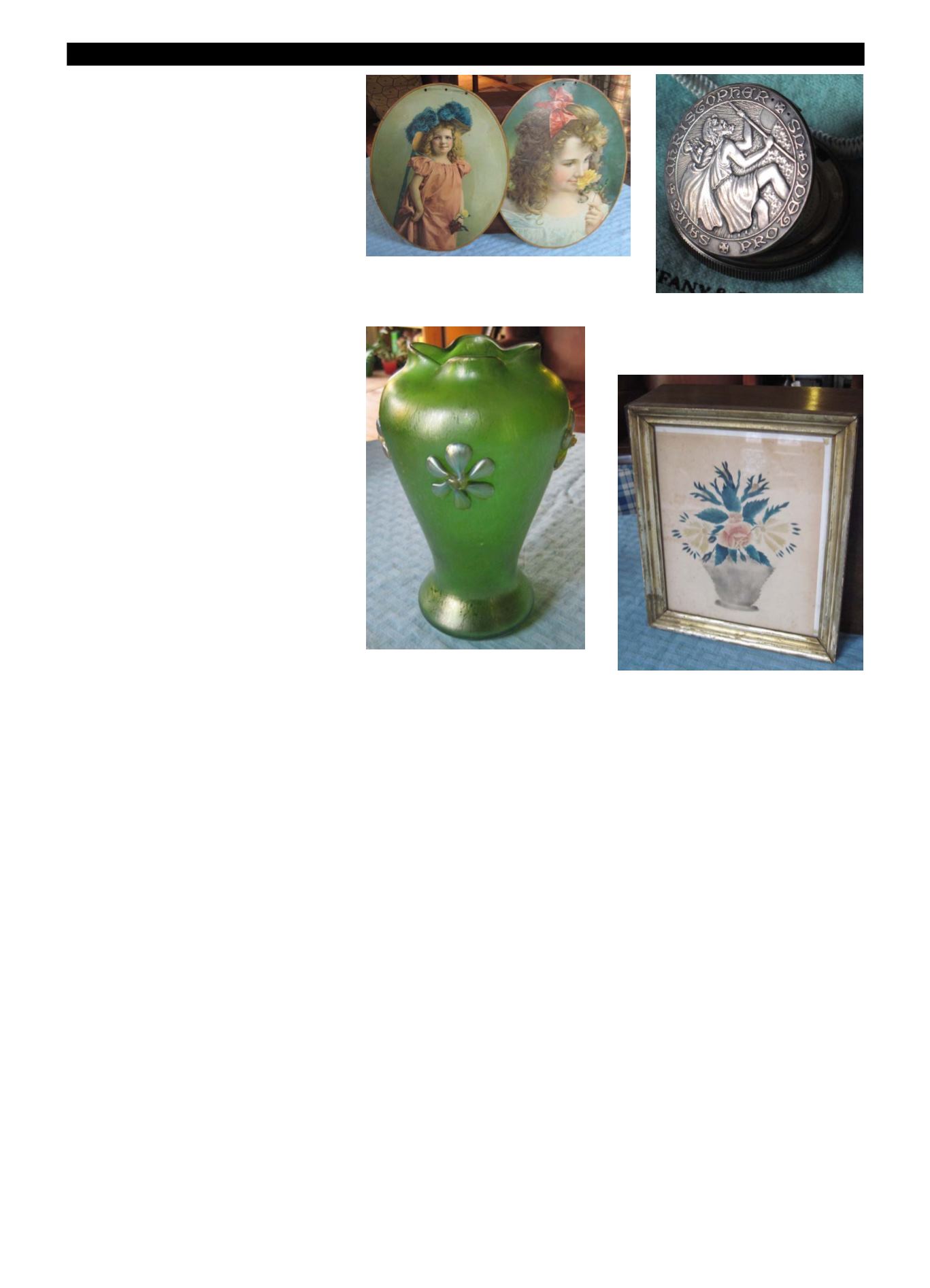
A Tiffany traveling alarm clock barely larger
than a quarter. When we visited, it still needed
to be cleaned, so Baskt hadn’t set a price on it.
She said, “Inquire.”
Two chromolithographs on tin that Bakst said came from
a Vermont country store. They are labeled “A Lady of
Quality” and “Purity” with a 1904 copyright and $385 each.
Watercolor theorem on paper in a 12" x 10"
lemon-gold frame, $345.
Loetz Ciselé green vase with flower prunts (Bakst
said “prunts” is what glass people call those
applied motifs). It’s 10¼" tall and $1385.