


 55 / 213

Maine Antique Digest, March 2017 27-A
-
FEATURE -
27-A
The Young Collector
2016: The Year in Review
by Hollie Davis and Andrew Richmond
W
e normally pause after the holidays and reflect
on the year behind us. That’s not so much
because it’s the end of the year, but mostly
because we’re usually lying in bed sick, sure we’re going
to die, and it seems like a good use of time to reflect back
on our lives. This year was no different in that respect, as
we spent the week between Christmas and New Year’s
spreading good cheer and bad germs.
The year 2016was verydifferent frompast years inother
ways, though, because it began with Andrew’s departure
from Garth’s Auctions after nine great years. Leaving the
security of full-time employment (and health insurance
and paid vacation and sick days and so on) and a great
group of coworkers was scary and sad. It was all part of
the plan though, as Andrew’s goal since graduate school
was to be an independent entity in the antiques world. Six
or seven years ago, things might have been different. But
now there are these two adorable responsibilities who
demand to be kept fed and educated. (Clothing we can
skimp on. Hooray for homeschool!) Early on, we thought
that becoming established dealers was the way to go, but
capitalizing such a venture in the new market was simply
impossible. A brick-and-mortar shop would have been
right out, while dealing in a productive way that would
have allowed for growth, such as trying to schedule ten to
15 shows per year, would have been expensive, required
a great deal of inventory, and would have been grueling
while working a part- or full-time job to keep income
steady. Even attempting a full-time job selling online is
challenging, at least as a start-up. So, here we are!
After so many years of operating in the same realm,
this move has allowed us to have an understanding of
parts of the antiques trade that is more than theoretical.
It is, as we all know, one thing to watch someone else
do something, and quite another to do it yourself.
Increasingly though, as we saw friends resign themselves
to jobs where research was something they had to do on
their own time, if at all, while other friends tacked around
the country, following jobs in an attempt to find one of
the increasingly fewer rungs on a ladder upon which they
could rise, making our own ladder seemed like the only
viable choice. There are, as we have said before, very
few “ups” in the antiques business. At some point, for
many, you just hit a ceiling beyond which you cannot rise
without capital or luck, and when you reach that point,
you put your trust in both the business and the cost-of-
living raises being steady.
So on January 16, 2016, Andrew hammered down his
last lot as a full-time auctioneer, spent Sunday taking a
deep breath, and on January 18, hung out his shingle as
an appraiser, consultant, and (very) part-time dealer. As
all of you small business owners know, those are only the
jobs for which one gets paid. There are also accounting,
marketing, budgeting, projecting, staffing, and on and
on. Years with small businesses have taught us that you
generally either have time to do something but no money
with which to do it or money with which to do it but no
time, and this year has been no different.
The year included consultations about buying and
selling as well as estate and insurance appraisals aplenty.
Appraising promises to be just as “colorful” as auction
work. On one of Andrew’s first appraisals, he sent Hollie
a quick message to let her know that things were going
well and he was just going about his business—now that
the police had shown up. (That was an estate appraisal.
Meanwhile, divorce appraisals have been peaceful and
pleasant.) The past year also involved over three dozen
public appearances (research lectures, valuation events,
and presentations on estate planning) at museums,
libraries, and with collector organizations. That included
a trip to Detroit to the annual meeting of the American
Association for State and Local History (AASLH) to
offer an introduction to the antiques trade to museum
professionals. (Just this week, Andrew found out that he
and his fellow presenters will be reprising their program
in July at the annual meeting of the Association of
Midwest Museums.)
The public appearances, which were mostly appraisal
events and speaking about estate planning, were
technically paying gigs. But spending four hours in the
car, an hour talking and answering questions, and then
two more hours crushing hopes and dreams, well, it’s
draining, people, and not particularly profitable in the
immediate sense. But marketing always costs money.
In the antiques business where we all know each other,
word of mouth will go a long way, but without those clear
pathways outside of the industry, it comes back to the old
standbys of visibility, name recognition, and reputation.
Those you have to earn the old-fashioned way—and by
crushing hopes and dreams tactfully.
One of the best parts about making this move to
self-employment is the ability to really put our money
where our mouth is. We can work at making changes
and building connections where we’ve long felt they
needed to be, and the presentation at AASLH was just
that. Historically, there has been a chasm between the
academic and the commercial sides of antiques and
decorative arts. Both sides are working with objects,
although in different ways, but the larger issue facing
both museums and the trade is outreach. We are all trying
to reach new people and suffering from the effects of
a lack of awareness and support. That chasm has also
done a disservice to both sides, leaving museum people
disconnected from the monetary value of the objects in
their collection and at the mercy of those who
do
know
how much things are worth, while those in the trade
aren’t aware of what museums are looking for, how to
market it to them, or how to navigate their (sometimes
very lengthy) process for acquisitions.
Andrew had time for all these lofty philosophical
thoughts while traveling this past year. Lots and lots of
traveling—about 24,000 miles, coast to coast. Much of
the travel was in the form of day trips (he was in 33 of
Ohio’s 88 counties), but there was also about a month
and a half of living in hotels. We know many dealers are
likely chuckling at only six weeks in hotels. He continues
to collect data on pizza across our great nation. A typical
hotel check-in involves a very important question of the
desk clerk: “What’s the best local pizza that delivers?”
He’s been doing it for over ten years with one regret: he’s
not been mapping good pizza or blogging about it.
A good portion of those six weeks were spent in New
York City. Andrew’s “second home” was a hotel on East
64th Street, where he stayed while serving excitedly as
a folk art consultant at Sotheby’s. He spent three weeks
cataloging more than 250 lots (including the Ralph and
Suzanne Katz collection), which let him interact with
some extraordinary objects, such as a version of Edward
Hicks’s
Peaceable Kingdom
, a phenomenal almshouse
painting by John Rasmussen, and much more. He went
back in January for a ten-day stretch of exhibition
previews and auctions and
to lecture on the Katz col-
lection at the Sotheby’s
symposium. He would like
to note publicly that ten days
on someone else’s dime in
New York City is fun, but
the long days in the galleries
were exhausting—but not
one-fifth as exhausting as
Hollie holding down the
play fort with two kids for
those same ten days.
Yet he also managed to
slip away for a bit to do the
usualAmericanaWeek stuff,
which included visits to the
Winter Antiques Show, the
Ceramics and Glass Fair,
and the Outsider Art Fair.
Ronald Hurst and his team
at Colonial Williamsburg
did a huge favor to everyone
who attended the Winter
Antiques Show by hauling
some of their iconic folk
art up for the exhibition.
Overall, crowds were
good, and sales seemed to
be as well. Andrew even
picked up a nice piece of
Zanesville glass from Ian
Simmonds at the Ceramics
and Glass Fair.
Of course the real best part of Americana Week was
reconnecting with and being uplifted by the amazing
people at work in this business. Seeing Brock Jobe receive
the Wunsch Americana Foundation’s award, along with
Colonial Williamsburg’s Leroy Graves, whose remarks
left few dry eyes in the room, was a highlight of the week.
Other highlights were taking the visiting Winterthur
students around the Sotheby’s galleries and the annual
pub night for the “Winterthur mafia.” And then of course
there was an Americana Week tradition—breakfast with
M.A.D.
’s editor-in-chief Clayton Pennington. It’s always
great to talk shop over eggs and toast. So many topics
covered in 90 minutes, but what is said at the Avenue
Diner stays at the Avenue Diner!
Travel was generally uneventful, both to NewYork and
throughout the year, especially since a good bit of it was
child-free. Once you’ve traveled with children, traveling
with a circus would seem uneventful. Aside from some
lost luggage that required him to show up for the first day
of a big contract job wearing grubby travel clothes and
1345 gate changes, things went well.
Andrew wasn’t the only busy one in 2016. Along
with managing a household and homeschooling our
children, Hollie also successfully negotiated the buyout
of
Prices4Antiques.com, also called p4A Antiques
Research Services, LLC, the company for which she
has worked for over ten years. As of March 31, we’ll
both be business owners. Hollie hopes to reenergize
Prices4Antiques.comand keep it useful and relevant, but
at the same time, she is exploring new ways to provide
worthwhile services to antiques auctioneers, dealers, and
collectors for years to come. Again, a chance to put our
money where our mouth is!
So 2017 is shaping up to be another busy year and one
full of changes, including the bittersweet one of saying
goodbye to our little 1894 schoolhouse. We’ve lived
in central Ohio for more than a decade—but we’re far
from family; the house is little; and with Nat and Nora
growing (so fast), we’ve decided this year is the time to
move forward with our other long-ago-laid long-term
plan of moving to our favorite Ohio town, Marietta. We
haven’t found our dream home, but it will be old and in
the country and the perfect spot for all these old things
we love. Regardless, we hope you’ll come with us. We
remain so thankful for our other home, the one we’ve
found in this community, and we hope you’ll all be
taking steps toward fulfilling your own dreams in 2017.
David N. Friedman
308 Merrimon Ave.
Asheville, NC 28801
sqantiques@gmail.com828-412-3260
For More, Visit
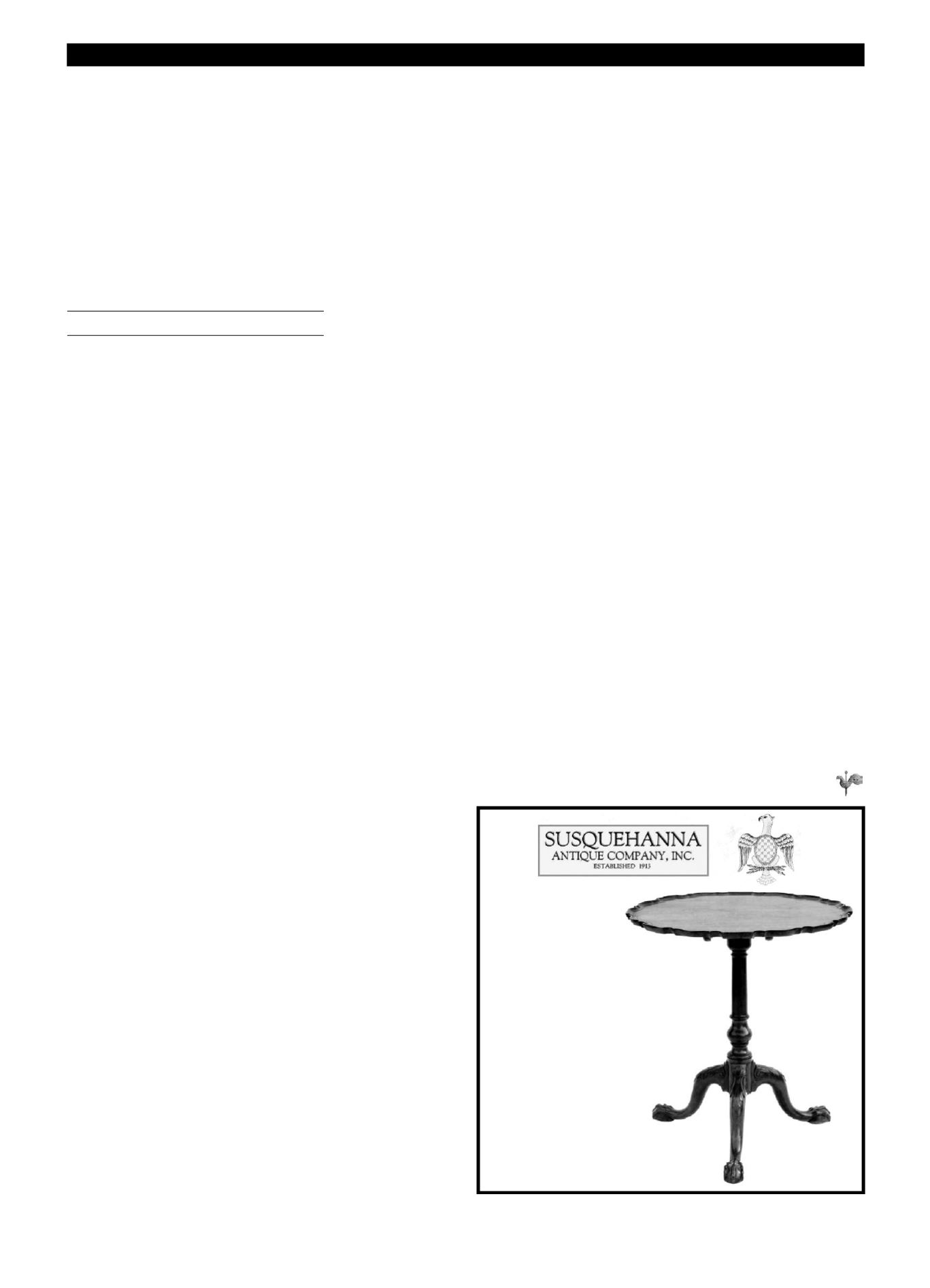
www.susquehannaantiques.com www.susquehannaframes.com“Rare Charleston Carved Mahogany
Tea Table of Small Scale, possibly
by Henry Burnett working 1755-75”
25.5” Diameter, 28” High.
Put our money where our mouth is.