


 61 / 213

Maine Antique Digest, March 2017 33-A
-
AUCTION -
33-A
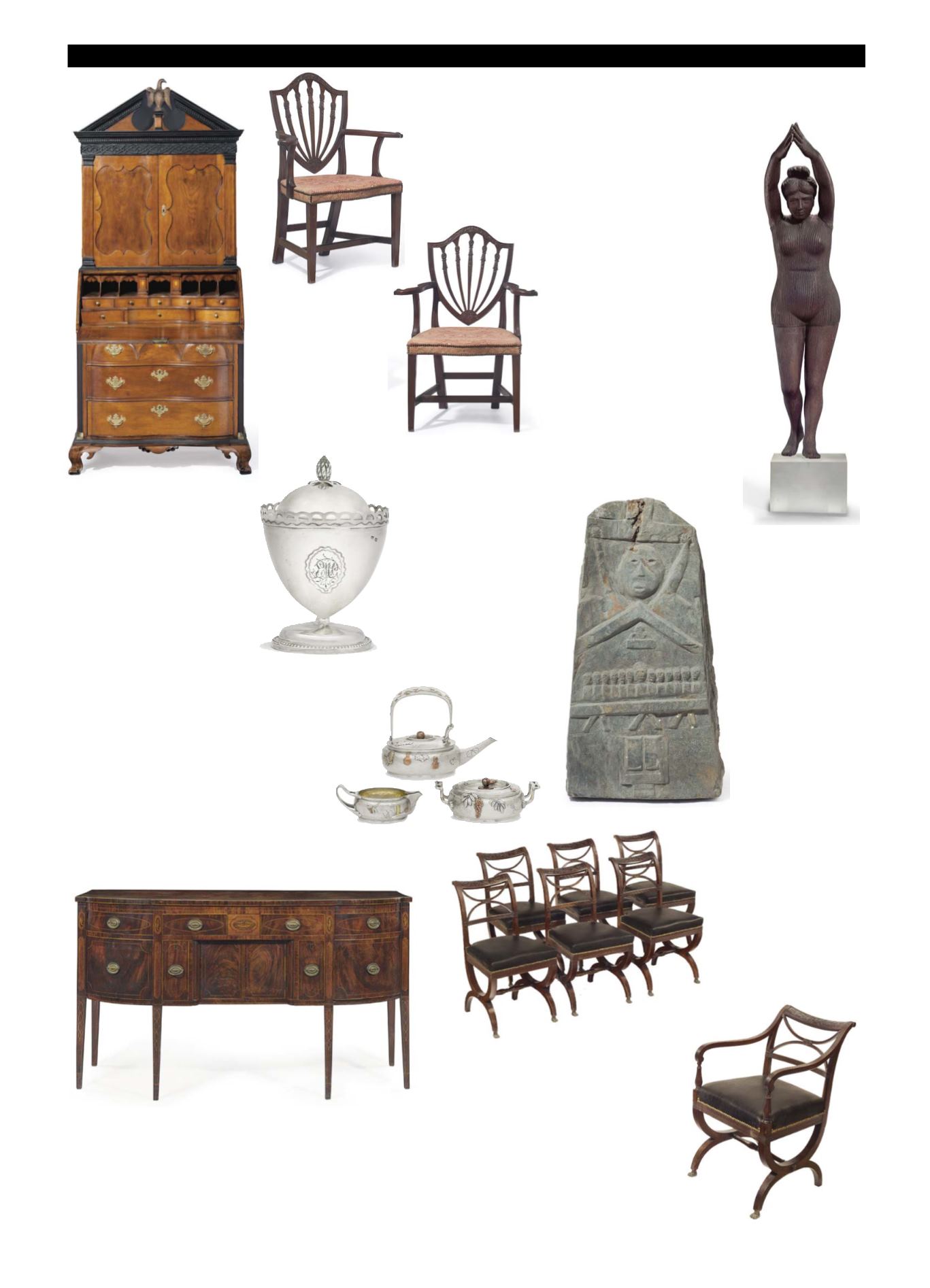
This Chippendale partly ebonized and
inlaid cherrywood blocked reverse-
serpentine desk-and-bookcase looked
far better in person than in its catalog
illustration. From the Connecticut River
Valley, 1780-1800, it is 87½" x 36¾" x
19¼". Estimated at $50,000/100,000, it
sold to an online bidder from Virginia
for $30,000. Albert Sack deemed it a
“Masterpiece” in
Fine Points of Furniture:
Early American
(1993). Ex-Mrs. J. Insley
Blair, it is recorded in her 1943 inventory
as a “Cherry Secretary Desk. Serpentine
Block. Broken Pediment. Eagle. Orig.
Brasses.” She bought it from Henry
V. Weil in August of 1927 for $4100
(approximately $54,788 in today’s dollars).
The condition report noted that the finial
was probably a replacement, as were the
brass knobs and the rear left foot and left
side base molding.
Salem, Massachusetts. The 1791 accounts of Major General John Fiske
show that he paid Jacob Sanderson £31-4-0 for “12 Mahogany Chairs
compleat for the house.” Six years later, the set was described as “ten
mahogany chairs & two arm’d” and valued at $85. Six of the side chairs
from this set were given to the Essex Institute (now the Peabody Essex
Museum) by the couple’s granddaughters in 1913. Dean Lahikainen,
author of
Samuel McIntire: Carving an American Style
, notes that
McIntire may have emulated the eagle-
carved handholds on a Boston armchair
owned by Elias Hasket Derby. McIntire
also designed and built the Fiskes’Walnut
Street mansion, which was completed in
1787, and their accounts include further
payments to Sanderson, McIntire, and
cabinetmaker William King. The chairs
are recorded in Natalie K. Blair’s 1943
inventory, in which she describes them
as “Pr. Mahog. Armchairs. Carved
Shields. Bird’s Head Arms. McIntyre
[
sic
]. Salem.” She also noted that they
descended in the North and West families
and that she purchased them from
Willoughby Farr in 1931 for $6875.
A well-executed 18½" high
carving of a diving woman
by an unknown artist, dating
to the first half of the 20th
century, ex-Harris Diamant,
sold for $18,750 to Leigh
Keno, underbid by the
Internet. The estimate was
$8000/12,000.
An order bidder paid $13,750 (est.
$7000/10,000) for a 1785-90
Bermuda silver sugar bowl
and cover with the mark of
Thomas Blatchley. Bermuda
silver on the market is rare.
According to Christie’s,
the most recent was a silver
tankard, marked by Thomas
Savage Sr., circa 1710, at
Sotheby’s on January 23, 2009,
which brought $62,500. Thirty-
eight silversmiths are recorded as
working in Bermuda between 1650
and 1900, of whom only 12 were
born in Bermuda.
A soapstone stele by
Raymond Coins (1904-1998)
commemorating the founding
of a church, circa 1975,
44½" x 22", estimated at
$8000/10,000, sold for $68,750
to a phone bidder on the line
with Martha Willoughby.
An Internet bidder paid $32,500 for the Butler family Federal inlaid
mahogany sideboard, attributed to William Lloyd (1779-1845) of Springfield,
Massachusetts, circa 1811. Measuring 41" x 71" x 27¼" and estimated at
$20,000/30,000, it is attributed to Lloyd based upon a virtually identical
example that is dated 1811 and bears a label. When this same sideboard sold at
Christie’s East in June 2001, it brought $204,000. (The labeled sideboard sold
for $255,500 at Sotheby’s in October 1998.) William Lloyd was Springfield’s
most well-documented and prolific cabinetmaker of the early 19th century. He
established his own business by 1802 and was listed as a cabinetmaker in the
city directories up until his death.
An Internet bidder won this pair of carved Federal mahogany armchairs with
eagle-carved handholds, ex-Mrs. J. Insley Blair, for $27,500 (est. $10,000/20,000),
underbid by a collector in house. The chairs were documented to Jacob
Sanderson (1757-1810) and the carving to Samuel McIntire (1757-1811) of
The Coster family set of seven Classical mahogany
curule-base dining chairs with seaweed-carved crests and
brass paw feet, attributed to Duncan Phyfe (1768-1854),
New York, 1810-20, six sides and one arm (together
with a later armchair probably by Ernest Hagen), sold
to a phone bidder for $62,500 (est. $50,000/80,000),
underbid by an Internet bidder. Curule-base furniture
was illustrated and described as “Chairs with Grecian
Cross Fronts” in the 1808
Supplement to the London Chair-
Makers’ and Carvers’ book of Prices for Workmanship
,
probably the direct source for curule-base forms made
in New York. Not shown, the two chairs from the set
offered as the following lot sold for $23,750 to Alan
Miller (est. $15,000/30,000), also underbid by an Internet bidder.
A silver,
mokume
, and mixed-metal three-piece tea
set with the mark of Tiffany & Co., New York,
1878, and with French import marks sold for
$65,000 to a phone bidder. The catalog said
that Tiffany’s exhibit of Japanesque silver
won worldwide acclaim and the grand prix
for silverware at the Paris Exposition of 1878. A
woodcut illustration in Emile Bergerat’s
Les chefs-d’oeuvre d’art à l’Exposition Universelle
,
Paris, 1878, vol. I, p. 121, depicts the same model of teapot.