


 67 / 213

Maine Antique Digest, March 2017 39-A
Maria & Peter Warren Antiques
In business since 1982, specializes in 18th and 19th Century
English Pottery and Porcelain, Chinese Export, Delft, Glass and Crystal Perfume and Vanity Sets,
Early American Furniture, paintings, and other wonderful Decorative Arts.
Absolutely everything to
make your home distinctive.
14 Rowledge Pond Rd., Sandy Hook, CT 06482 PHONE: (203) 984-6174 E-MAIL:
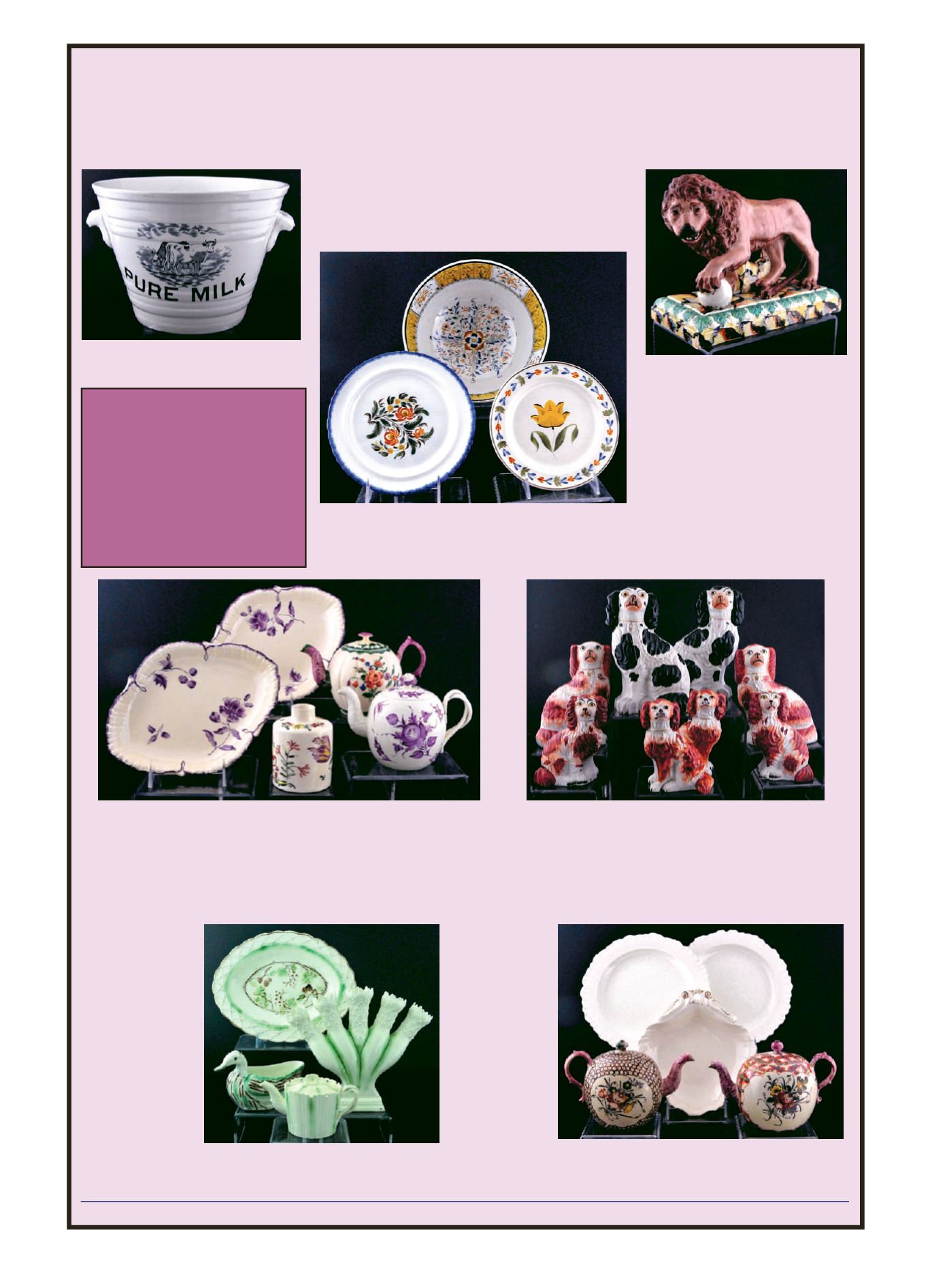
ajwarren1@yahoo.comA pair of English Creamware puce decorated plates in the manner of James
Bakewell, (10” L x 7½” W) c. 1770-90; to the right, is an English Creamware molded
floral teapot decorated in polychrome enamels, (4½” H x 7½” W) c. 1770-90;
below that is an English Creamware puce enamel decorated teapot, impressed
“wedgwood,” with traces of gilt remaining, (5½” H x 7¼” W), c. 1770-80. In the
center a polychrome floral decorated tea caddy with an Oriental motif (not pictured)
on the opposite side, (4” H x 3¼” W), c. 1770-80.
An English Pearlware Bowl decorated in Pratt colors, (8¼” D x
4½” H); together with a 7½” D plate decorated with a beautiful
rendering of a tulip, c. 1810; Provenance: Kahn collection and an
8¼” D plate decorated with a central floral decoration and a blue
feather edge, c. 1810.
A wonderful group of English Staffordshire “Comforter” Spaniels
beginning with the 12” H pair of Black and White dogs, they are
impressed with a number two on the base; alongside that pair, we have
a 9” H red and white pair with no impressed number on their base. In
the front row, the 7” H pair are impressed with the number 5; all of the
aforementioned are “flatbacks.” The pair in the middle have separated
front legs and are 6½” H, these were never meant to be displayed on a
mantel as they are decorated, “all around” and could be viewed from all
angles. All of the Spaniels are c. 1860-70.
An English Creamware
fruit molded oval plate
with green and brown
underglaze enameled
decoration, (8” x 10¼”).
c. 1780-90; pictured
together with a lovely
English Creamware
Quintel decorated in
underglaze green enamel
stripes, along with a
molded decoration to the
top third of each of the
fingers, (8” x 9½”)
c. 1780-90, probably
Derbyshire. To the
lower left is a wonderful
example of an English
Creamware sauceboat
in the form of a duck
decorated in underglaze green and brown enamels
(7” L x 4” H) c. 1780-90; and to the right an English Creamware galleried
teapot with looped handles, floral knop and molded spout (6” W x 4” H), most
likely Yorkshire, c. 1770-1780.
A pair of English
Creamware
shell-edged
plates, impressed
“wedgwood,”
9¾” D, c. 1770-80,
Provenance: Deike
Collection; together
with an English
Creamware Shell
dish with traces
of gilt remaining,
impressed
“WEDGWOOD,”
c. 1790-1800,
Provenance: Rinaldo
Collection; along
with two English
Creamware Chintz
polychrome teapots
with enameling by David Rhodes and attributed to Wedgwood, both are 5½” H x 8”
W, c. 1770-1780. An almost identical example of the teapot pictured on the left can be
seen in Donald Towner’s book
Creamware
, plate 17B.
An English Whiteware black transfer decorated
milk pail decorated in the front with cows in a
pasture and the words, “Pure Milk,” c. 1870.
Show Calendar for 2017:
Chester County Antiques Show -
Phelps School, Chester County, Pennsylvania -
April 7-9
Newport Historical Society Antiques Show -
St. George’s School, Middletown, R.I. - July
Ellsworth Antiques Show at Woodlawn,
Woodlawn Museum, Maine - August
Main Line Antiques Show - Cabrini University,
Radnor, Pennsylvania
Delaware Antiques Show - Chase Center
on the Riverfront, Wilmington - November
A fine and large example of an English
Staffordshire Lion on a marbelized base
with one paw resting on a white sphere,
12” L x 10” H, c. 1810-30.
By way of background, a pair of these lions
were originally sculpted and created in the
16th c., for the Grand Duke of Tuscany,
Fernando l de’ Medici, to serve as majestic
ornaments for his villa’s garden staircase.
And, although they were later moved to
Florence in the 17th c. to flank the steps
of the Loggia dei Lanzi at the Piazza della
Signoria, they have retained their reference
as the “Medici Lions.” In the mid-late 18th c.
through the mid-19th c., examples of these
lions began appearing throughout England
and were copied extensively throughout
the potteries.