


 72 / 213

4-B Maine Antique Digest, March 2017
-
AUCTION -
4-B
in a 2014
M.A.D.
opinion piece referred to as
wabi-sabi
. Freely
interpreted from the Japanese, it means “living with imperfection
and transience.” Certain vintage classics in the “Fall Start” auction
lineup made a compelling case for reevaluation.
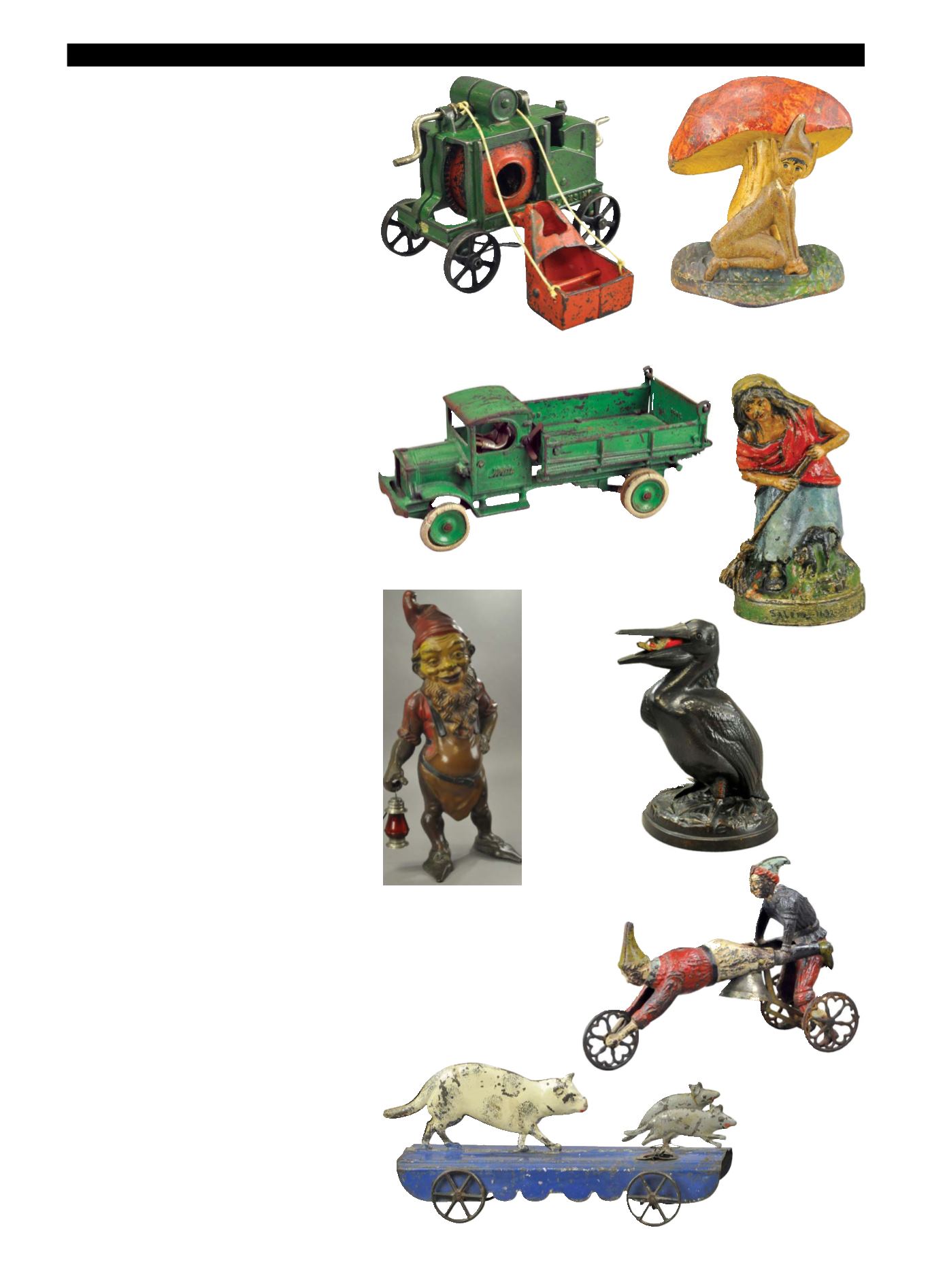
First, consider the Lansing cement mixer made in 1929 by the
short-lived Vindex firm. Despite a replaced drum, levers, and
scoop, it was well worth the $8850 for attaining possibly the most
sought after and well detailed of all construction toys.
When an Ives Leap Frog bell toy sold at Bertoia’s Max Berry
sale in 2014, it was deemed unique. Then recently a North Carolina
estate alerted Bertoia that it had a second Leap Frog toy. Despite
a few flaws, epoxy wear on one clown’s leg, and wheel oxidation,
the 8¾" long bell ringer jumped to $14,160. It would make a great
addition to any advanced collection.
Cataloged as in excellent-to-pristine condition and rated ever
desirable, a William F. Goodwin carriage from the 1880s, painted
tin, 11½" high, is the only example ever seen with a seated
composition child in the cart, as shown in BlairWhitton’s
American
Clockwork Toys
,
1862-1900
. It ambled just beyond estimates to
$8260 but seemed deserving of more wiggle room.
It’s no secret that one can no longer find clockwork carousel
toys that match the quality and workmanship of the George
Brown automatic waltzers from the 1870s. One detraction to
the example in this sale was the likely replacement of the lead
dancers. The handsomely hand-stenciled, highly filigreed 11" high
museum-quality toy, one of two known examples, estimated at
$10,000/15,000, did a deep dive at $5015. There was no rationale
for sitting on one’s paddle and missing out.
The dollar toy steam engine is an American invention. Half a
dozen different patents were issued between 1869 and 1872.
Pioneer U.S. makers such as Weeden, Buckman, Beggs, and
Stevens enjoyed a brief heyday as steam was hailed an exciting
source of power. One drawback—many parents agonized over
buying them for their youngsters because of live steam safety
hazard concerns.
Today steamer toys are regarded more as a grownup’s diversion,
with a strong following in Europe, where a host of German firms
(Bing, Doll, Schoenner, Plank, and Märklin) created precision-
made units that were mainly sold through optical instrument shops.
Toy authority Richard O’Brien included them as “philosophical
toys.”
Although the most die-hard steam toy following today thrives
in Europe, at Bertoia, surprisingly, one of its foremost exponents,
Paul Hale, an Australian, consigned a shining array of more than
100 horizontal and vertical steam plants. A superb Märklin steam
plant that graced Bertoia’s catalog back cover had a marine-style
engine and protected water glass fly ball governor. The 24½" high
engine generated the most crowd appeal at $8260. Jeanne Bertoia
mentioned that Hale also included his handmade cedar crates for
most of his steam toys.
In what has evolved through the years as an eagerly anticipated
rite of passage, Bertoia’s Sunday preholiday outpouring of
glittering vintage Christmas treats boasted nearly 250 Santas,
candy containers, store displays, feather trees, ornaments,
sleighs, and reindeer. The Bertoia bounty also included over 100
Halloween, Washington’s birthday, and Easter standouts, and 70
alluring valentines. It would take a wizard to diplomatically cite
the winners here without committing a grievous oversight to a
deserving dazzling entry.
The top choice from the Santa selection seemed a given. One
of the most exquisite German belsnickel composition candy
containers we’ve witnessed at auction was a blue-eyed, brown-
robed Santa with glass icicles dangling off his beard as well as on
a lichen moss tree, his hood trimmed with gold beads, that towered
at 16" high. The recent attic find handily doubled estimates at
$26,550.
At the “Fall Start” auction, Santa made his rounds astride a polar
bear, donkey, and white horse and motored in a loofah sedan and
a lithographed tin convertible friction auto, but by far the most
exemplary transport mode was by two reindeer sleighs. Cue in the
jingle bells as upward glided an FAO Schwarz clockwork nodder
Santa and reindeer with wicker rig, 42" long, at $7080,
Then a German composition Santa Claus at the reins of a
reindeer-drawn loofah sleigh candy container experienced only
slightly tougher sledding. Santa sported a rabbit fur beard and a
red felt robe and held a feather tree sprig. His head was removable
to access the candy goodies. The reindeer in full gallop had glass
eyes, lead antlers, and a full harness. At 18" long, it made tracks
at $4425.
Bertoia invariably includes a few highly decorative wood-
carved Christmas displays from the venerable Erzgebirge wood
toy factories seldom seen outside of their German Ore Mountain
origins. A fantastic polychrome chandelier with a large center
pendulum, hand-turned, carved figures and propellers with folk
art charm, and exaggerated bird and floral detail, 25" high, made
$5605.
A Gebruder Heubach, Germany, early 1900s bisque-head girl
skier, 6¾" diameter, made $443. A girl skier sitting on a bench
holding a large snowball, 11" long, brought $1180, while a skier
atop a snowball candy container made $324.50. The choicest
Heubach was of a spun cotton girl perched on a pressed cardboard
snowball candy container, 6" high, holding a feather tree sprig,
which tripled estimates to $2006.
It’s always fun to pick and choose from the elegant and whimsical
Lansing cement mixer, Vindex,
1929, possibly the most elusive
of all construction toys, 6½"
long, $8850.
One of the most intriguing among 170
doorstops at the sale was this elf under
a mushroom, cast iron, “N514E,” 7½"
high, that sold for $3835.
Arcade White Motor dump truck, Cleveland,
Ohio, circa 1929, name embossed on door of green
cab, opening tailgate, lift lever activates truck bed
for dumping, ex-Don Kaufman, 11½" long, $6490.
Sarah W. Symonds
doorstop, marked “Salem
Witch 1692,” woman
sweeping with black cat
at feet, 9¾" high, $5605.
Garden gnome lawn ornament,
cast iron, “Pat. Nydea Pend
347,” electrified with lantern,
ex-Donal Markey, 27" high,
$4425.
Over 50 mechanical
banks made a few
waves, including this
bizarre
J. & E. Stevens
mechanical bank known
as Pelican—Man Thumbs
Nose. As the beak opens
on this bank, patented
by John Gerard in
1878, a man emerges.
It sold for $6490.
This Leap Frog (a.k.a. Two Kids) bell toy by Ives,
1880s, with one clown holding the other’s leg to
push wheelbarrow style,
8¾" long, is only the sec-
ond example to surface. It sold for $14,160.
The one auctioned at Bertoia’s Max Berry
event in 2014 was thought to be unique.
Cat chasing mice plat-
form pull toy, Fallows,
1880s, 9" long, $8260.