


 52 / 213

24-A Maine Antique Digest, March 2017
-
FEATURE -
24-A
“We’re suckers
for objects that
have stories.”
In the Trade
Marni Bakst, Oh Antiques, Verbank, New York
by Frank Donegan
D
uring the many years that we’ve published this
feature, we have interviewed well over 100
dealers, yet we have never encountered one who,
to the best of our knowledge, was a Ruby Lane seller.
Now we have. She’s Marni Bakst, who sells from her
early home overlooking a mill stream in Verbank, New
York. She’s been a Ruby Lane seller for ten years. It is
essentially her only outlet.
Bakst stocks an interesting mix of antique and vintage
smalls and art in her online Ruby Lane shop. There are
those, she admitted, who might view Ruby Lane as
something of a garage sale with an awful lot of costume
jewelry. It’s certainly not the first place you’d look if you
wanted a Lannuier pier table or a Goddard/Townsend
secretary.
But as she said, “I’m
not such a snob. I think
Ruby Lane is a great
platform.” Bakst is not a
high-volume seller, and
the site accommodates
her needs. “Some people can sell sixty lots a week,” she
explained. “I have to work at my own pace. Ruby Lane
lends itself to that. I just don’t worry about what other
people are doing.”
Her pace is unusual in that it has to blend in with her
husband’s work schedule. He’s actor William Sadler,
who has appeared in hundreds of plays, movies, TV
shows, and Web series. He has been in films as diverse
as
The Shawshank Redemption, Die Hard 2, Bill & Ted’s Bogus
Journey
, and
Mist
. He has appeared with Denzel Washington in
the Broadway revival of Shakespeare’s
Julius Caesar
, in which, as
Caesar, he got to say the famous words “Et tu, Brute” as Washington’s
Brutus assassinated him.
Sadler is the type of actor whose name you might not know but
whose face is immediately recognizable. He said that when he’s
in restaurants, people stare at him, whisper to each other, and then
conclude that maybe he’s not the celebrity they first thought he was.
An actor’s life is unpredictable; consequently, so is Bakst’s.
Sometimes she accompanies Sadler on location. At other times, such
as when he was in the popular series
Roswell
, “we were bicoastal for
three years,” she said. Her Ruby Lane store fits her schedule nicely.
“I don’t have to do my own site,” she said.
“She doesn’t have to mind the store,” Sadler added.
Bakst took advantage of this flexibility recently. “Last spring Bill
had a job in Berlin, and I had a chance to go for a month. I’m not
going to give that up.” She went but didn’t have to completely shut
down the business. “I can kind of step back and things keep selling,
even though I can’t send them off to people till I get back.
“It’s a friendly site. I’ve gotten to know a lot of the people there,
and they’re fairly responsive. It’s small enough so that it can be
personal.” And the $69 a month basic fee means it’s affordable, she
said.
“Personal” certainly would be an accurate way to describe many of
the objects she buys. One of her favorite acquisitions, for example,
is a pair of small pink circular silk pads with lace edges and little
rosebuds in the center. They came from the estate of a woman who,
back in the 1920s, apparently had felt that her bust was not robust
enough and used these to enhance her curves. “Falsies” doesn’t come
close to describing the charm of these delicate survivors from another
time. (Bakst keeps them in a box on her dresser; they aren’t currently
for sale.)
“We’re suckers for objects that have stories,” Bakst said but added,
“I don’t care much for pedigree. I have an appreciation for all sorts
of things. I have a huge amount of what I call ‘little pretties’—things
that people might want to put on their desks or vanities.”
This helps explain her business name, “Oh.” She’s especially
attracted to odd things that might make you stop and say, “Oh, I don’t
know if I’ve ever seen something quite like that before.” Her initial
choice for a business name was “!” but as she said, “New York state
wouldn’t allow me to use a punctuation mark as a name.”
Sadler noted, “The runner-up name was ‘pieces of string too small
to use.’”
Bakst grew up on New York’s Upper West Side. Her father was
an internist; her mother, a teacher. Of her father, she said, “He was a
lifelong learner. That’s what keeps me interested in antiques. There’s
always something to learn.”
She said that as a kid growing up in NewYork City, “I was exposed
to all the arts. I saw Mary Martin in
Peter Pan.
I hung out at the
Metropolitan [Museum of Art] after school. I always had a book of
poetry with me.”
She went off to the University of Chicago to major in philosophy
but ended up in Oakland, California, at the California College of the
Arts (then called the California College of Arts and Crafts). There,
she said, “I missed the last semester––the one where they help you
put together your portfolio. So I was essentially unemployable.” She
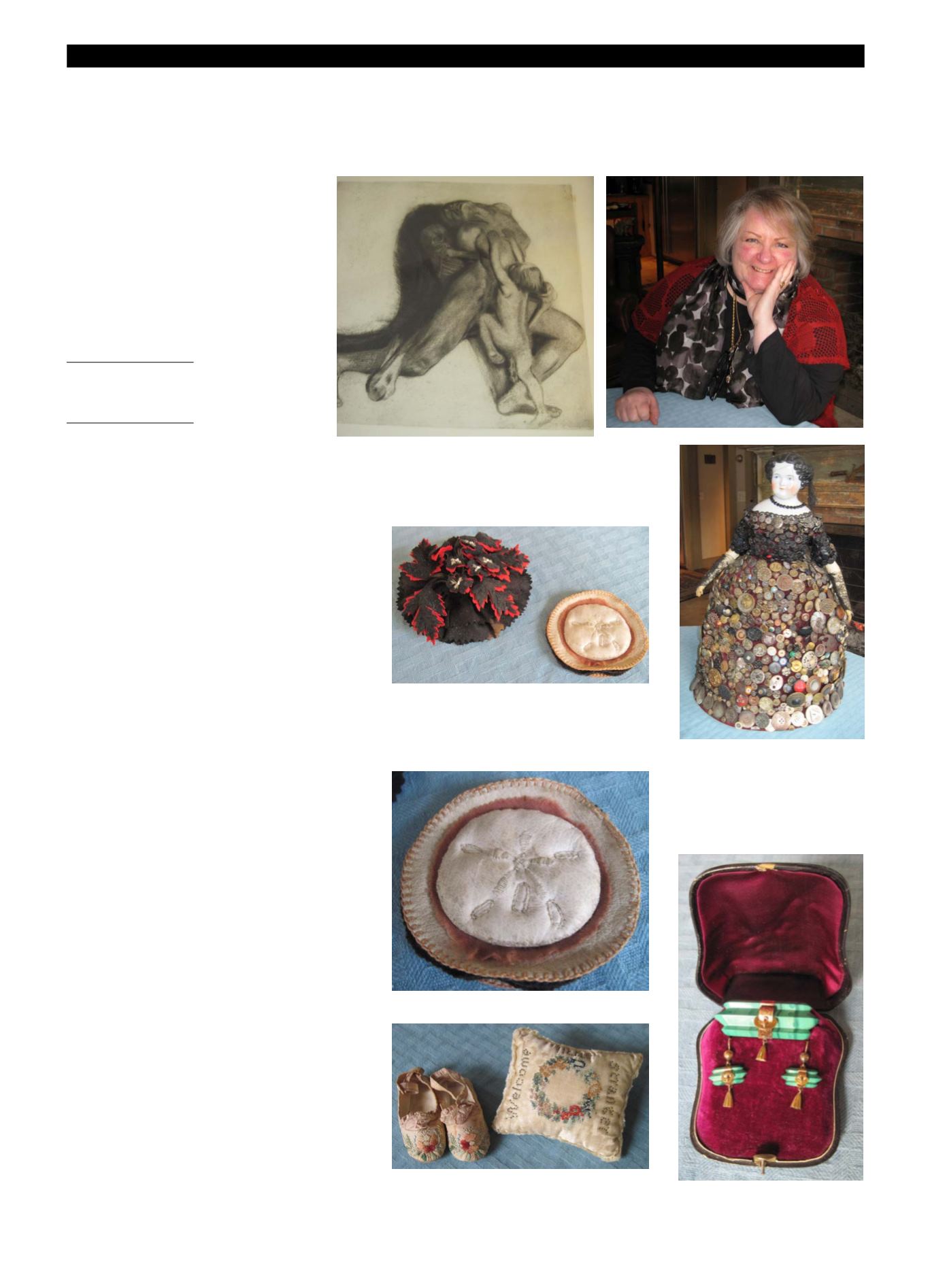
Here’s a 19th-century porcelain doll that
in the 20th century acquired a hoop skirt
with a button collection mounted on it. A
1930s lampshade provides support for the
skirt. Doll collectors might object to the
doll’s condition, but, Bakst said, “I think
she’s a fantastic piece of folk art.” The
piece is priced at $2650.
Käthe Kollwitz (1867-1945), drypoint and soft ground
etching on wove paper,
Tod und Frau
(
Death and Woman
),
published by Alexander von der Becke, Munich, and
printed by Felsing, $995. (It’s nicely framed, but the
reflective glass and harsh daylight forced us to choose
between a well-pictured frame or the image itself.)
Marni Bakst.
Embroidered baby pillow pincushion with the motto
“Welcome Little Stranger.” Stickpins form the letters of
the motto, so you probably wouldn’t want to give this to a
baby. It’s $225. The satin-stitched baby shoes are $265.
Closeup of the sand-dollar pen wipe.
Two pen wipes. The red, black, and white upper one is
beaded and embroidered with little pansies. The lower
example is embroidered in the form of a sand dollar. Pen
wipes in good shape are apparently rare and collectible.
Bakst is asking $1650 for the sand dollar and $1400 for the
other.
Czarist-era Russian malachite brooch
and earrings in original fitted case,
$4300.