


 40 / 213

12-A Maine Antique Digest, March 2017
were separated, descending through
her two sons. Edith Hope Goddard
(1868-1970), the only child of Wil-
liam Giles Goddard, inherited the
table sold this January. She mar-
ried Charles Oliver Iselin and took
the table to Upper Brookville, New
York. She bequeathed the table to
Robert H.I. Goddard (1909-2003),
her first cousin once removed, who
owned the other Nicholas Brown
table.
The $8,416,000 table had
descended to Thomas and Hope
(Brown) Ives, who left their house
and its contents to their son Moses
Brown Ives (1794-1857), a Harvard
graduate and merchant at Brown and
Ives, and his wife, Anne Allen Dorr
(1810-1884). Moses and Anne’s
daughter, Hope Brown Ives (1839-
1909), who inherited the Thomas
Poynton Ives house and the table at
their death, married Henry Grinnell
Russell on January 20, 1864, and
they lived in the house. They died
without issue, he around 1905 and
she in 1909. The house and contents
then descended to her cousin, Robert
H. Ives Goddard, who took residence
in 1910-11. The two tables had been
together for three generations (Nich-
olas Brown, Hope [Brown] Ives, and
Charlotte [Ives] Goddard) before
they descended to separate lines to her two sons. They
were reunited in 1970 on the bequest of Hope (Goddard)
Iselin. They were in the same family for 35 years before
the first table was sold in 2005 and the second table was
offered in 2017.
There was much discussion about exactly when this
second table was made. The cognoscenti—that is, cura-
tors, conservators, and Erik Gronning—believe it was
made in the 18th century as a mate to the Goddard
table by a first-rate craftsman, probably in Providence
where Nicholas Brown lived, who carved the top out of
solid wood and was aware of Goddard’s shop practices.
Then the next generation added a drawer in the Federal
period. The buyer had little competition, and this sculp-
tural icon in the history of American furniture was made
more affordable to today’s collectors by the addition of
a drawer. The selling price of $912,500 is a fraction of
what it might have brought without its added drawer.
A few more pieces of furniture with documentation
sold during Sotheby’s long sale on Saturday afternoon,
January 21. A diminutive figured mahogany blockfront
chest of drawers, made in Massachusetts, circa 1760,
was signed “Walter Frothingham, Charlestown” in
chalk on the underside of the long drawer, and on the
inside of the backboard another chalk inscription reads
“Joseph Hallowell
.
” With its original cast brass hardware
and a dark rich historic surface, it sold to Stonington,
Connecticut, dealer Roberto Freitas for $187,500 (est.
$150,000/250,000). The signature appears quite similar
to that of Benjamin Frothingham Jr. that appears on a
high chest at Winterthur. Given the locations of the sig-
natures, the backboards could have been inscribed only
when the chests were being constructed. Therefore, this
remarkable chest stands as the sole surviving object
identifying Walter Frothingham and Joseph Hallowell
as likely apprentices in the workshop of master cabinet-
maker Benjamin Frothingham Jr.
Folk art, needlework, and silver were among the
top lots consigned by various owners. A silk cutwork
flower picture, stitched in Philadelphia, circa 1800,
and in a shadow box frame, sold for $212,500 (est.
$60,000/80,000) to Leigh Keno, underbid in the sales-
room by Philadelphia dealer Amy Finkel on her cell
phone with her client. It is related to another Philadelphia
“cut silkwork” picture by Hannah Newbold Deaves that
sold at Sotheby’s for $120,000 (est. $100,000/200,000)
in January 2005 to Keno. The two pictures have similar
rabbits and flowers.
New York collectors in the salesroom bought a rare
portrait,
Young Woman in Paneled Room
, by Shel-
don Peck for $187,500 (est. $30,000/50,000). A pair of
oil on canvas portraits of Captain and Mrs. Pollycar-
pus Edson by Rufus Hathaway, painted in 1791, were
mounted on boards and trimmed so that Captain Edson
is slightly larger than Mrs. Edson and her fan is cut in
half. These sold to a collector on the phone for $200,000
(est. $100,000/150,000), underbid by Chicago collectors
in the salesroom. The Chicago collectors instead bought
the very last lot in the sale, a Bill Traylor 1939-42 tem-
pera painting on poster board of a man smoking, with a
bird in the sky and a dog under the bench, for $93,750
(est. $60,000/80,000).
Sotheby’s sold the collection
of Dr. Ralph and Susanne Katz
from a separate catalog on Satur-
day morning, January 21. Most of
it was bought by collectors, but
two museums acquired portraits.
The cover lot,
View of the Berks
County Alms House
,
an oil on
canvas signed by John Rasmussen
(1828-1895), dated 1880 and with
a list of the names of the direc-
tors below the image, sold for
$516,500 (est. $80,000/120,000)
to collector Steve Smith in the
salesroom, underbid by sev-
eral phone bidders and a dis-
appointed Patrick Bell of Olde
Hope Antiques, who was in the
salesroom. It is a record for Ras-
mussen, one of three almshouse
painters. The others are Louis
Mader (1842-after 1899) and
Charles Hofmann (c. 1820-1882),
who lived in the almshouse. An
almshouse painting by Charles
Hofmann sold at Pook and Pook
in October 2013 for $545,100, a
record price. Steve Smith was the
underbidder then.
A painted fireboard from the
Moses Martin House, Salem,
New York, circa 1830, oil on can-
vas, depicting an arrangement of
fruit on a curly maple table floating on a background
of light green concentric rectangles, sold for $100,000
(est. $60,000/80,000) to a collector bidding online. Two
phone bidders competed for James Hope’s landscape of
Clarendon Springs, Vermont, and it went to a collector
for $87,500 (est. $30,000/50,000). A collector in the
salesroom paid $50,000 (est. $40,000/60,000) for
Lady
in a Blue Dress
by John Usher Parsons (1806-1874). It
was painted on unprimed, unstretched fabric, circa 1835.
Four of the seven Thomas Chambers paintings in the
Katz sale found buyers. (There was one attributed to
Chambers that also sold.)
New York Harbor with Cas-
tle Garden and Ships
,
circa 1840, sold for $37,500 (est.
$30,000/50,000) to a collector on the phone. The Shel-
burne Museum bought Noah North’s portraits of Mrs.
Elizabeth Powers Darrow and Stephen Powers, painted
in 1834, for $22,500 (est. $15,000/20,000). Stephen’s
portrait is inscribed
“Stephen Powers born at Dam-
ariscotta New Castle Lincoln Co. Maine, June the 1st,
1814 No. 41.” The portrait of Eliza Jamison of Virginia,
painted by Thomas Jefferson Wright in 1831, went to
Colonial Williamsburg for $20,000 (est. $6000/8000).
Williamsburg seems to be buying its southern heritage.
There was a lot of silver on the market this January. On
January 20 Sotheby’s sold the collection of the late Iris
Schwartz, 270 lots, of which 228 sold for $1,826,251,
and 84% sold by lot. There were a few surprises. A
descendant of Paulding Farnham paid $175,000 (est.
$20,000/30,000) for an enamel and gem-set Viking-style
vase designed by Paulding Farnham for Tiffany & Co.,
New York, in 1901.
New York City dealer Tim Martin of S.J. Shrubsole
paid $150,000 (est. $150,000/250,000) for a pair of sil-
ver candlesticks by Myer Myers, New York, 1750-65.
The stepped, shaped square bases have shells at the cor-
ners, and both candlesticks are marked four times on the
base. They are two of a set of four that David Barquist
suggests were owned by Jacob LeRoy and his second
wife, Catherine Rutgers, who married in 1766. Only one
other set of four candlesticks by Myers is known. They
were made for Catherine Livingston Lawrence and are
now divided between the Metropolitan Museum of Art
and Yale University Art Gallery.
Curator Bradley C. Brooks of Bayou Bend, Houston,
standing in the back of the salesroom, bought a tureen on
stand made by Baldwin Gardiner, New York, circa 1830,
for $87,400 (est. $80,000/120,000). It is engraved with
the arms and crest of John G. Coster, one of only five
millionaires in New York City in 1830. Baldwin Gar-
diner (1791-1868/9) was the younger brother of silver-
smith Sidney Gardiner of the firm Fletcher and Gardiner
in Philadelphia. Baldwin worked for this partnership in
their Philadelphia retail shop until 1815 when he estab-
lished his own fancy hardware store.
Three phone bidders competed for a Canadian silver
presentation Kiddush cup with maker’s mark “A.H.,”
probably for Anselm Hardy of Quebec, dated 1858, and
pseudo-English hallmarks and a presentation inscrip-
tion to New York Rabbi Samuel Meyer Isaacs. It sold
for $50,000 (est. $6000/8000). A member of Montreal’s
Congregation Shaar Hashomayim purchased the cup
with the intention of donating it back to the congregation
in honor of its 170th anniversary.
In the wake of the sales of Ruth Nutt’s silver in 2015
and 2016, the 18th-century silver market seems saturated
and soft in a diminished market that has suffered since the
death of several major collectors who made the market
strong in the 1980s and ’90s. Modest estimates reflected
the new price level, and dealers and collectors bought
selectively. In the various-owners sale on January 20 that
followed the Iris Schwartz sale on Thursday, 19th-cen-
tury silver again performed better than Colonial wares.
A Japanesque vase by Tiffany & Co. fetched $275,000,
far exceeding its $8000/12,000 estimate. Standing at the
back of the salesroom, Annamarie Sandecki, a Tiffany
archivist, did the bidding for the Tiffany & Co. collec-
tion. It was designed by John Curran for Tiffany’s con-
tribution to the 1893 World’s Columbian Exposition in
Chicago, and the vase’s description corresponds to the
“Trout Vase” and displays chased koi and aquatic plants
with stylized water lilies and lily pads.
A silver brandywine bowl by Gerrit Onkelbag, New
York, sold for $372,500 (est. $300,000/500,000) in the
salesroom to Jonathan Trace for a collector. It is rare
and exciting to have provenance that goes back to the
original owners and with a historical story. John Harris
(b. 1678) and and his wife, Jannetje Nissepadt (b. 1680),
like most wealthy Dutch families in New York, wanted
one of these silver bowls, and enough survive so that
most serious collectors and museums have one. This one
was consigned by John Harris’s descendants. When the
Harrises’ great-granddaughter Catherine Smith married
Elisha Boudinot in 1778, George Washington attended
their wedding, andAlexander Hamilton acted as grooms-
man. The bowl was gifted to the couple by Catherine’s
parents, Mary and William Peartree Smith, at the time of
their marriage, and it was at their wedding that the bowl
became known as the “Washington bowl” because Wash-
ington reportedly drank punch from it. During Lafay-
ette’s campaigns in America between 1780 and 1787, he
visited the home of the Boudinots (Elisha was the chief
justice of the New Jersey Supreme Court). Family his-
tory recounts that on that occasion their son brought the
punch bowl and a towel for the marquis to use in wash-
ing his hands before he sat down to dinner.
While the top lots of Colonial silver brought less than
they did a decade or even two decades ago, dealer Tim
Martin of S.J. Shrubsole and dealer Jonathan Trace of
Portsmouth, New Hampshire, who specializes in metals
and silver, acted like specialists on the floor of the stock
exchange, buying Colonial silver for their clients and for
stock. They are passionate about preserving the finest
examples in the best condition, and they were buying
at a more affordable level. Mark McHugh and Spencer
Gordon of Spencer Marks, Southampton, Massachusetts,
selectively bought multiple lots of 19th-century Ameri-
can silver. Museums also made some acquisitions.
Silver gilt and gold performed well. An unusual sil-
ver-gilt and enamel Tiffany & Co. bowl, circa 1908, sold
for $27,500 (est. $3000/5000) at Sotheby’s. At Chris-
tie’s a set of 23 champagne coupes in 18k gold, with a
“W” maker’s mark, circa 1950, sold for $113,750 (est.
$100,000/150,000). A 14k gold Reed & Barton flatware
service sold for $189,900 (est. $160,000/220,000).
When silver buyers finished at Sotheby’s on inaugura-
tion day, they moved on to Christie’s, where silver was
sold at the end of the day. The selection of Colonial silver
from the Wunsch estate was not embraced with enthusi-
asm. The three major lots, two with six-figure estimates,
failed to sell, and those that sold fetched prices at the low
end of estimates. The John Blowers coffeepot, circa 1735,
sold for $32,500 (est. $30,000/50,000), and the Samuel
Casey teapot made in Kingston, Rhode Island, in 1765
sold for $25,000 (est. $20,000/30,000). The Hull and
Sanderson wine cup from the Old South Church also sold
for its low estimate of $150,000 (est. $150,000/250,000),
and a beaker with the mark of John Coney sold to
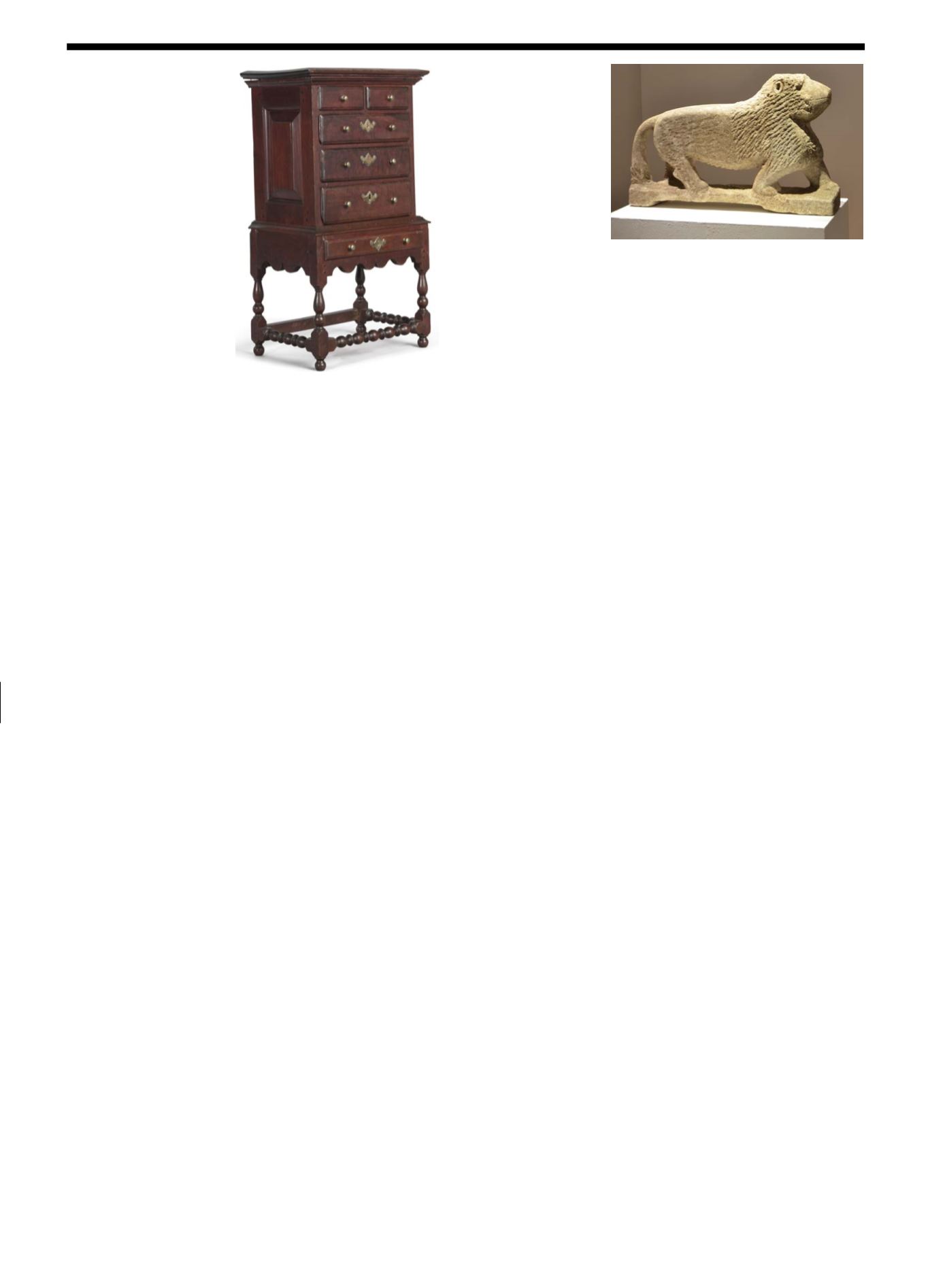
A record $612,500 (est. $80,000/120,000)
was paid for this miniature William and
Mary turned and joined walnut flat-top
high chest of drawers, with paneled sides
and original cast brass hardware. It was
made in Chester County, Pennsylvania,
circa 1725, and was used as a valuables
cabinet. Sotheby’s.
William Edmondson’s
Lion
sold to New York City col-
lector Jerry Lauren for $511,500 (est. $200,000/300,000).
Christie’s.