


 37 / 213

Maine Antique Digest, March 2017 9-A
Lunders Give Another $100 Million-Plus
Gift to Colby College
C
olby College in Waterville, Maine,
has received another gift of more than
$100 million from Peter and Paula Lunder
in support of the Colby College Museum of
Art. The gift will add nearly 1150 artworks
to the museum’s collection and will launch
the Lunder Institute for American Art.
The institute will be dedicated to the prac-
tice, study, and exhibition of American art,
and will transform Colby’s art collection and
scholarly activities by bringing together art-
ists, curators, scholars, and students through
cross-disciplinary engagement. A residency
program will provide increased opportuni-
ties for students of all disciplines to interact
with scholars and artists.
“The Lunders’ generosity has trans-
formed Colby College and the arts land-
scape in Maine,” said David A. Greene,
president of Colby College. “Now, with
this gift to significantly expand the col-
lection and create the Lunder Institute, the
museum will become a global destination
for artists, scholars, and visitors.”
The gift includes paintings, sculptures,
photography, and works on paper that date
from a 1501 engraving by Albrecht Dürer
to a 2014 aquatint by Julie Mehretu. The
more than 150 artists include Mary Cassatt,
Jasper Johns, Nina Katchadourian, Jacob
Lawrence, Maya Lin, Joan Mitchell, Claes
Oldenburg, Betye Saar, Vincent van Gogh,
Rembrandt van Rijn, Ai Weiwei, Fred Wil-
son, and James Abbott McNeill Whistler.
The gift brings the total number of works
given by the Lunders, who are longtime
benefactors to the college and the museum,
to more than 1500. The latest gifts join hun-
dreds of pieces previously promised and
given in 2007, valued at more than $100
million.
Admission to the Colby College Museum
of Art is free. Hours are Tuesday through
Saturday, 10 a.m. to 5 p.m., and Sunday,
noon to 5 p.m. The museum also is open
Thursdays until 9 p.m. during the academic
year. For additional information, visit the
website
(www.colby.edu/museum).
Buttersworth Tops Doubleday Collection Sale at Doyle
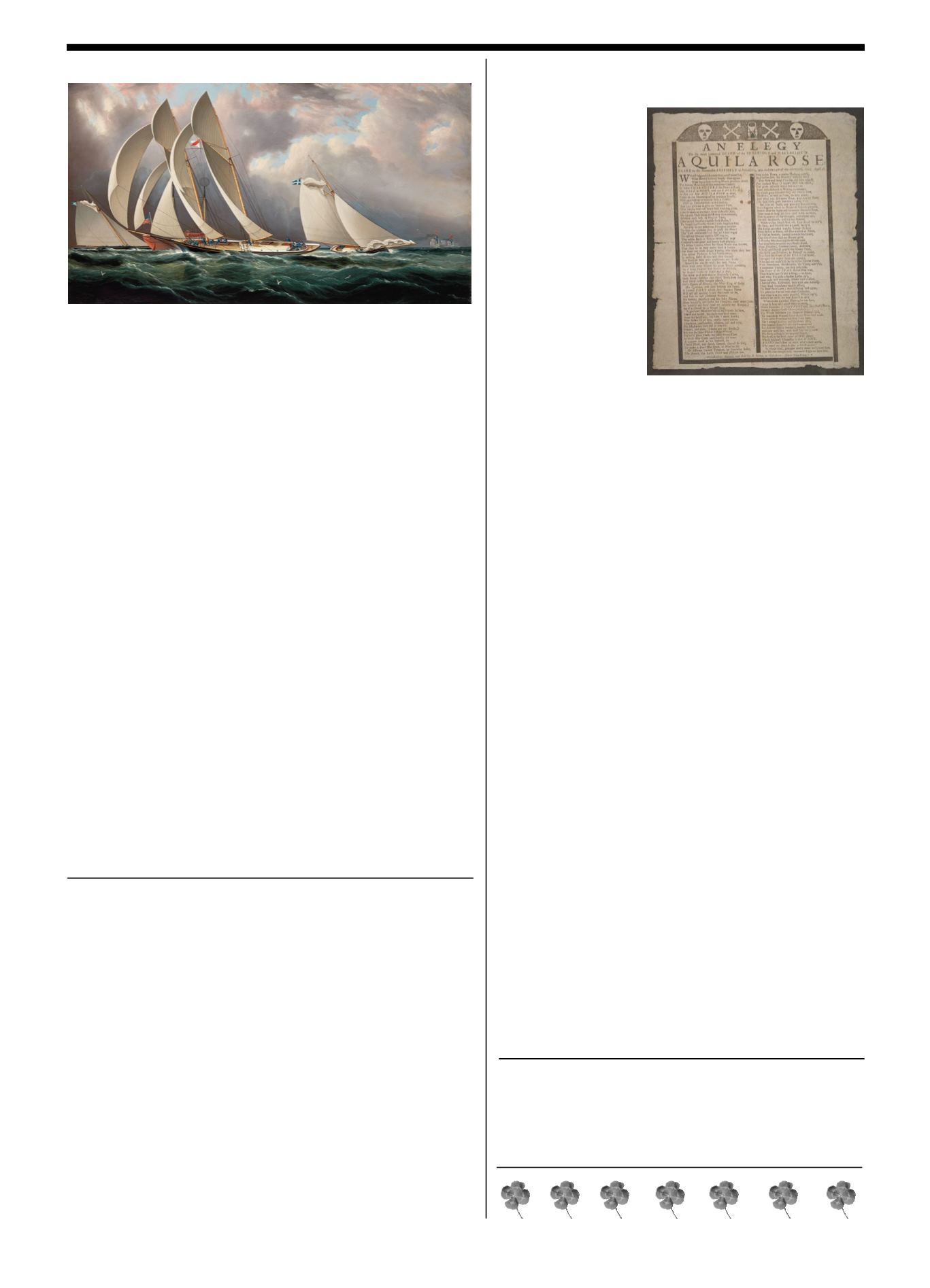
This signed oil on canvas by James E. Buttersworth,
Yacht Racing off Sandy Hook
, 20
1
/
8
" x 36",
was the top lot of the sale at $348,500 (est. $200,000/300,000). It sold to Alan Granby of Hyland
Granby Antiques, who was bidding in the salesroom.
by Julie Schlenger Adell
T
hree marine paintings by James Edward
Buttersworth (British /American, 1817-
1894) and one pair attributed to him were
part of the sale of the collection of Nelson
Doubleday Jr. at Doyle in New York City
on January 11.
Yacht Racing off Sandy Hook
, a signed
oil on canvas, 20
1
/
8
" x 36", sold in the sales-
room to Alan Granby of Hyland Granby
Antiques, Hyannis Port, Massachusetts,
whose only competition came from a
bidder on the telephone. Estimated at
$200,000/300,000, the painting was ham-
mered down at $280,000 and with buyer’s
premium sold for $348,500. Granby said he
was happy with his purchase and bought it
for himself. “It’s one of the five best But-
tersworths,” he declared.
Racing in New York Harbor
, a Butters-
worth painting that came up for sale at
Sotheby’s the following week, on Janu-
ary 21, sold for $300,000. Estimated at
$250,000/350,000, the 24" x 32" circa 1875
oil on canvas was from the collection of E.
Newbold and Margaret du Pont Smith.
At a reception held at Doyle a few days
before the auction, the historian at the New
York Yacht Club, John Rousmaniere, com-
mented, “Buttersworth’s style is so natural.
The waves look right. Buttersworths have
the details,” he noted. “They are portraits,
but more than portraits.”
Anne Cohen DePietro, Doyle’s director
of American art, wrote in the lot notes that
the painting “captures the drama of the June
14, 1877, annual regatta of the New York
Yacht Club off Sandy Hook, New Jersey.
At right center is the
Active
, the yacht of
Frank W. J. Hurst, treasurer of the NYYC,”
who is likely to have commissioned the work.
The entire sale of 275 lots totaled
$2,414,176 with 96% of lots sold.
The auction attracted dealers and col-
lectors of fine art and sculpture, sports
memorabilia, jewelry, furniture, and dec-
orative accessories (mostly Georgian), and
it included the library of books and man-
uscripts from the Doubleday estate on the
North Shore of Long Island, New York.
Doubleday (1933-2015) lived most of
his life in Oyster Bay and Locust Valley
on the North Shore. He joined the family
publishing company as a young man and
became president and chief executive of
Doubleday and Company in 1978. He
sold the company in 1986, the same year
he became the majority owner of the New
York Mets, who won the 1986 World Series
in a dramatic win against the Boston Red
Sox. Doubleday was an avid yachtsman.
His collection of marine paintings included
works by Montague Dawson and Robert
Salmon as well as those by Buttersworth.
The other paintings by Buttersworth in
the sale were
New York Harbor with Castle
Clinton, a Pilot Ship and a Frigate
, signed,
8" x 10", estimated at $25,000/35,000,
which sold for $68,750; and
Yacht Race
with Tugboat Towing a British Ship to
Sea
, signed, 8
15
/
16
" x 12
13
/
16
", estimated at
$12,000/18,000, which sold for $9375.
Memorable Race I
and
Memorable Race
II
, the pair attributed to Buttersworth, each
7" x 11", estimated at $6000/8000, sold for
$5625.
Further information is available online
(www.doyle.com) or by calling (212)
427-2730.
Long-Lost First Franklin Broadside Acquired
by Penn Libraries
by Lita Solis-Cohen
A
quila Rose, a 28-year-old
Philadelphia poet and
pressman, died in 1723. That
same year Benjamin Frank-
lin broke his indenture with
his brother, left Boston, and
stopped in New York to see if
the printer William Bradford
had a job for him. Bradford
did not have a job, but he told
Franklin that his son Andrew,
a printer in Philadelphia, had
lost his pressman to death.
Seventeen-year-old Franklin
headed to Philadelphia.
According to James Green,
librarian at the Library Com-
pany in Philadelphia and an
expert on Franklin and his
printing, by the time Franklin
got to Andrew Bradford, the
job had been filled, but the
older Bradford, who had jour-
neyed by horseback to Phila-
delphia to see his son, said to Franklin,
“‘Let’s go see this new guy that came
to town.’ They went to find the crazy
Samuel Keimer.”
Green said that Franklin wrote about
his visit to Keimer in his autobiogra-
phy. Franklin arrived when Keimer
was setting type for an elegy to Aquila
Rose but did not have his press set up.
Franklin offered to set up the press and
finish the job. He set the type in two
columns, made a woodcut of skull and
bones for the top, and put a mourning
border around it. Keimer was pleased
with the job and gave Franklin some
work. Franklin stayed in Philadelphia,
had great success as a printer, helped
establish every major cultural institu-
tion in the city, including the Univer-
sity of Pennsylvania, Pennsylvania
Hospital, and the Library Company,
and played an important role in the
formation of the United States.
It is not known how many copies of
the Aquila Rose elegy broadside were
printed and pasted up in public spaces.
One surfaced in the 1820s when Sam-
uel Hazard, a Philadelphia historian
who went door to door searching for
documents, found one and printed
the elegy. Then it disappeared until
Carmen Valentino, a Philadelphia
dealer in rare books and manuscripts,
bought Hazard’s scrapbook. In that
scrapbook he found the broadside. In
January, Penn Libraries, Philadelphia,
announced that it had acquired the
broadside.
Valentino said he thinks his find of
the Hazard scrapbook is as important
as when his mentor Joseph Molloy
found a copy of John Dunlap’s first
printing of the Declaration of Inde-
pendence in a chest during the Leary’s
Book Store clearing-out sale in Phil-
adelphia in 1968. In 1969 the Dunlap
broadside sold at Freeman’s in Phila-
delphia for $404,000. The Aquila Rose
elegy is much rarer.
Valentino won’t say where he found
it, how long he has had it, or what he
sold it for. He did say that he removed
the Aquila Rose elegy from the scrap-
book and had it professionally con-
served. When he sold it to Penn Librar-
ies, he included the scrapbook in the
deal.
“I’m known for
not
breaking up
archives,” Valentino said. “Hazard is
important. He read Franklin’s autobi-
ography carefully, and that is where he
got the idea to look for the first thing
that the seventeen-year-old Franklin
printed in Philadelphia.
“I give credit to the provost and the
Penn librarians who did their homework
and realized how important this broad-
side is to Philadelphia and to the nation.
They realized that Franklin’s introduc-
tion of Puritan Boston imagery [skull
and bones] was alien to Quaker Phila-
delphia, but Franklin made it work. It is
an important image in Philadelphia art
history, and now it will be the first thing
in the Franklin bibliography.”
According to Penn Libraries’ Kislak
Center for Special Collections, Rare
Books, and Manuscripts curator Arthur
Mitchell “Mitch” Fraas, scholars know
of around 900 surviving works printed
by Benjamin Franklin. “Many of these
works, especially broadsides and small
ephemeral pieces, exist in only one or
two copies,” explained Fraas. “The
Penn Libraries now hold more than a
third of his print production, making our
collection of Franklin’s printing among
the most important in the world.”
Fraas also pointed out that Aquila
Rose was a writer and pressman just
like Franklin. “His work was pub-
lished posthumously in London the
following year; it was quite something
for an American poet to be published
abroad.” Fraas said the scrapbook is
an important artifact too. “It shows us
how an antiquarian looked at the past
in that period. It seems right that these
treasures have come to an institution
Franklin founded.”
The broadside was on exhibition
from January 17, Benjamin Franklin’s
birthday, until February 10 in the Van
Pelt-Dietrich Library Center at Penn
Libraries.
Photo courtesy Penn Libraries.
Antiques Week in New Hampshire Show Change
G
urley Antique Shows has announced that the Americana Celebration show,
also known as the Deerfield Antique Show, will be on Monday, August 7,
and will return to the Deerfield Fairgrounds in Deerfield, New Hampshire. For
more information, call Joshua Gurley at (207) 229-0403 or Rachel Gurley at
(207) 396-4255.