


 32 / 213

4-A Maine Antique Digest, March 2017
Letters
Obituaries
The Meeting Place
COMMON REVOLVER
Ian,
The French revolver you featured in
the February “Letter from London” (see
p. 6-D) is common and a good example
worth no more than several hundred dol-
lars. They are best known for having been
supplied to the Confederate States and
supposedly carried by the cavalry in their
boots as a “backup” weapon. That they
were so supplied is well documented, but
I have always been skeptical as to their
value in the heat of battle, being of small
caliber and rather crudely made (even
for the time). If it had been my choice,
I’d have picked a bowie knife. I own an
example which is quite rare for bearing a
“CSA” stamp on the frame. I always enjoy
your column. Keep up the good work!
Bill Rogers
via e-mail
OLD WAYS FOR YOUNG PEOPLE
Dear
M.A.D.
,
Bill and I just read the Young Collec-
tor’s article “A Poor State of Affairs” by
Hollie Davis and Andrew Richmond in
the January issue (see p. 3-D). We found it
to be incredibly well written and very true.
The only point they did not mention was
one we have noticed over the past eight or
so years. This is the fact that this scorn of
antiques (for fear of seeming poor) seems
to have been exacerbated by, if not caused
by, the 2008 depression. Now, since then,
young people are not only actually less
well off than their parents, but the future
does not seem to promise them that they
eventually will be better off.
When we were young (60 years ago)
we expected to start off married life with
castoffs and secondhand stuff. Because
we had been raised in the presence of
antiques, we haunted junk shops for good
old pieces and cheerfully refinished and
repaired them, gloating over our finds.
Though we as a generation probably
destroyed many an “old finish,” we did
salvage and enjoy a lot of antiques. This
delight in discovery and restoration and
use is not a part of present-day young
folks’
Zeitgeist
—sad. There are still junk
shops in which can be found salvageable
old furniture, which to use and display
will demonstrate not poverty but good
taste, appreciation for quality and history,
and a frugality to be admired. Not even to
mention the joy of the hunt!
Sincerely,
Emery Goff and Bill Carhart
Farmington, Maine
OLD ENGLAND/NEW ENGLAND?
Dear Clayton,
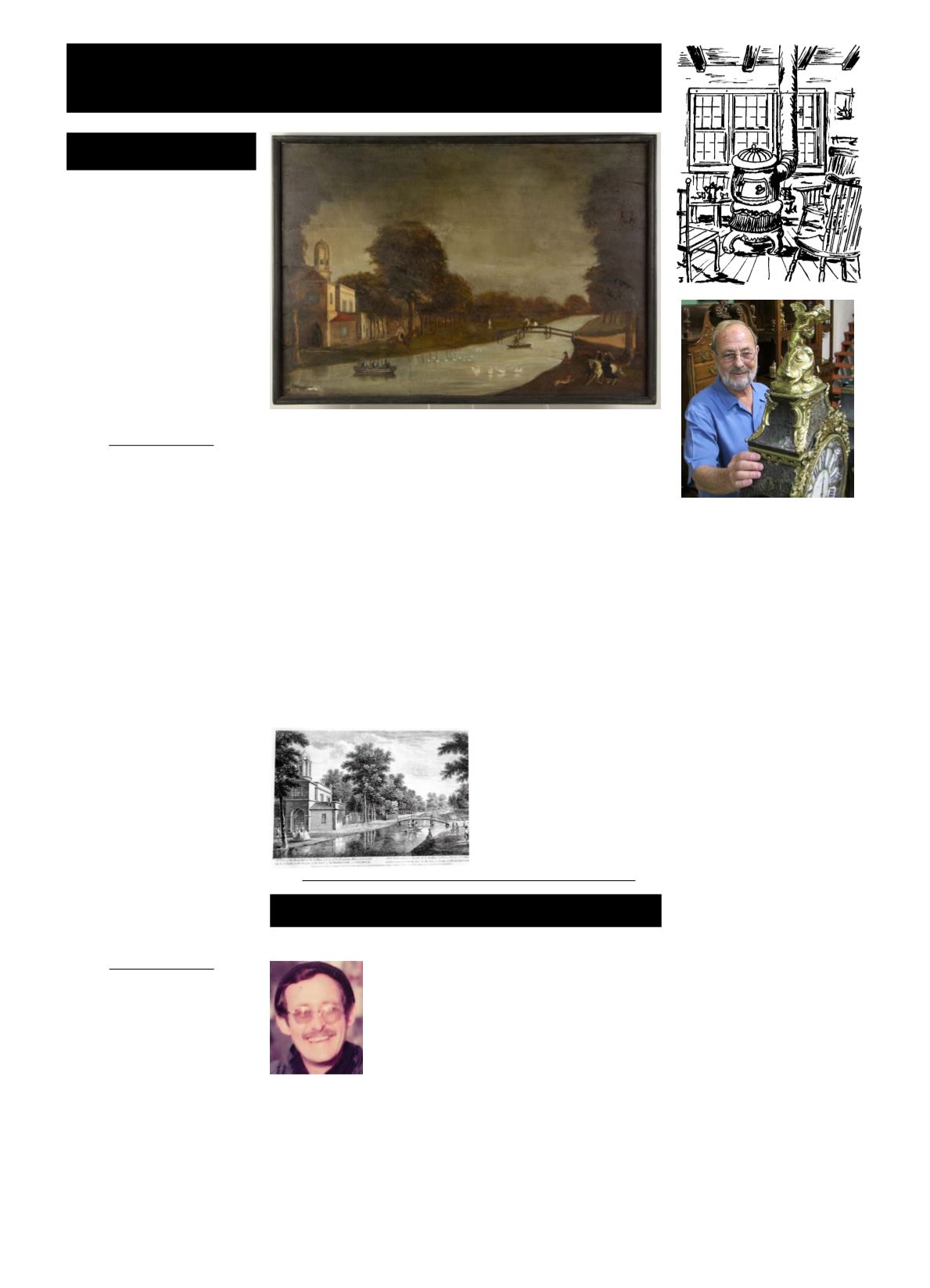
I was happy to see that Walter C. New-
man included a photo of a curious land-
scape painting in his review of the Jeffrey
S. Evans, Mt. Crawford, Virginia, sale of
November 12, 2016 (“Folk Art Cutwork
Leads Evans Sale,” Feb. 2017, p. 26-D).
I had noticed this object when I pre-
viewed the sale online in early Novem-
ber, but I didn’t agree with some of the
auctioneer’s comments, many of which
Newman repeated in his photo caption:
unidentified folk art view, unsigned, oil
on three-board panel, likely New England
origin, from the second half of the 18th
century.
In my opinion, this charming scene—is
it really “folk” since there are some rather
well-painted aspects?—is an 1830s/1840s
somewhat imaginary view of a part of
the “picturesque” garden surrounding the
early 18th-century neo-Palladian Chis-
wick House, still standing in Chiswick,
England, a western suburb of London.
The painting could be English or Amer-
ican—difficult to say the exact place of
origin—and while it might have been cre-
ated as an overmantel (because of the size
and the minimal frame), it really could
have been hung anywhere in a house.
On the left we see the back of a gar-
den pavilion known as the Bagnio or the
Casino (demolished 1778), and in the cen-
ter we see the Serpentine River or Great
Canal (which was actually a stream, Bollo
Brook, widened to form an artificial lake)
with its wooden bridge, replaced in 1774
by a much grander one of stone. There
was—and remains—a cascade and grotto
at the far right end of the river, but I can’t
tell if it appears in the painting.
Chiswick House, with its “folly-filled”
garden, was begun in the 1720s by
Richard Boyle, 3rd Earl of Burlington,
assisted by several design professionals
(including Colen Campbell and William
Kent) adjoining an older family house,
and it was well known from its origin.
This fame continued long afterward, and
because books have been written on the
subject, I need not do the same here. Suf-
fice it to say that the property, after some
years of neglect in the 19th and 20th cen-
turies, has been in the gracious care of
English Heritage for some time, its res-
toration is ongoing, and it is open to the
public.
There were numerous paintings and
prints made of the house and the garden
in the 18th and 19th centuries, and the
prints were widely circulated in England,
Europe, and North America. The Evans
panel relates to several prints known to
me—including a vignette on a marvelous
1736 map of the property by John Rocque
—but it is so similar to a circa 1753
engraving taken from a painting (lost?)
by John Donowell that I believe this print
to be the painting’s direct inspiration.
Both the Donowell print and the paint-
ing have figures and animals scattered
about, but the costumes of the Evans
painting are undoubtedly 19th century.
Looking at the price realized of
$3510 versus the presale estimate of
$800/1200, I suspect that I am not the
only person who recognized the back-
ground of this interesting work!
Ed Polk Douglas
Lyons, NY
THOMAS LIVINGSTON
Thomas W. Livingston, 80, of Oakland,
California, passed
away on January
24. He was born in
1936 in Oak Park,
Illinois, to David
and
Euphemia
Livingston.
Livingston was
the first Peace
Corps volunteer
to receive an experimental, overseas
assignment, teaching English in Ghana
from 1961 to 1963. Upon his return, he
obtained his Ph.D. in African history at
Columbia University and served as a
professor at the University of California,
Berkeley from 1968 to 1975.
His professional career then turned
to his passion for antiques and the dec-
orative arts, and until his death he was
well known and respected as the owner
of Thomas Livingston Antiques, San
Francisco. He was a kind gentleman and
scholar of art and history, who enjoyed
sharing his knowledge with visitors to his
antiques shop.
Livingston, a skilled pianist, and his
partner, Karel Wessel, enjoyed entertain-
ing friends in their Oakland apartment,
which displayed their collection of art and
antiques. His passion for the decorative
arts is evidenced by his roles as founder
and ardent supporter of the American
Decorative Arts Forum.
Livingston is survived by his life part-
ner, Karel F. Wessel of Oakland; his
nephews, David Livingston III (Nancy)
of Glen Ellyn, Illinois, and Robert Liv-
ingston (Beth) of Columbia, Missouri;
great-niece, Jenna; great-nephews Con-
nor, Barry, Seth, and Neil; and many dear
loyal friends.
Donations may be made at Berkeley
Society of Friends, 2151 Vine Street,
Berkeley, CA 94709 or online (www.
berkeleyfriendsmeeting.org/donate).
DON PRESLEY
The antiques trade lost one of its true
originals on January 12 with the passing
of Don Presley, principal auctioneer and
owner of Don Presley Auction Co., Santa
Ana, California. Presley had fought a
long and courageous battle against can-
cer, vowing that he would “never give
up without one heck of a good fight.” He
was 71 years old.
Donald Ray Presley was born in Shaw-
nee, Oklahoma, in 1945. He was the son
of George and Cynthia Presley, Oklaho-
mans who moved their family to Midway
City, California, in the 1950s.
Presley’s first jobs were working in
construction and at Gotham Steel. After
being injured in a forklift accident at the
steel plant, he underwent major back sur-
gery and spent much of his lengthy recov-
ery time in bed. According to family lore,
while recuperating, he became infatuated
with an audiotape someone gave him of
an auctioneer conducting a sale. He lis-
tened intently, mimicking what he heard,
and soon developed a cadence of his own.
According to his wife, Kimberly, Don
“got the bug, then and there.”
In the beginning of his new career,
Presley would call auctions for free to
gain experience. Later, as his confidence
and reputation grew, he started charging a
fee for his services.
From 1998 through 2012, Presley ran
his own company, Don Presley Auction
Co., from a gallery on West Katella Ave-
nue in Orange, California. His sales were
known for their welcoming atmosphere,
catered Mexican feasts, and Presley him-
self, whose lively auctioneering style was
punctuated by his quick wit and engag-
ing Oklahoma drawl. When Don Presley
Auction relocated in 2014 to its current
venue on South Main Street in Santa Ana,
California, the company’s loyal clientele
followed.
Presley’s friendly rivals often scratched
their heads in amazement over the way
he was able to get into Beverly Hills and
Newport Beach mansions to secure con-
signments. Those closest to him explained
that it was because he had kept the same
friends he knew from his youth. Many
were sons of immigrants who had arrived
in California with very little money, but
as adults they had become wealthy from
building successful businesses. When-
ever they wanted to sell art or downsize
Photo courtesy Frank Donadee.