


 39 / 213

Maine Antique Digest, March 2017 11-A
for Outsider art, Chinese export porcelain, and for the
single-owner Palmetto Hall sale. Palmetto Hall is a
plantation house in Mobile, Alabama, that the Jay P. Alt-
mayer family filled with English and American furniture,
English silver and porcelain, portraits of American wor-
thies, and southern landscapes. The Palmetto Hall sale
produced the only million-dollar lot of the week, a large
painting of the
North Shore of Lake Pontchartrain at
Mandeville
by Richard Clague (1821-1873). Estimated
at $120,000/180,000, it sold for $1,627,500 (including
buyer’s premium) to appraiser, broker, and consultant
Amanda Winstead of New Orleans, who was bidding for
a client. The price is a record for the artist. It boosted the
total for the sale to $5,364,625 and 92% sold by lot.
At the Altmayer sale, dealer Robert M. Hicklin, Jr.
of Charleston, South Carolina, paid $487,500 (est.
$60,000/80,000) for
Southern Hardwood Swamp Scene
,
a 22" x 26" oil on canvas by Hermann Herzog (1832-
1932). The underbidder of the Clague painting bought
William Henry Buck’s
Lookout Fishing Club
, a 12" x
20" oil on canvas, for $162,500 (est. $50,000/70,000).
Bay St. Louis Plantation Scene
by Buck, a 22¼" x 36"
oil on canvas laid down on board, brought $106,250
(est. $70,000/100,000). James Henry Beard’s portrait
of Zachary Taylor, a 49" x 38¾" oil on canvas, went
to a phone bidder for $187,500. A set of eight Ameri-
can Chippendale-style brass-inlaid and carved mahog-
any eagle shield-back decorated dining chairs sold for
$68,750 (est. $5000/10,000) to manuscript dealer Seth
Kaller for a client.
Four of Christie’s six auction records in January were
for Outsider art. With 78% of the lots selling, the total
for the Outsider art sale came to $1,242,750. William
Edmondson’s
Lion
sold to New York City collector Jerry
Lauren for $511,500 (est. $200,000/300,000), account-
ing for nearly half of the sale total. It was underbid by
the trade bidding for a collector in the salesroom. It is the
second-highest price for an Edmondson. A year ago his
Boxer
, 1936-37, sold for $785,000 at Christie’s, underbid
by Lauren.
Cara Zimmerman, Christie’s Outsider art specialist,
called her sale “Courageous Spirit: Outsider and Ver-
nacular Art,” which also reflects Christie’s courage in
investing in this growing field. There was a lot of energy
in the Christie’s salesroom at the Friday morning session,
but the crowd did not stay for the furniture and silver sale
that followed. Perhaps one day they will.
Christie’s sixth record for the week was for a Qianlong
period Chinese export snuffbox decorated with a Bibli-
cal subject that brought $32,500 (est. $10,000/15,000)
on Wednesday, January 18. Becky MacGuire, Christie’s
specialist for China trade sales, said she was pleased
with the $1,776,626 total and that 76% of the lots sold,
many for well over the estimates. That sale went head-to-
head with the Hamilton sale at Sotheby’s on Wednesday
afternoon.
Sotheby’s began its week of sales with the 100% sold
auction of the Hamilton papers. There is a tradition that
when every lot sells in a sale, a pair of white gloves is
presented to the auctioneer. Selby Kiffer, Sotheby’s
international specialist of books and manuscripts, was
the auctioneer and oversaw the sale. Eleven lots sur-
passed the previous auction record for any Hamilton
manuscript, $44,650, which was established at Christie’s
in May 2001 for a letter to William Heth in which Ham-
ilton references his duty as secretary of the treasury. Con-
tent determines the value of letters, and Hamilton letters
relating to the establishment of banks have brought a pre-
mium in the past.
There were no banking letters among the seven lots
that topped $100,000 at Sotheby’s. The previously unre-
corded draft of Hamilton’s Pacificus Essay No. VI, in
which Hamilton takes the side of revolutionary France in
its nascent war with European powers, brought $262,500,
a record for any Alexander Hamilton manuscript. It sold
to a collector on the phone. The draft, which Hamilton
wrote under the pen name Pacificus, is the only surviv-
ing manuscript of an essay that was incorporated into the
1802 edition of
The
Federalist
, considered Hamilton’s
most famous work.
The Federalist
is a compilation of
essays by Hamilton, James Madison, and John Jay that
first appeared in New York newspapers with Hamilton
using the pen name Publius.
Alexander Hamilton’s appointment as aide-de-camp
to General George Washington, which jump-started his
career, sold in the salesroom for $212,500 to Joe Fay,
bidding for dealer William Reese of New Haven, Con-
necticut, who said it was bought for a private collector.
The Hamilton sale surpassed its presale high estimate
of $2.1 million, figured without the buyers’ premiums.
Kiffer said members of the company of the play
Ham-
ilton
as well as seasoned collectors were bidding on the
phones. One newly impassioned historian, Zack Pelosky,
in fifth grade at the Friends Seminary in New York City,
came to the sale to spend money he had saved to buy
something, but he was not successful. He said he has
seen the musical three times and has
a passion for Hamilton, “not just
the musical but the man and for the
American Revolution.”
Manuscript dealer Seth Kaller,
a successful bidder on a number
of lots, bidding for clients and for
stock, said he thought the sale did
well, and he will exhibit some of
his purchases at the New York Anti-
quarian Book Fair at the Park Ave-
nue Armory, New York City, March
9-12.
Dealers pointed out that the let-
ters were not in good condition,
many have water stains, and some
have clipped signatures, a practice
common since the 19th century
when collectors pasted autographs
in books.
“Hamilton has long been col-
lected by hedge-fund managers who
buy letters relating to banking, but
this sale was filled with sentimental letters,” said Reese
after the sale. For example, a private collector bidding
online paid $118,750 (est. $40,000/60,000) for Hamil-
ton’s earliest surviving love letter to his future wife, Eliz-
abeth Schuyler. Hamilton’s letter to Elizabeth, announc-
ing that the army was preparing to engage Cornwallis in
Virginia and telling her it would not be prudent for her to
join the expedition to Yorktown, sold for $106,250 (est.
$30,000/50,000), even thoughAlexander Hamilton’s sig-
nature is cut away.
On January 19 at Sotheby’s, collectors bid on furniture
and English silver, some of it of the sort that Alexander
and Elizabeth Hamilton could have owned or used. It
came from the collection of George S. Parker II (1929-
2004), who assembled a study collection of Colonial and
Federal furniture in the 1970s and 1980s with the advice
of Pennsylvania scholar and conservator Alan Miller (see
p. 32-E). Parker gave the collection to the University of
Wisconsin to be used as a teaching tool, but after 20
years the university no longer wanted to care for it, and
it was consigned to auction. Sotheby’s used the occasion
to present a scholarly day-long symposium with leading
scholars discussing the fine points of connoisseurship of
American furniture and Parker’s collection of English
silver. Free to the public, it was better than many forums
offered by museums and educational institutions that
require expensive tickets.
Did the symposium influence bidding? Perhaps. The
total for the Parker sale was $5,034,104 and 85.9% sold
by lot. Major lots were bought by dealers, some for cli-
ents; a few collectors did their own bidding; and some
lots failed to sell.
“The market seemed wide and thin,” said Alan Miller
after the Parker sale. “There was someone bidding for
most of the lots but not a lot of competition, making this
a great time to be a collector. I think we witnessed the
formation of a new market.”
Erik Gronning was heartened to see “the spectacle of
this year’s Americana Week embraced by collectors, and
there was something for everybody.” He was not sorry he
had so much to sell and believed that the large amount of
material available encouraged participation. He clearly
enjoyed handling the diversity of collections and was on
the phone constantly with collectors during the sales. “I
think the results confirmed that Americana is alive and
well,” he said.
Sotheby’s sold American furniture and decorations
for various owners on Saturday afternoon, January 21,
beginning with the collection of the late E. Newbold and
Margaret du Pont Smith, a collection assembled over
two generations. It was offered in a separate catalog and
was followed by more furniture, folk art, and decorations
from various owners in a five-hour session that was not
over until after 7 p.m.
The Smith sale will be remembered for the record
$612,500 (est. $80,000/120,000) paid for a miniature
William and Mary turned and joined walnut flat-top high
chest of drawers, with paneled sides and original cast
brass hardware. Made in Chester County, Pennsylvania,
circa 1725, it was used as a valuables cabinet. The buyer
in the salesroom was Leigh Keno, sitting between his cli-
ents John and Marjorie McGraw. The underbidder was
collector Steve Smith. When the small tall chest sold at
Sotheby Parke Bernet’s sale of the Garbisch collection in
May 1980 for $33,000, Peggy Smith thought she might
have overpaid because it was $10,000 more than the
other spice chests in that sale. Jack Lindsey included it
in the Philadelphia Museum of Art’s exhibition
Worldly
Goods: The Arts of Early Pennsylvania, 1680-1758
in
1999.
Also in the Smith sale was a Queen Anne tall-case
clock, the works by Peter Stretch and the cherrywood case
attributed to John Head, Philadelphia, circa 1750. It sold
for $348,500 (est. $150,000/300,000) to Luke Beckerdite
for a client furnishing a grand house. It is a record for any
furniture by John Head. Its dial is engraved with the motto
“
Tempus Rerum Imperator
,” which translates to “Time is
the commander of all things.” The clock is illustrated in
Stretch: America’s First Family of Clockmakers
by Don-
ald L. Fennimore and Frank L. Hohmann III.
Steve Smith paid $212,500 (est. $250,000/500,000)
for a Philadelphia sofa with dramatic back-swept arms.
A collector on the phone got a Philadelphia compass-seat
walnut armchair for $187,000 (est. $250,000/350,000),
and a Philadelphia compass-seat easy chair went to Del-
aware dealer James Kilvington for a client for $106,250.
The Newbold Smith sale added $3,386,188 to the week’s
total. Pennsylvania dealers Skip Chalfant and Philip
Bradley were major buyers.
The Nicholas Brown figured mahogany scalloped-top
tea table with open ball-and-talon feet, made in Provi-
dence, Rhode Island, circa 1765, that descended in the
Brown, Ives, and Goddard families and is pictured on the
Sotheby’s various-owners sale catalog sold for $912,500
(est. $800,000/1,200,000) on the phone without compe-
tition. It was the highest price for a piece of American
furniture during the week, but it missed the million-dol-
lar mark.
An appealing sculptural form, it has a compelling his-
tory. It was made to match another tea table made by John
Goddard in Newport for Nicholas Brown that sold at
Sotheby’s in 2005 for $8,416,000 to Albert Sack, under-
bid by Leigh Keno. The craftsman, who was probably in
Providence where John Brown lived, was familiar with
the Goddard shop practices, but the carving is clearly by
another hand. Moreover, a drawer was added to the table
between 1795 and 1815. Both tables and another are
listed in Nicholas Brown’s 1791 estate inventory. One is
valued at £2, another at £3-15-0, and the third at £4-10-0.
Nicholas Brown left his estate to his three children.
Both tea tables descended to Hope Brown, who mar-
ried Thomas Poynton Ives (1769-1835), a partner in the
Brown family firm. She died in 1855. This tea table along
with the tea table sold at Sotheby’s in 2005 descended
to their daughter Charlotte Rhoda Ives (1792-1881),
who married William Giles Goddard (1794-1846). He
graduated from Brown University and was a professor
of philosophy at the university. After Charlotte
Ives Goddard’s death in 1881, the two tables
☞
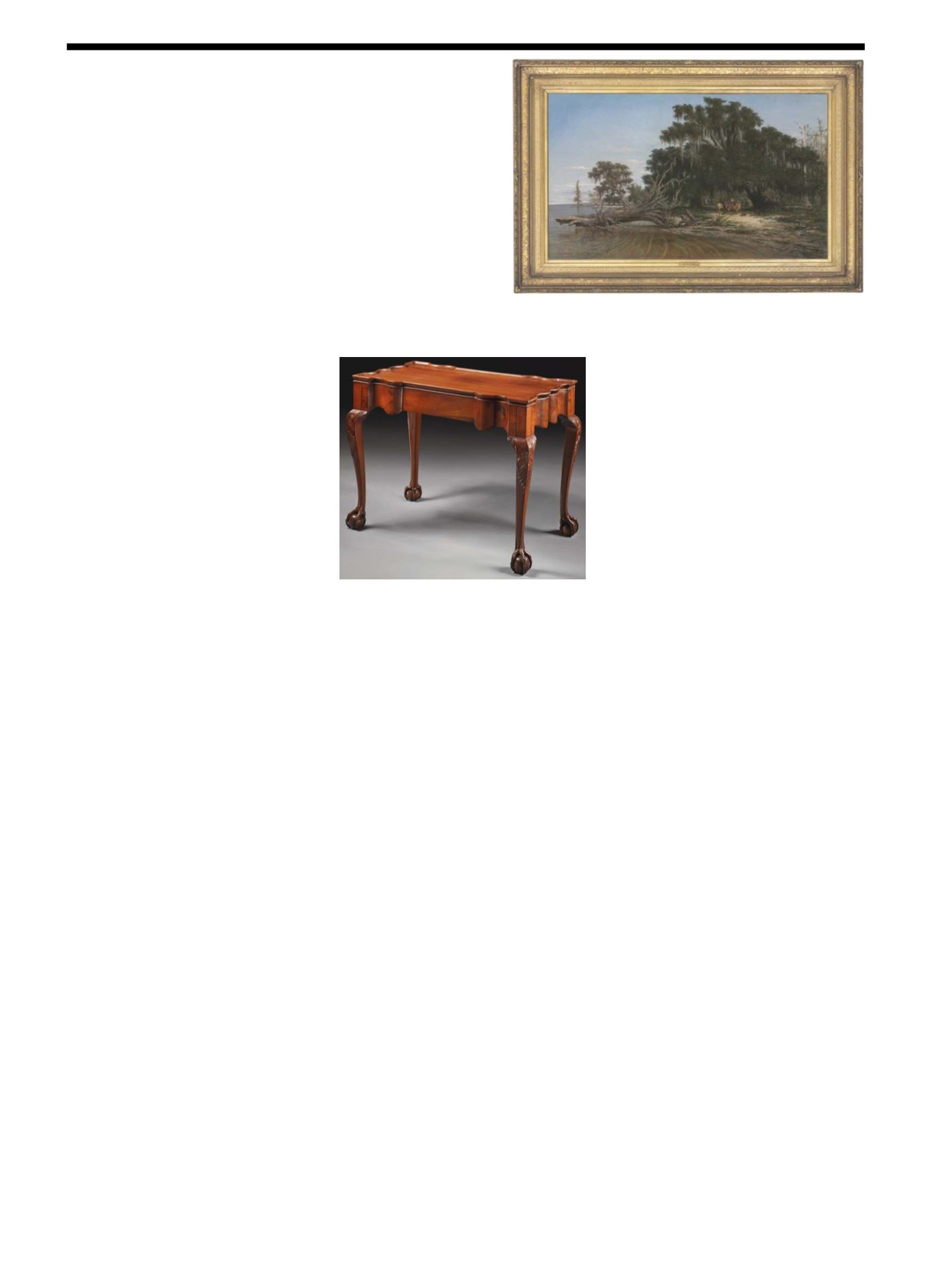
North Shore of Lake Pontchartrain at Mandeville
by Richard Clague (1821-1873),
sold for $1,627,500 (est. $120,000/180,000) to appraiser, broker, and consultant
Amanda Winstead of New Orleans, who was bidding for a client. Christie’s.
Nicholas Brown figuredmahogany scalloped-top tea table
with open ball-and-talon feet, made in Providence, Rhode
Island, circa 1765, $912,500 (est. $800,000/1,200,000).
Sotheby’s.