


 205 / 213

Maine Antique Digest, March 2017 33-E
-
AUCTION -
33-E
Parker was not known to the New
York collecting community. He
rarely came east. Often he did
not see what he bought until it was
delivered to his Janesville, Wisconsin,
house. From the 1980s until he died
in 2004, he relied on Alan Miller, a
conservator and furniture scholar from
Quakertown, Pennsylvania, to bid and
to buy for him. Before he met Miller,
Parker bought from John Tompkins
of Millbrook, New York, and John
Walton of Jewett City, Connecticut.
Miller is not a dealer. Sometimes he
found furniture in dealers’ inventories,
but most often he bought at auction,
so price histories are available. Miller
said Parker always placed art before
condition and sought furniture that had
a story to tell because he was putting
together a study collection to be used
as a teaching tool. He wanted to be
able to understand the development of
American furniture from the earliest works to the Federal
period made from New England to the Middle States.
He gave his collection to the University of Wisconsin
through his Caxambas Foundation. The university used
it for 20 years and then consigned it to Sotheby’s.
The Parker sale did well. Of the 256 lots offered,
220 sold for $5,035,104; that is 85.9% by lot. Advisors
Luke Beckerdite and Alan Miller were major buyers,
and dealers Skip Chalfant, Philip Bradley, and James
Kilvington represented clients and also bought for
stock. Some New England dealers were active in the
salesroom, and the trade and private collectors competed
in the salesroom, on phones, and online. Estimates were
reasonable, reflecting today’s market and the fact that
many pieces were restored.
Although Parker’s Rhode Island block-and-shell
kneehole bureau table had been published as made in
Newport, recent scholarship suggested that it was made in
Providence, making it very rare. Luke Beckerdite bought
it for $672,500 (est. $300,000/500,000), underbid on the
phone. At the sale of the estate of Mrs. Lansdell Christie
in January 1996 at Christie’s, it sold for $156,500. The
Hollingsworth-Humphreys Philadelphia piecrust tilt-top
tea table, circa 1770, sold to a collector on the phone
for $636,500 (est. $150,000/250,000), underbid in the
salesroom by Steve Smith, a discerning Pennsylvania
collector.
It is hard to explain why Charles Thomson’s mahog-
any armchair, with carving attributed to John Pollard,
Philadelphia, circa 1770, did not sell. It had a rich
old surface, and the restoration at the top of the stiles
and splat and on the rear legs was masterful, but there
was no bidding. The estimate was $200,000/300,000.
At Christie’s in June 1993, it sold for $123,500 (est.
$70,000/90,000). A side chair from the same set sold at
Christie’s in January 1987 for $341,000, then a record
for any American side chair.
New York City dealer Frank Levy said he was thrilled
to get a rare New York mahogany games table with
porringer corners, circa 1760, with its original cast brass
hardware, for $9375 (est. $10,000/15,000). He said he
had been the underbidder when it sold for $48,400 (est.
$30,000/50,000) at Christie’s in June 1992. West Chester,
Pennsylvania, dealer Skip Chalfant got a Boston turret-
corner Queen Anne walnut games table, circa 1760, for
$37,500 (est. $40,000/80,000). At Christie’s in October
1997, it sold for $74,000.
Some furniture brought more than in the past, and some
brought less. The fact that collectors and the trade were
willing to buy furniture with some restoration, much of
it minor, such as replaced knee returns, extended legs, or
replaced feet, demonstrates the strength of the market.
The fact that there was bidding on more than 85% of the
lots shows the breadth of the market, which hit bottom
during the Great Recession, has now turned around, and
is on the upswing. For more information, call Sotheby’s
Americana department at (212) 606-7130 or check the
website
(www.sothebys.com).
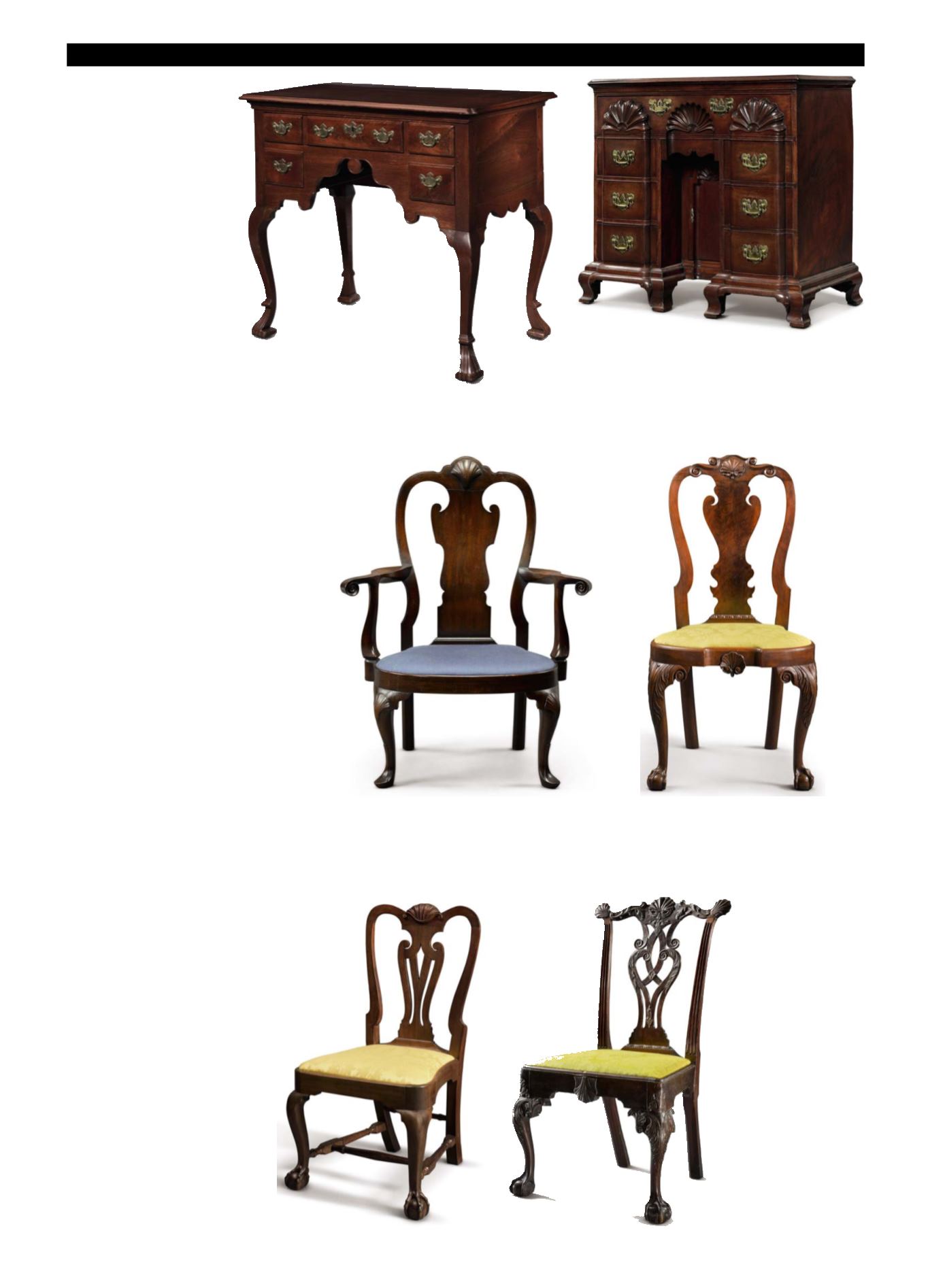
Walnut dressing table, attributed to the Irish
cabinet shop, Philadelphia, circa 1745, 29½"
high, with a Joe Kindig Jr. provenance, sold
for $10,625 (est. $10,000/15,000).
Carved and figured mahogany block-and-shell kneehole bureau
table, Providence, Rhode Island, circa 1765, with original brasses,
34½" x 37" x 18¼", sold for $672,500 (est. $300,000/500,000)
to Luke Beckerdite for a client. It has a John Walton, David
Stockwell, and collector Lansdell Christie provenance. It sold at
Christie’s in January 1996 for $156,500. Did the recent exhibition
of Rhode Island furniture and its accompanying catalog have an
influence on the market for Rhode Island furniture?
Walnut compass-seat armchair, Philadelphia, circa 1750,
set inscribed “Perot,” proper right rear leg replaced,
41½" high, with a Walter Mullen, F.J. Carey III, and Alan
Miller provenance, sold for $43,750 (est. $50,000/80,000)
to Luke Beckerdite. A more highly developed compass-
seat Philadelphia armchair sold the following Saturday at
Sotheby’s Smith sale for $187,500 (est. $250,000/350,000).
Queen Anne carved walnut compass-seat side chair,
Philadelphia, circa 1755, 42" high, proper left front foot
partially replaced, seat rail and slip seat marked “I,” sold
for $93,750 (est. $60,000/80,000) to Alan Miller in the
salesroom. At Sotheby’s in June 1990, it sold for $38,500. It
is a fully developed Philadelphia compass-seat chair, and
the color of its surface has been improved.
Queen Anne shell-carved mahogany
compass-seat side chair, attributed to
John Goddard, Newport, Rhode
Island, circa 1765, chair marked
“VI,” slip seat marked “I,” the base
of the proper right rear leg with a
triangular patch, 38¼" high, sold
on the phone for $50,000
(est. $20,000/30,000), underbid by Massachusetts dealer
Gary Sullivan. In January 1995 at Christie’s, it sold for
$9200 (est. $10,000/15,000).
Philadelphia rococo side chair,
circa 1760, the slip seat marked
“VII,” 40¼" high, with a Joseph
Kindig and William du Pont
provenance, sold for $150,000 to
Alan Miller (est. $80,000/120,000).
It is from a set that is the most
elaborate of the strapwork type,
with additional carving on the shoe
extending from the knees up onto
the corners of the seat frame. It has
shells on the ears and a shell with
pendant leafage on its crest.