


 204 / 213

32-E Maine Antique Digest, March 2017
-
AUCTION -
32-E
Sotheby’s, New York City
The Parker Sale
by Lita Solis-Cohen
Photos courtesy Sotheby’s
O
n January 19 at Sotheby’s sale of the
collection of the late George S. Parker
II, a “very fine and rare William
and Mary walnut chest of drawers” made
in Pennsylvania sold in the salesroom for
$32,500 (with buyer’s premium) to Delaware
dealer James Kilvington. That chest of drawers last sold
in 1990 at the landmark sale of the May and Howard
Joynt collection at Christie’s for $38,500. Kilvington
bought the chest for his client, a collector sitting next to
him.
Both dealer and client expected fierce competition
because conservator Chris Storb, in his blog In Proportion
to the Trouble, had written about the chest before the sale,
alerting those insiders in the world of American furniture
that it was made by John Head, a fact that Sotheby’s had
not mentioned in the sale catalog. Storb also pointed out
its remarkable state of preservation, its original brass
drop pulls and escutcheons, and its turned feet at full
height, and noted that there was very little wear on the
drawer runners. It is truly a miraculous survivor, the best
preserved of all Head chests. Most chests of this period
have lost their feet or suffered neglect when they fell out
of fashion. This one seemed to have hardly been used;
even Head’s chalk markings were pristine.
Storb knows a Head chest when he sees one. He and
conservator Alan Andersen described Head to a scholarly
audience at the 2014 Winterthur Furniture Forum when
they analyzed materials, tool use, and construction and
design, and identified Head’s chalk markings, all evident
on this chest.
John Head, mentioned as a joiner in
Hornor’s Blue
Book: Philadelphia Furniture
(1935), was first identified
as a major Philadelphia cabinetmaker by Jay Stiefel, a
Philadelphia lawyer who discovered Head’s vellum-
covered account book while he was doing research at
the library of the American Philosophical Society. The
account book has 231 pages of densely written entries
documenting Head’s daily transactions from 1718
to 1763. An English immigrant joiner, Head came to
Philadelphia in September 1717 with his wife and four of
what were to be 11 children. He worked in Philadelphia
as a cabinetmaker until 1744 when at age 56 it appears
he retired from that part of his business and continued as
a successful merchant.
The account book and Stiefel’s interpretive essays
have been available on the American Philosophical
Society website since 2001, when they were published
in its Library Bulletin. Later this year, in celebration
of the tercentenary of Head’s arrival in Philadelphia,
the American Philosophical Society will digitize the
Head account book and make it available on its website
and will publish a book by Jay Stiefel, bringing up to
date all he has learned about Head in the last 16 years
Truly a
miraculous
survivor.
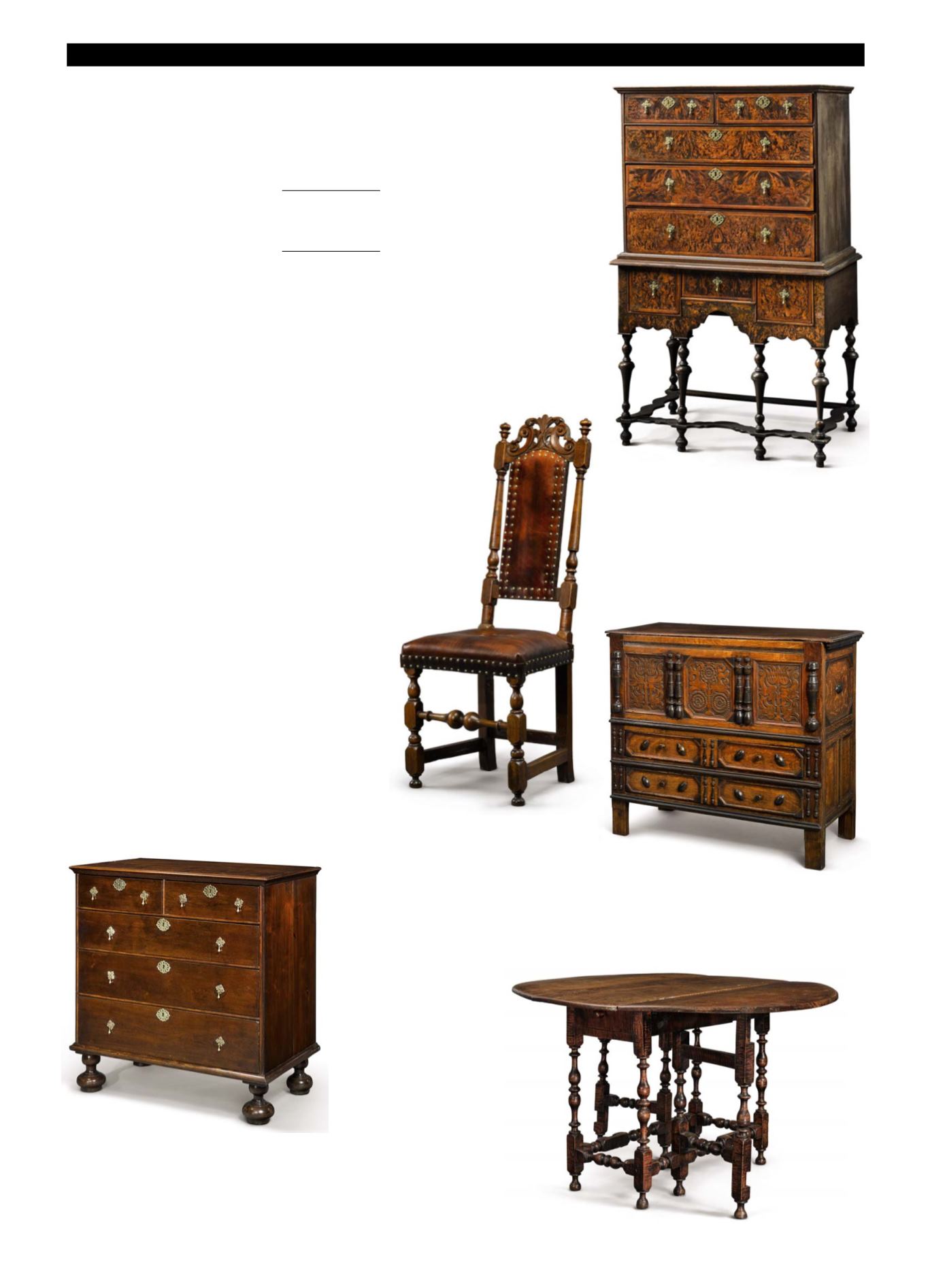
This William and Mary burl maple-veneered and walnut
high chest of drawers, Boston, Massachusetts, circa 1720,
with a dark, rich historic surface, front stretcher and
proper right side stretcher replaced, 61¾" x 39" x 21¾",
sold for $27,500 (est. $30,000/50,000). The stretchers follow
the outline of the apron, which retains its beaded border. In
January 1991 at Christie’s, it sold for $38,500. At Christie’s
in 1986, it sold for $41,800. A chest from the same shop was
in the Taradash collection and illustrated in Israel Sack’s
American Antiques
, vol. V, p. 1265, no. P4223.
Pilgrim-Century joined and carved oak, pine, and turned
maple sunflower chest with two drawers, Wethersfield,
Connecticut, circa 1680, bottom 5" of legs replaced, 41½"
x 48" x 20½", sold for $21,250 (est. $8000/12,000) in the
salesroom to dealer and collector Norman Gronning of
Vermont for his own collection.
William and Mary
tiger maple gate-
leg table, Rhode
Island, circa 1715,
four feet replaced,
28½" x 17½"
(closed) x 42¾",
sold for $15,000
(est. $3000/5000)
to Philip Bradley
in the salesroom,
underbid on the
phone. At Sotheby’s
in January 1994, it
sold for $13,800.
and illustrating the more than 60 pieces of
furniture documented or attributed to John
Head. The book should be available early in
the fall. Institutions have already reserved
250 copies.
According to Stiefel, Head made 118
chests of drawers costing £3 each, and lots more,
including 26 suites of high chests and dressing tables,
55 oval tables, 52 bedsteads, 91 clock cases, 19 cradles,
five corner cupboards, 11 close stools, three clothes
presses, and 73 coffins. Casper Wistar’s chest of drawers
and dressing table were the first to be documented
to Head and are illustrated in the 1999 catalog for the
Philadelphia Museum of Art exhibition
Worldly Goods
.
In 2008, Storb, Andersen, and Stiefel published an article
on Head’s documented furniture, which included a third
piece ordered by Wistar, a walnut tall-case clock with a
William Stretch movement.
Since 1999, 66 objects by Head have been attributed,
including high chests, dressing tables, chests-on-chests,
chests of drawers, clock cases, a desk, an oval gate-leg
table, and a spice chest. Of these only about half a dozen
are chests of drawers, fewer than the number of attributed
clock cases. Read Storb’s In Proportion to the Trouble
blog to learn the fine points of Head’s shop practices.
He illustrates his blog with first-rate photographs of the
details of construction.
The chest came up early in the sale of the collection
of the late George S. Parker II, the scholarly CEO of
the Parker Pen Company, who died in 2004. In
addition to American furniture, Parker
collected English silver and American
Colonial portraits, also offered at
this sale. An art history major at
Brown University, he had an interest
in Classical archaeology, maps, and American
paintings. After the John Carter Brown Library
published his book
The Mapping of the Great
Lakes
with full-size facsimiles of the earliest
maps of the Great Lakes that could be used by
students, he gave his map collection to Brown
University. Parker also collected Modernist
paintings. He especially liked The Eight, some
of whom were also associated with the Ash
Can school. Sotheby’s sold his paintings in the
American paintings sale in October 2016. His
collection of American furniture from the Pilgrim
Century to the Federal period expressed the
American experience.
Philadelphia William and Mary walnut chest of drawers,
made by John Head, 1718-26, with its original cast brass
English hardware, 40" x 39½" x 21½", sold for $32,500
(est. $8000/12,000) to Delaware dealer Jim Kilvington. Jay
Stiefel identified this chest as identical to that illustrated
in Adam Bowett’s
Early Georgian Furniture:
1715-1740
(2009), p. 304, fig. 28. It sold at the Joynt sale at Christie’s
in January 1990 for $38,500.
William and Mary carved,
turned, and joined maple leather-
upholstered side chair, Boston,
circa 1710, 47¾" tall, sold on
the phone for $21,250 (est.
$8000/12,000). At Sotheby’s on
January 19, 2003, it sold for
$39,600 (est. $4000/6000). It has
some loss to the feet height. It
was refinished and reupholstered
in Russian leather by historic
upholsterer Robert Trent of
Wilmington, Delaware.