


 113 / 213

Maine Antique Digest, March 2017 13-C
-
AUCTION -
13-C
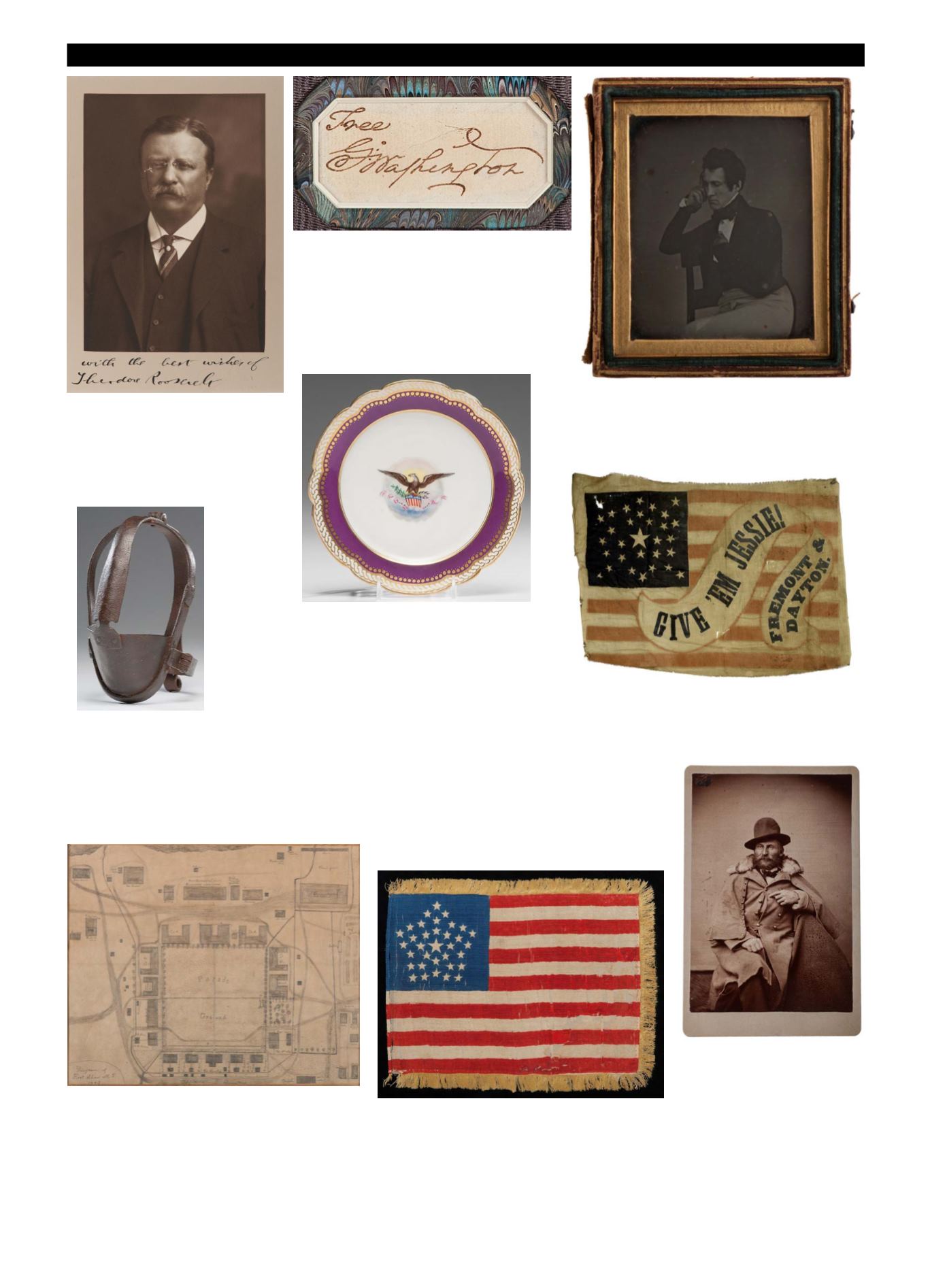
This wrought-iron slave mask
with nose holes on the front,
1840-50, is approximately 12"
x 10" x 6", has age-consistent
wear, and brought $1920.
The earliest known and possibly only daguerreotype of
Eliphalet Remington II, founder of Remington Arms Com-
pany and designer of the Remington rifle, housed in a full
case, sold with a binder of supporting documentation and five
cased images of other family members, all images in excellent
condition. The lot brought $9300.
George Washington clipped signature from a free frank enve-
lope, 1¼" x 2¾" (sight), horizontal crease, archivally matted
and framed with a portrait of Washington (not shown) and a
wax seal impressed “GW,” $5228.
This signed sepia-toned silver gelatin photograph
of Theodore Roosevelt has a blind stamp of Pach
Bros., New York, and was taken in August 1913.
It is 5¾" x 3¾" plus mount, matted and framed,
in near-excellent condition, and brought $2760.
This is a printed circa 1856 campaign flag for Republican
presidential candidate John C. Fremont and his running mate,
William L. Dayton, with the title of the popular campaign song
“Give ’Em Jessie!” The canton has 31 stars in a circular pattern.
The 20" x 27½" flag has toning, fraying to the top margin, small
holes, and soiling and sold for $27,600.
This Limoges porcelain salad plate is from the state
service made by Haviland for President Abraham Lin-
coln. The center is printed and painted with a brown
eagle clasping a laurel branch and a cluster of arrows in
its talons. The royal purple rim is edged with a border
of gilt dots and “Alhambra” tracery. The circa 1861,
7¼" diameter French plate has minimal loss to gold
detailing along the rim and expected wear to the base,
and it brought $8400. A village in northern Italy lends
its name to the dinnerware, commonly referred to as
the “Solferino Service.” In 1859 a purplish-red dye was
discovered shortly after the Battle of Solferino, which
resulted in 40,000 casualties in one day. The color was
dubbed solferino for its resemblance to the bloody
battlefield. Reviled as pretentious when originally
unveiled, the dinnerware became quite popular, and
replacement pieces for the service were ordered for the
administrations of Presidents Andrew Johnson, Ulysses
S. Grant, Chester Arthur, and Grover Cleveland.
Two pencil diagrams of Fort Shaw (shown) and Fort Missoula,
Montana Territory, by an unknown cartographer show detailed
military buildings, shops and businesses, roadways, and vegetation.
The one of Fort Shaw is dated 1883, and the one of Fort Missoula
is dated 1884. Each is 13¾" x 16¾" and has soiling, pencil smears,
toning, and light folds. Removed from frames and not laid down,
they sold for $8400 the pair.
Civil War-period printed 35-star American parade flag with
Great Star pattern, silk, with a rarely encountered gold-colored
fringe border, 12" x 15", professionally mounted in a paint-dec-
orated and gilded frame that dates to 1840-70, significant fabric
breakdown in the stripes with some loss, $3900. The catalog
noted, “The 35-star flag became official July 4, 1863, with the
admission of West Virginia into the Union and was used during
the closing years of the Civil War, therefore dating this flag to
1863-65. Considering that most silk flags from this period did not
survive, this is an extremely rare example.”
This cabinet card of General George
Crook by Mitchell & McGowan, a
studio portrait likely taken in northern
Wyoming during the Indian Wars, circa
1878, has albumen in overall near-ex-
cellent condition. A small imperfection
in the top left is from spotting in the
negative. It brought $4305. Even though
Crook was considered the army’s most
skilled Indian fighter, he did not always
live by the sword. He preferred peaceful
negotiations rather than violence, and he
was a staunch advocate for the fair and
humane treatment of Native Americans.