


 111 / 213

Maine Antique Digest, March 2017 11-C
-
AUCTION -
11-C
brought $480, to a 1901 Buffalo Bill Wild West souvenir
token that sold for $720.
“The thing about [Wild West memorabilia] is its range
in values, and its appeal to collectors who may have only
three to five hundred dollars to spend as well as collectors
who have tens of thousands of dollars to spend.”
The Wild West material ended the auction. The day
started with historical documents that in the first five lots
included a one-page signed letter from Samuel Adams to
a political compatriot, written in Boston on December 15,
1777, that brought $28,800 and a military commission
signed by John Hancock as president of the Continental
Congress on July 8, 1776, that made $18,000.
Other significant political material ranged from
a partially printed document regarding a political
appointment, signed in 1793 by George Washington as
president and Thomas Jefferson as secretary of state,
which sold for $9600, to a color photograph of Ronald
Reagan, Gerald Ford, Jimmy Carter, and Richard Nixon,
autographed by all four men, that realized $1476.
Politics were also involved in one of the auction’s
highlights, a political flag from the 1856 presidential
race. Lettered “Give ’Em Jessie! / Fremont & Dayton,”
the printed cotton flag has 31 stars in a circular pattern
and measures 20" x 27½", with damage that includes
fraying, holes, and unevenly cut edges. As the only
known example, according to Cowan’s, and not listed in
Threads of History
, the leading book on political textiles,
the flag sold for $27,600.
In the election, John C. Fremont, a former Republican
California senator, war hero, and family man, ran
against James Buchanan, an experienced Democratic
Pennsylvania politician and bachelor. Cowan’s catalog
filled in the story behind the slogan on the flag: “Both
campaigns published popular songs to entertain and
influence voters. One of Fremont’s more popular jingles
was ‘Give ‘Em Jessie,’a parody set to the tune of ‘Wait for
the Wagon.’ The revised lyrics replaced ‘Will give them
hell’ for ‘We’ll give ’em Jessie,’ referencing Fremont’s
wife, Jessie Benton Fremont…. Fremont suggested that
Buchanan’s bachelorhood was due to character flaws
and selfishness. The song ‘Give ’Em Jessie’ intended
to appeal to male voters and show that Jessie would
maintain the American home and Fremont would protect
free labor; rights and values that Buchanan would either
threaten or could not uphold as president and as an
unmarried man.”
The CivilWar material was highlighted by several items
related to Abraham Lincoln, including a one-page letter
on Executive Mansion stationery, written to the secretary
of war and signed by Lincoln, which sold for $15,990,
and a salad plate from the Lincoln White House, which
was bid to $8400. In five words Horstman summed up
the enthusiasm for the material. “People are passionate
about Lincoln,” she said. Other Civil War items ranged
from archives to albums and from photographs to folk
art. The latter included carved wooden pipes, some
denoting battles. The most expensive, at $1680, was an
example having deep-relief carving commemorating the
First Battle of Bull Run on July 21, 1861.
“The folk art Civil War pipes—each is a work of art
on its own. The people who collect this area related to
the Civil War, those guys really appreciate them and see
them as artwork and as historical relics. What made these
even more special is that they came from the collection
of Norm Flayderman, Civil War collector and dealer,”
said Horstman.
The overall breadth of the auction was shown in items
as varied as a Red Ensign, a British naval flag dating to
the first half of the 19th century, at $5100, and a carte de
visite of the hanging of Little Six and Medicine Bottle
at Fort Snelling in 1865, one of only two such CDVs
known, that sold for $18,000.
For more information, phone Cowan’s at (513) 871-
1670 or visit
(www.cowanauctions.com).
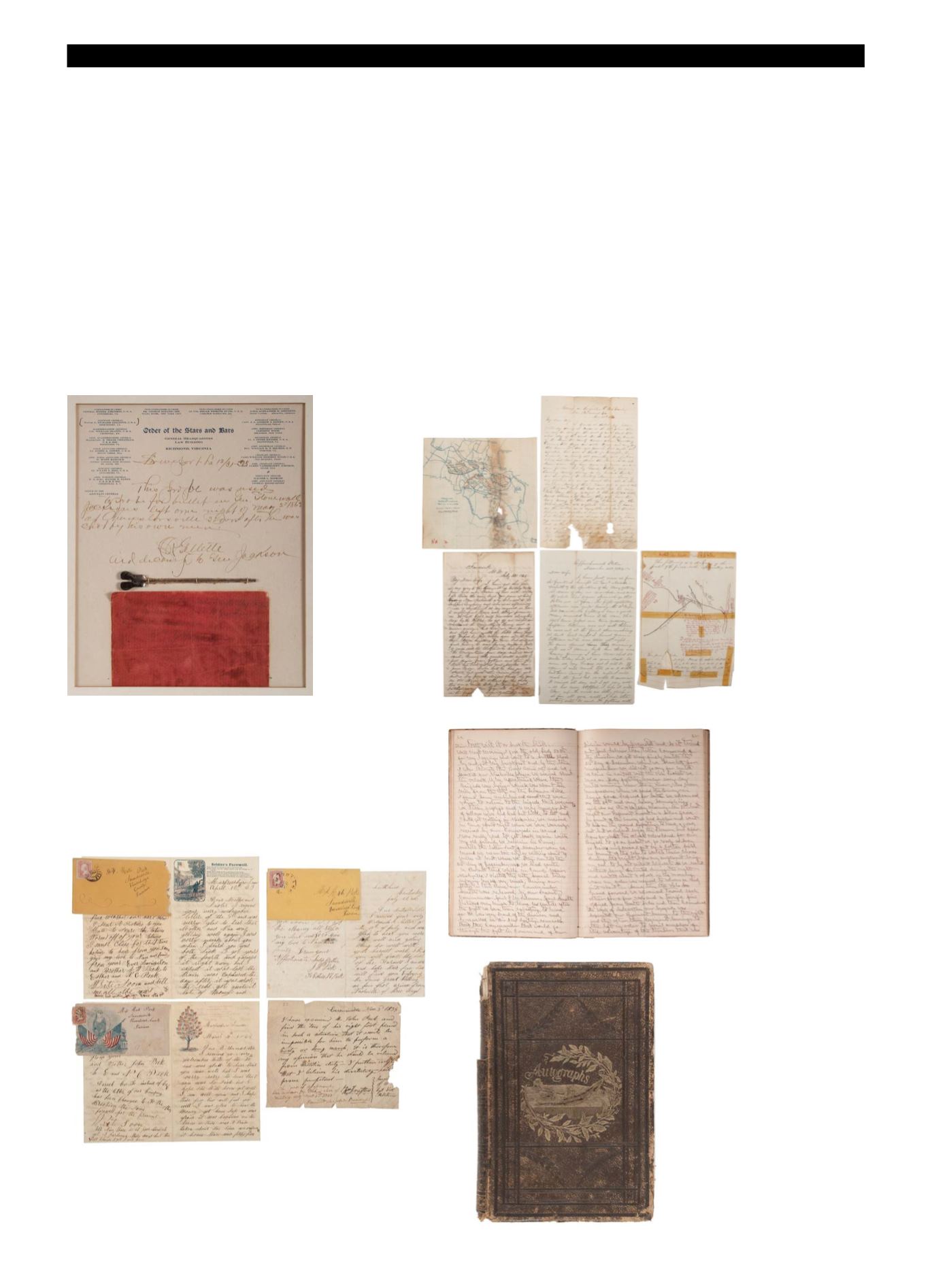
This medical probe is stitched to Order of the Stars
and Bars letterhead, inscribed from Shreveport,
Louisiana, on December 31, 1898. The message
reads, “This probe was used to probe for bullet in
Gen. Stonewall Jackson’s left arm night of May
2 - 1863 at Chanslorsville [
sic
] 3 hours after he was
shot by his own men,” signed by O.R. Gellette, aide
de camp to Jackson, along with a piece of red paper
inscribed “Chanslorsville [
sic
] May 1st 1863 / Maj.
Gellette deliver to Gen. Lee attached message. T.J.
Jackson.” It sold for $6600.
This Civil War archive of Brigadier General
James Sanks Brisbin comprises 93 letters
written by Brisbin to his wife, 1862-65,
including one describing the bloody Gettys-
burg campaign; two autographed battlefield
plans for the Battle of Bull Run and oper-
ations on the North Anna River; Brisbin’s
presidential appointment as major, with
stamped signatures of President Andrew
Johnson and Secretary of War Edwin Stan-
ton, dated August 20, 1866; and supplemen-
tary research documents, including copies of
other correspondence
from Brisbin. It sold
for $10,200.
Civil War journal of Colo-
nel Richard C. Dawkins, Co.
B, 6th Regiment, Kentucky
Volunteers, dating to 1862-63,
approximately 105 pages with
entries, $8400.
Civil War archives of John William Peck, 4th Indiana Cavalry,
1862-65, composed of approximately 123 letters written as a second
lieutenant, likely every letter written by Peck to his mother and
sister in Indiana while on the front lines, plus a few related items,
$8100.
Civil War autograph book, Johnson’s
Island, Ohio, with an inscription “To Miss
Laura H. Doane / From a Friend / ‘Military
Prison’ / Johnsons Island / Feb 24th/64,” 62
pages. This was apparently compiled by a
Confederate internee at this island prison-
er-of-war camp located in Lake Erie just off
present-day Sandusky, Ohio, where nearly
3000 Confederate officers were held. The
book has approximately 377 Confederate
officers’ signatures and is inscribed on the
front and back of each page. Many of the
signers include their name, rank, regiment,
hometown, and date and place of capture.
Most of the autographs were collected in
1863. It sold for $7800.