


 110 / 213

10-C Maine Antique Digest, March 2017
-
AUCTION -
10-C
Cowan’s Auctions, Cincinnati, Ohio
American History
by Don Johnson
Photos courtesy Cowan’s
I
tems related to earlyAmerican figures, theAmerican
West, and the Civil War all drew considerable
interest during the American history sale held by
Cowan’s Auctions in Cincinnati, Ohio, on November
18, 2016.
The top lot at $36,000 (includes buyer’s premium)
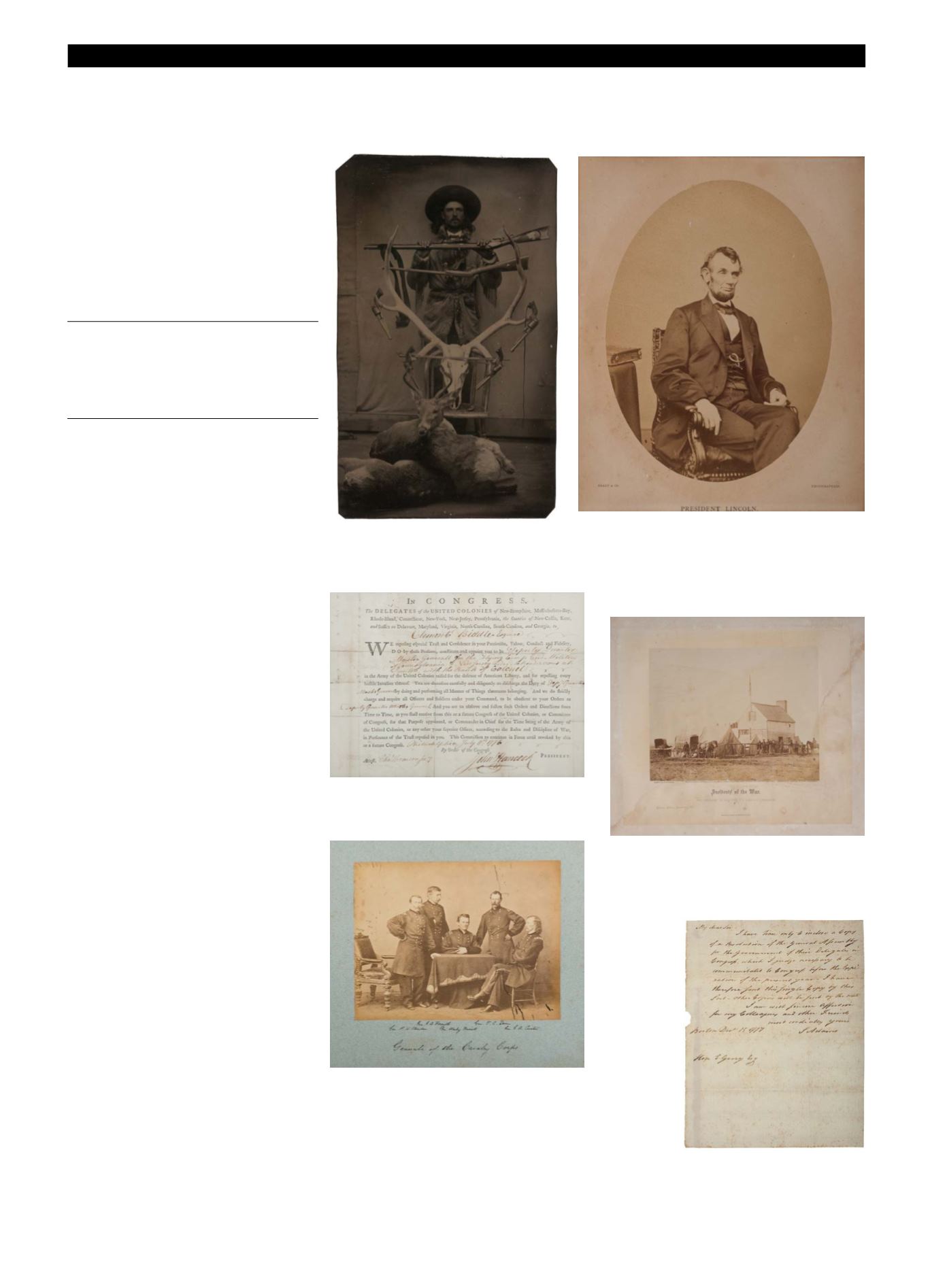
was a sixth-plate tintype of a young William Frederick
“Buffalo Bill” Cody, posed with guns and game. The
image was likely taken at Fort McPherson, Nebraska,
circa 1871, a dozen years before Cody founded Buffalo
Bill’s Wild West. In the image he holds a rifle while
standing behind an elk skull perched on a chair with a
second rifle and four revolvers on the antlers, all behind
the bodies of three mule deer.
Most images of Cody are from later in his life and
tend to be printed in paper formats, such as cabinet
cards. The tintype of Cody showed a much younger
man, roughly 25 years old.
“I believe it’s a one of a kind, and it could be one
of the earliest images of him,” said Katie Horstman,
Cowan’s director of American history.
Other Buffalo Bill material also brought spirited
bidding, including a key to the city of Manchester,
England that was presented to Cody in 1887. In its
original velvet-lined case, the ornate metal key sold for
$7800.
The trip to England was the first of many overseas
ventures by Buffalo Bill’s Wild West. Setting up in
London, the show served as the unofficial American
delegation to Queen Victoria’s Golden Jubilee that
summer. Cowan’s catalog noted, “The queen attended
two shows, and the American press reported that she
stood and bowed when Cody rode up to the royal box
and presented the American flag—supposedly the
first time a British monarch so honored the Stars and
Stripes.” Cody and his crew remained in England until
May 1888, performing in London, Birmingham, and
Manchester.
The best of the Buffalo Bill posters was a 28" x 41"
example that showed an aging Cody holding the reins
and tipping his hat from a coach pulled by two horses.
The work was lettered “Buffalo Bill ‘Still Holds the
Reins’ / Personally Directs Every Performance and
Gives Daily Receptions.” Having repaired tears and
restoration, the poster sold for $3900. The print remains
popular, as contemporary copies are readily available.
Other posters did even better. One of “Dr. W.F.
Carver, Champion Rifle Shot of the World” pictures
the showman in a prairie setting, mountains in the
background, leaning against his rifle and wearing a
jacket with multiple sharpshooting medals. It was
offered with an 1878 broadside and an 1879 magazine
article, and the lot sold for $10,200. However, the 29¼"
x 22¼" poster, believed to be the only example known,
was the driving force behind the bidding.
Born in Illinois in 1851, William Frank “Doc” Carver
was a dentist when he moved to Nebraska in 1872. He
abandoned his medical practice and began touring the
country in 1876, giving shooting exhibitions and billing
himself as “Champion Rifle Shot of the World.” In
1883 he and Cody launched the Rocky Mountain and
Prairie Exhibition, which lasted just one season. Cody
then formed his Wild West show, while Carver created
a number of rival enterprises, most notably a diving
horse attraction.
Aside from posters, ephemera included a target card
picturing Annie Oakley, a revolver raised in her left
hand. Near the center of the card was a red heart that had
been pierced by a bullet. A vertical cut running from the
bottom of the card toward the center was perhaps the
result of Oakley’s having shot the card edge-on. The
piece sold for $2040.
The Wild West portion of the auction wasn’t just
about high-dollar objects. Items ranged from a signed
photograph of Frank Butler, Oakley’s husband, which
“The folk art Civil War pipes—
each is a work of art on its own.
The people who collect this area
related to the Civil War, those guys
really appreciate them.”
This albumen photograph of Abraham Lincoln by Anthony
Berger is imprinted on the mount “Brady & Co.” because
the negative was made in Brady’s Washington studio.
The sitting occurred February 9, 1864. The 8" x 6" (plus
mount) image has even toning to albumen, a short crease
presumably made before mounting, light spotting to the
mount, and adhesive on the back and sold for $4800.
A sixth-plate tintype of a young Buffalo
Bill Cody posed with guns and game, this is
believed to have been taken at Fort McPher-
son, Nebraska, circa 1871. In very good
condition, it sold for $36,000.
Military commission signed by John Hancock as president
of the Continental Congress, Philadelphia, July 8, 1776,
appointing Clement Biddle to an office in the Continental
Army, $18,000.
Samuel Adams signed letter written to
political compatriot Elbridge Gerry,
Boston, December 15, 1777, very good
condition overall, $28,800.
Gardner’s Photographic Sketch Book of the War
, Philp
& Solomons, 1865-66, volume II, containing 50 albumen
photographs by Alexander Gardner and others, staining
and water damage to the pages, other condition problems,
$13,200.
Pictorial History of the War of the Rebellion
,
Miscellaneous
, volume 1, is a
large-format Civil War photo album containing 91 prints, made directly
from original negatives during the 1890s, assembled by Colonel Albert
Ordway, a pioneering photo historian of the Massachusetts Commandery,
Military Order of the Loyal Legion of the United States (MOLLUS). It is
number 36 of 120 albums assembled and owned by Brevet Brigadier Gen-
eral Albert Ordway and sold for $12,300.
The catalog noted: “MOLLUS albums today are rare to the market-
place with the majority residing in the U.S. Army’s Military History
Institute at Carlisle, PA, which took possession of the Massachusetts Com-
mandery collection in 1973.… The importance of Ordway and his associate
Major Arnold Rand’s collecting efforts, in an era when many negatives
and photos were discarded, cannot be over-estimated.”