


 112 / 213

12-C Maine Antique Digest, March 2017
-
AUCTION -
12-C
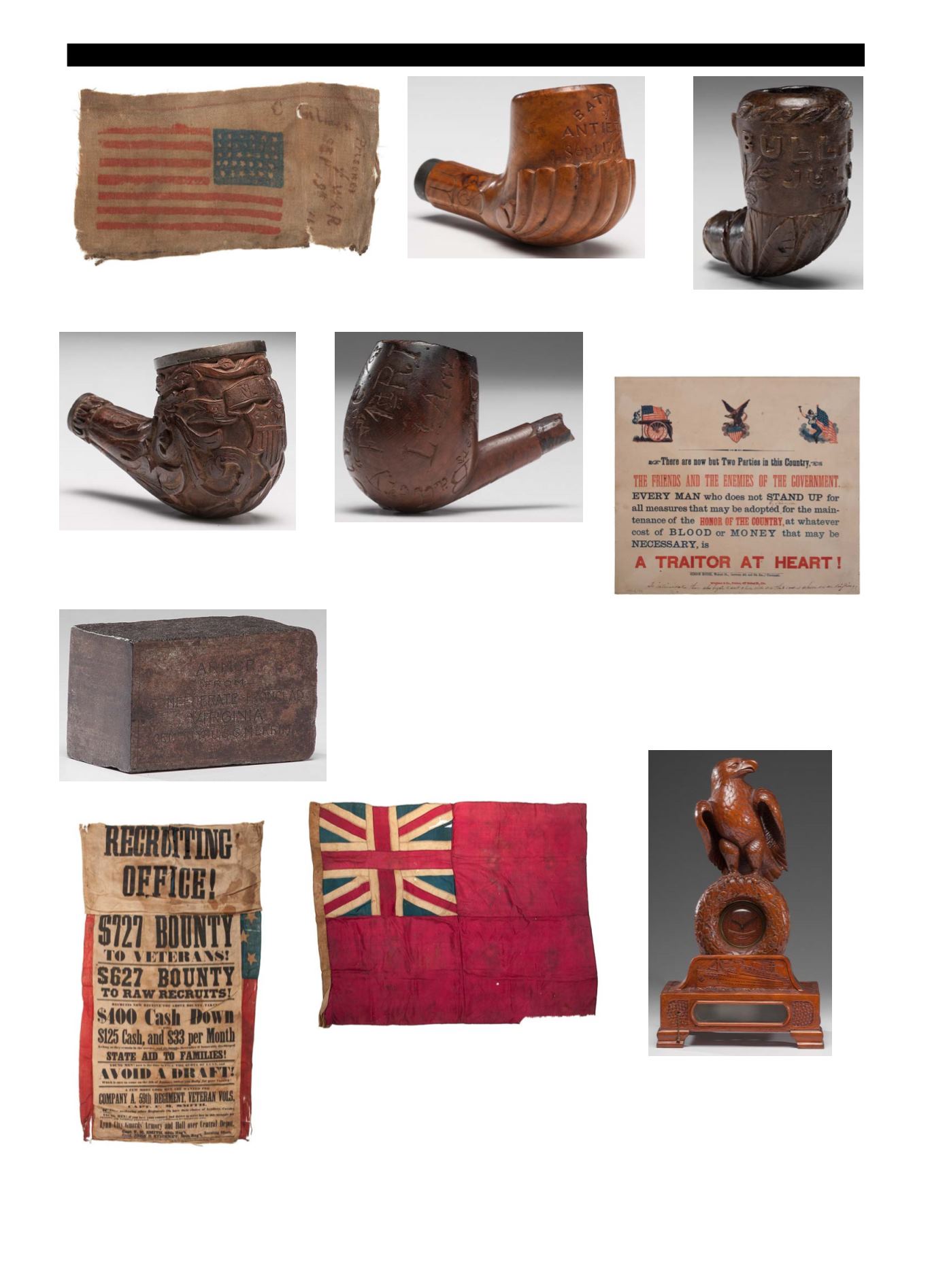
American flag made during the Civil War by Charles Gilman, 6th
Ohio Infantry, while held as a prisoner of war, hand painted on a
rough piece of canvas likely cut from a flour or meal bag, having
seven red stripes, 33 stars in the blue canton, approximately 6½" x
12", signed, $3360.
Civil War folk art hand-carved pipe, lettered
“Battle / of / Antietam / Sept 17 1862” and with
tapered and fluted motifs, bowl 1¾" high, overall
3½" wide, $2400.
Civil War folk art hand-carved pipe,
neatly lettered “Bull / Run / July 21 /
1861” and featuring leaves, the bowl
3" high, overall 3¾" wide, small crack,
chips, scratches, and nicks, $1680.
Civil War folk art hand-carved pipe, lettered for the
2nd New Hampshire Volunteers, having a design of
an American shield, banner, leaves, and scrolls, sil-
ver bowl rim and shank, bowl 2
1
/
8
" high, overall 3½"
wide, unfinished and somewhat primitive, $1920.
Civil War folk art hand-carved pipe, lettered for Cap-
tain Belger’s Battery F, 1st Rhode Island Light Artillery
and “Bridge / near Winton / N.C. / July 30 / ’63,” bowl
1¾" high, overall 2½" wide, stem broken off, nicks and
scratches, $1680.
Civil War broadside illustrated with patriotic motifs
of a U.S. flag by a cannon, a spread-winged eagle with
a federal shield, and Abraham Lincoln with a flag, let-
tered “There are now but Two Parties in this Country,
the Friends and the Enemies of the Government…,”
printed in red, blue, and black, 11" x 12½", credits
to Gibson House and Wrightson and Co. Printers of
Cincinnati, inked inscription “To intimidate those who
begin to ask when will all this end & where are we
drifting,” toning, light soiling, linen backing, $2460.
Armor from a Confederate ironclad, lettered
“Armor from Confederate Ironclad Virginia
Formerly U.S.S.
Merrimac
,” the 2.8-pound
block measuring 3" x 1
7
/
8
" x 1
7
/
8
", wear and
spotting, $1920.
Civil War Massachusetts recruitment
banners attached to a U.S. flag, late
1863, 51" x 27", the flag with wear and
tearing, banners with splitting, stains
to all, $4200.
This wooden folk art clock was finely carved by
German prisoner of war E.S. Schwietert in the shape
of an eagle perched atop a wreath on a base with a
carving depicting the S.S.
Columbus
. The clock face
is lettered “Fort Stanton / New Mexico” and “1942.”
The base also has a working light. The whole is 25"
high x 9" wide and sold for $1800. Fort Stanton was
established in 1855 as a military post to control the
Mescalero Apaches. In 1939 it served as a detention
center for more than 400 German nationals taken
from the luxury liner
Columbus
when it was scuttled
outside of New York to prevent its capture by the
British. Once the United States entered World War II
in 1941, Fort Stanton became an official POW camp.
This red silk naval ensign, English, 1800-50, 31" x 40", has soil-
ing, holes, and losses to the fabric and sold for $5100. The catalog
noted, “In 1801, Ireland joined with Great Britain to form the
United Kingdom of Great Britain and Ireland, which resulted in
the Union Jack being added to the canton along with St. Patrick’s
Cross. In 1854, the Merchant Shipping Act specified that the Red
Ensign was the appropriate flag for a British merchantman. The
provision was repeated in subsequent British shipping legislation.
Until 1864, the Red Ensign was the primary ensign of the Royal
Navy, and worn by ships of the Red Squadron of the navy, as well
as by unassigned warships. A previous owner relates that this flag
was from one of Lord Nelson’s ships, used during the Battle of
Trafalgar, although no documentation accompanies the flag to
confirm this. The battle occurred in 1805, making the flag design
appropriate for the period.”