


 119 / 213

Maine Antique Digest, March 2017 19-C
-
AUCTION -
19-C
Marion Antique Auctions, Marion, Massachusetts
Mostly Nautical
by Frances McQueeney-Jones Mascolo
The highlight of the Ippolito
scrimshaw was a rare 9½" x 5
7
/
8
"
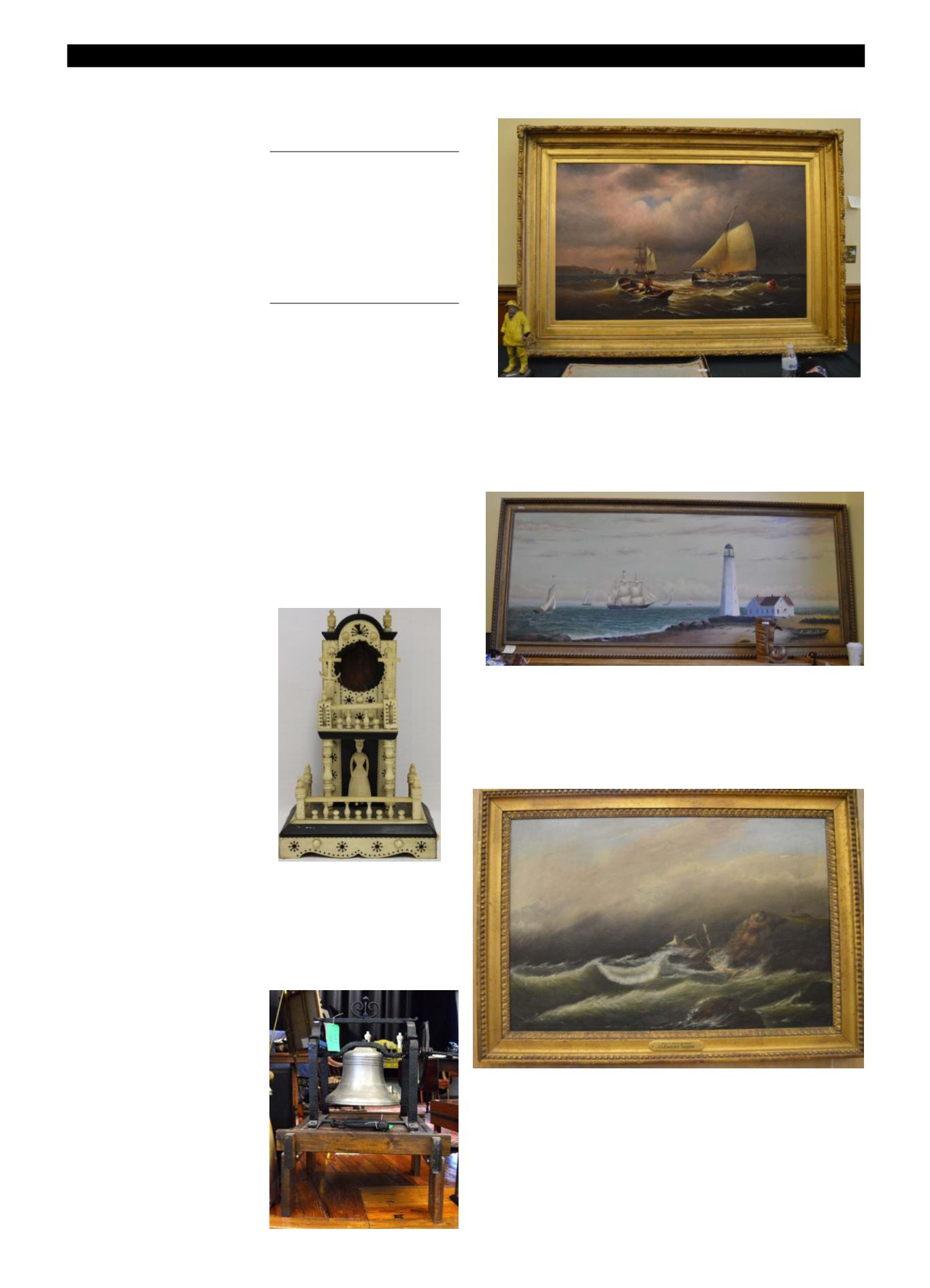
sailor-made watch hutch in the form
of a house with a porch with a woman
in the doorway beneath an upper
balcony, where the watch would be
placed. It brought $2760. Marion
Antique Auction photo.
A 38" x 96" oil on canvas view of Clark’s Point Lighthouse in New Bedford by contem-
porary New Bedford artist Robert Duff with a dory in the foreground and sailing ves-
sels offshore sold for $2400 (est. $1000/2000). The painting was one of three commis-
sioned by a New Jersey pharmaceutical company for $25,000 each. A New York couple
who summered in Marion consigned the painting, and it went to an area collector.
As the Storm Nears
, a 34" x 55" oil on canvas by Charles Henry Gifford (1829-
1904) in a period carved and gilded frame that is probably original, sold for
$22,800. The painting, dated from 1877 or 1878 and estimated at $20,000/30,000,
retains a Vose Galleries label and a collection label for R. Judge and D. Hanrahan.
It came most recently from the estate of Noel Taber Hill.
M
arion Antique Auctions moved
its November 26, 2016, sale
to the Music Hall across
from the harbor in downtown Marion,
Massachusetts. The setting was slightly
crowded but appropriate to the antiques
offered, as most had a local or coastal
connection.
Once known as Veterans’ Hall, the
125-year-old imposing brick building was
given in 1891 to the town by Elizabeth
Taber, who also built parks, a library,
and Tabor Academy, which she named
not for herself but for Mount Tabor and
its biblical significance. The VFW hall,
where Marion Antique Auctions ran
previously, has closed for renovations to
transform into a town and senior center.
Frank H. McNamee and C. David
Glynn, who run Marion Antique
Auctions, have deep roots in southeastern
Massachusetts, and they deliver objects
relevant to the area. Material from area
estates and collections routinely draws a
full house. The marine trade was present
and accounted for—and busy.
The sale opened with marine and
whaling objects from the collection of
the late Michael Ippolito of Bridgewater,
Massachusetts. Ippolito was a historian,
scholar, beloved teacher, athlete, and
collector whose interest in whaling made
for a deep collection. Four walking
sticks from the Ippolito estate sold. A
19th-century scrimshaw whalebone and
baleen example carved with a closed fist
handle sold for $660 (includes buyer’s
premium). A 19th-century example,
also with a closed fist handle, had a
scrimshawed lace cuff and brought
$600. A pair of scrimshaw whalebone,
baleen, and teakwood knitting needles
with carved clenched fists brought $1200
(est. $300/500). A whalebone measuring
stick, 29¼" long, and a 14" rolling pin
with a turned handle and a mahogany
center fetched $1020 together. A lot of
two scrimshaw whales’ teeth, signed by
20th-century New Bedford scrimshander
Robert Monfils, sold for $1860 (est.
$400/600). One tooth depicted a stove
boat and the other a stove boat with a
portrait of Herman Melville. Both came
from the Ippolito estate.
Ippolito also collected whaling tools. A
group of three including a chopper with a
whalebone handle, signed “James Carr,”
a whalebone seam rubber carved with a
sailor’s knot, and a lignum vitae seam
rubber brought $720. A 19th-century
grommet iron harpoon with attached
weaving strands, 13¼" long, brought
$1320. A 19th-century cast steel sliver
spade, signed “JD,” was determined to
have been made by James Durfee of Fall
River, Massachusetts, or Joseph Dean
of Assonet, Massachusetts, and sold for
$570.
A lot of 34 New Bedford whale oil
bottles, one of which contained Gay Head
clay, boxes, and tins, with an advertising
card, mostly from William Foster Nye’s
1844 oil company, today known as Nye
Synthetic Lubricants, sold for $720.
Three walrus tusks carved by Eskimos as
cribbage boards, from the Ippolito estate,
brought $1200.
A 19th-century carved wood folk art
figure of Abraham Lincoln, probably
sailor made, was the auctioneer’s favorite
object in the sale. It realized $1800.
Ippolito had gathered an impressive
collection of whaling books and
ephemera. The highlight of them was
a lot of four rare 19th-century books on
whaling, two of which described whaling
This bell, dated 1798 and made from bell
metal, may have been cast in Boston. It
has been cleaned; the bolt connecting the
bell to the overhead bracket is replaced;
and it is set in a modern wooden stand. It
realized $780.
This oil on canvas, 20" x 30",
Ship in Storm off Coast,
was attributed to Massachusetts
artist Clement Drew (1806-1889), and a modern plaque affirmed that attribution. It sold
in the room for $1200.
in the South Seas, that brought $1560 (est.
$400/500). A lot of three books included
Wrecks around Nantucket: 1664-1915
by
Arthur H. Gardner and published in 1915
by the Inquirer and Mirror Press;
History
of Nantucket
by Obed Macy; and a third
book of letters from an American farmer
published in London in 1782. The lot
realized $1080.
Two whales’ teeth, one decorated
with a scrimshaw scene of an American
whaleship and a pod of whales and the
other with awhaleship and twowhaleboats
with crews hunting a whale, sold for
$1250 online. A Nantucket friendship
basket by José Formoso Reyes with an
ebony whale on the lid and a broken hinge
was accompanied by the original Reyes
brochure of 1960 and was passed. (It had
seemed to sell on the day.) The basket
had been owned by astronomer Margaret
Harwood, the first director of the Maria
Mitchell Observatory on Nantucket.
Frank H. McNamee and
C. David Glynn, who
run Marion Antique
Auctions, have deep
roots in southeastern
Massachusetts, and they
deliver objects relevant
to the area.