


 190 / 213

-
FEATURE -
W
here the BEST SHOWS Are!
Looking for Great Shows?
e Professional Show Manager Association is a group of well respected producers of
of antique, collectible and consumer showes. If you’re looking for a speci c sho
P
S M A
Where the BEST SHOWS Are! Looking for Great Shows?
e Professional Show Managers Association is a group of well-respected
producers of various types of antique, collectible and consumer shows. If
you’re looking for a speci c show in a particular locale, visit our Show Calendar
at
www.psmashows.org. If you produce consumer shows, consider the bene ts
of joining this outstanding organization.
For more information contact us at
860-243-3977 or
www.psmashows.org18-E
Computer Column #339
Three-Dimensional Printing and Antiques
by John P. Reid,
jreid@dca.netT
hree-dimensional printers controlled by a personal
computer are well established. Owning one is
the dream of many computer buffs, but there
is surprisingly little mention of their use for making
missing parts in antiques restoration. Perhaps there
are reservations about the authenticity of such repairs,
but responsible dealers and knowledgeable collectors
manage such matters appropriately. The object is to
restore an item’s original beauty and function without
reducing its historic value.
Routine repair by replacement is an accepted part
of the life cycle of such things as wooden ships,
automobiles, and upholstered furniture. Joshua Slocum’s
inspirational 1900 book
Sailing Alone around the World
noted that every piece of wood on his old sloop had been
replaced piece by piece, yet the international registry still
considered it to be the same vessel.
There is much information in the links listed below,
but the URLs are cumbersome. Digital-edition readers
can click on the links. Print-edition readers will find
a clickable list of links at my web page (http://jnjreid.
com/3dprint).
Tools
A computer inkjet page printer is a 2D or two-
dimensional device. Inside, an ink cartridge zooms left
and right on a rail, squirting colored droplets. Rollers
move the paper down as the page is printed.
In a 3D printer, the ink cartridge is replaced by an
“extruder,” which oozes droplets melted off a reel
of plastic filament. The extruder is moved left and
right, up and down, and back and forth on three sets
of rails or swinging arms. A computer tells the printer
where to deposit plastic based on stored data. It is a
fascinating process to watch (https://www.youtube.com/ watch?v=dnIVrLqrEI8).The second half of the equation is creating the data to
be used. Two methods are common. If a duplicate part is
available, the data can be created by a scanner made for
3D printing. Otherwise, a drawing of the desired piece
can be made with CAD (computer-aided design) software
such as the free SketchUp Make described in Computer
Column #330 on page 3-B of the June 2016 issue. The
data is exported in the required CAD file format.
Three-dimensional printers cost from a few hundred
dollars to quite a few thousands of dollars. The price
depends on how large a part can be made, the variety
of filament materials that can be used, whether multiple
colors are possible, and the speed of operation. Scanner
prices are in the middle of the printer price range.
Learning to use the tools takes time. Expect botched
jobs and messes to clean up initially. There are plenty
of up-to-date books such as
Make: Getting Started
with 3D Printing
(2016) and
Make: Design for 3D
Printing
(2015) available as e-books or in print at online
booksellers. Three-dimensional printing courses are
popping up everywhere. Geek speak for 3D printing is
“additive manufacturing.”
Case Histories
England’s Victoria and Albert Museum in London
restored an elaborate chair once belonging to Marie
Antoinette. It was part of a large suite produced in 1788
but now widely dispersed, so there was little guidance
about the original finish or upholstery. Decorations were
hand carved and had been damaged by cleaning. No
two pieces were exactly alike. The elaborate crest with
an “MA” monogram was photographed, and its left and
right sides compared. The few other chairs with intact
crests were compared as well. A consensus drawing
was created and used to 3D-print a replacement for the
missing part of the crest (https://3dprint.com/45399/ marie-antoinette-museum-chair).The British 46-gun frigate H.M.S.
Unicorn
was
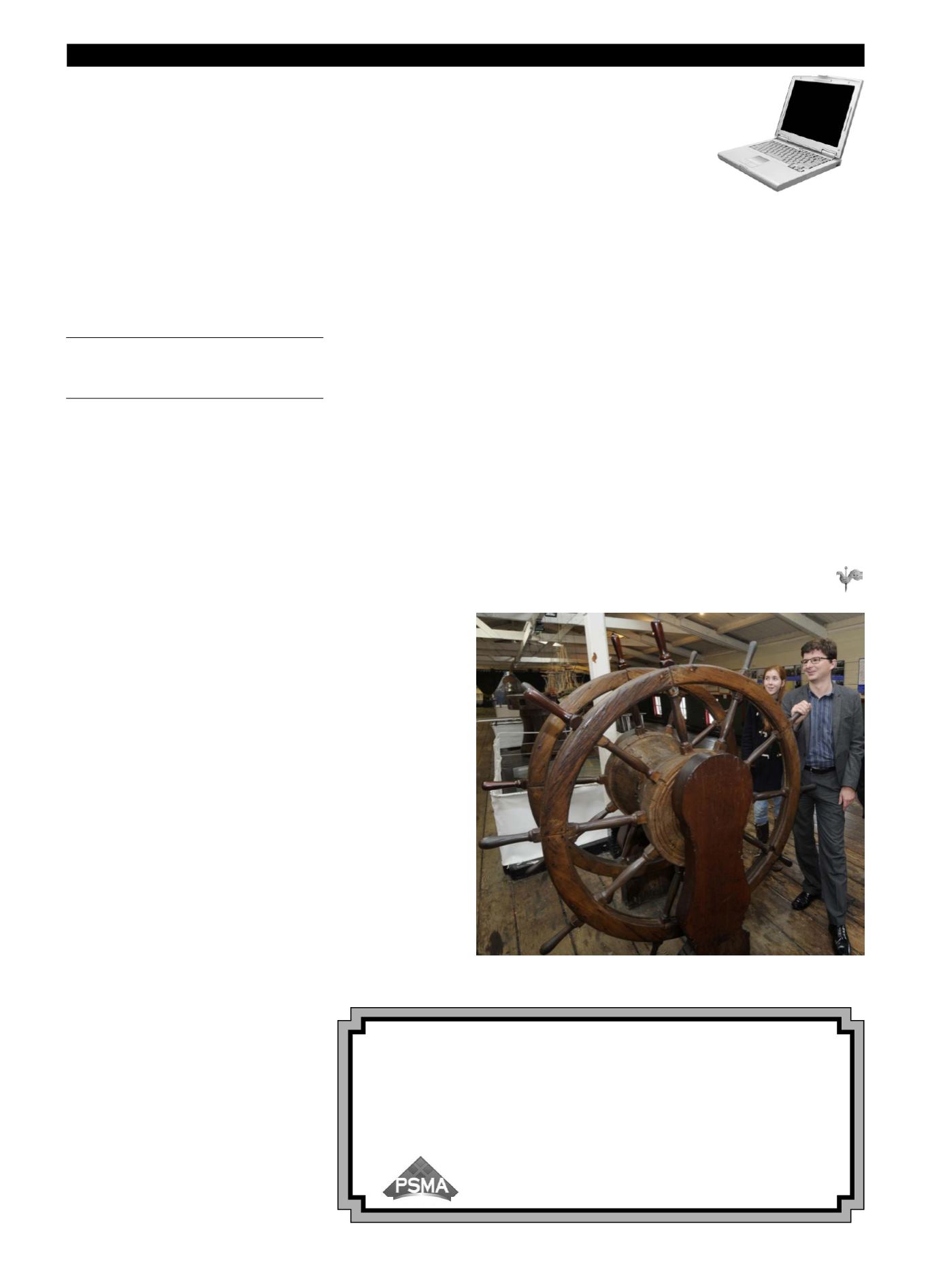
launched in Chatham, Kent, in 1824. It is now docked
permanently in Dundee, Scotland where it is being
restored as a museum. It is one of the oldest sailing
ships afloat. The helmsman’s wheel was missing several
handles. When the restorers had difficulty finding a
woodturner to make replacements, 3D printing was
suggested. An existing handle was scanned and new ones
printed in gray plastic. These were deemed authentic and
appropriate to the museum’s “please touch” environment
(https://3dprint.com/16891/hms-unicorn-3d-print-ship).
Jay Leno’s famous garage uses 3D printing for making
missing antique automobile engine and body parts.
Three-dimensional printing of metal involves added
steps. There are several methods. In one, finely divided
metal mixed with a binder is used instead of plastic.
After printing, the piece is fired to sinter or fuse the fine
particles of metal into a solid. In another method, an easily
melted material is used. The printed piece then becomes
the pattern for a process similar to lost-wax casting. Leno
has resources. The 3D printer he appears to use sells for
over $30,000 (http://www.popularmechanics.com/cars/ a4354/4320759).Simpler parts can be replaced by using scanning and
3D printing. Casters from early 19th-century furniture
are easy to reproduce. Nonmetal automotive restoration
parts are regularly re-created with inexpensive 3D
printers (http://www.rapidpsi.com/blog/case-studies/a- classic-auto-restoration-using-3-d-printed-parts.html).Frank Lloyd Wright’s Hollyhock House in Hollywood,
California, is now a museum and a candidate to be a
UNESCO World Heritage Site. The restoration back to
its 1920s décor lacked one thing. The original owner
had a 1st-century A.D. marble relief from Roman Libya,
Three Dancing Nymphs
, which is lost. Cosmo Wenman,
3D printing and scanning consultant, created a replica of
a similar marble relief that is in the J. Paul Getty Museum
in Los Angeles. Milled in plaster and painted to resemble
marble, it is the first thing to greet visitors to the house
(https://cosmowenman. wordpress.com).T h r e e - d i me n s i o n a l
printing is being used on
a grand scale to make rep-
licas and museum minia-
tures of architecture and
artifacts allegedly des-
troyed by ISIS in theMiddle
East. Photographs, draw-
ings, and measurements
collected for centuries by
archaeologists are used
as input to the printers.
There are similar pres-
ervation projects around
the world (https://3dprint.
com/151973/3d-printed-arti
facts-colosseum).
Antique musical instru-
ments are seldom identi-
cal to their modern coun-
terparts. Restorers are
using 3D printing to make
replacement violin bridges,
b r a s s a n d wo o dw i n d
mouthpieces, and keyboard
parts. Tool collectors are
making 3D printed replace-
ment parts such as wooden
handles.
The British warship
Mary Rose
sank in 1545 with a loss of 500 lives.
Swansea University is making 3D printed replicas of
salvaged artifacts and human skulls for study by Tudor
history researchers around the world (https://3dprint.
com/155222/3d-printing-mary-rose-artifacts).
Ceramics are often extensively restored. Chips and
missing parts are replaced, and tedious inpainting is
common. Collectors sometimes carry ultraviolet lamps
to identify such repairs. Three-dimensional printing
is gaining a role in this field. When only shards are
available and some are missing, scanning, computer
software, and 3D printing can make exact replacements
for the missing shards. For historic pieces, unpainted
replacements often are combined with the available
shards. The restored piece is strong enough for display
while authentically representing the original object. For
less important ceramics, missing chips, handles, knobs,
and spouts can be 3D printed and painted for replacement
(https://cfileonline.org/technology-inside-the-world-of- repairing-priceless-ceramic-art).Business Opportunity
Three-dimensional printing is being adopted by many
businesses including automobile manufacturers. An
Internet search in most communities will find small
businesses doing 3D printing. Their interests are broad,
and few specifically support antiques restoration. Perhaps
this is an opportunity in areas where antiques businesses
are dense. I would be glad to hear from anyone working
in this area for a future column.
Replacement handles of gray plastic made by 3D printing for the wheel of the 1824 H.M.S.
Unicorn
are looked over by British naval restoration expert Andrew Baines. Photo by Dave
Martin, Dundee, Scotland.
Perhaps this is an opportunity
in areas where antiques
businesses are dense.
18-E Maine Antique Digest, March 2017